Chapter 01 : Concept and scope of economics
| Introduction Economics as a social science is concerned with human behaviour in the allocation of scarce resources to satisfy unlimited wants. In this chapter you will learn about basic terminologies of economics, the branches of economics, definitions of economics, the nature of economics, and the central problem of economics. The competencies developed will enable you to appreciate economics and the various economic terminologies in daily life. |
| Think A world with unlimited resources |
Activity 1.1
Search from different sources, including online, for different economic terminologies.
The scope of economics
Economics is a study of how a society allocates scarce resources to satisfy their material wants. Allocation of resources involves decisions about how economic agents (individuals, businesses, governments, and nations) choose to use resources in undertaking economic activities.
The scope of economics encompasses what economics is all about. It includes issues of wealth, human behaviour and scarce resources, among others. It also addresses whether economics is a science or an art, and whether its approach to analyse economic event is positive or normative. This chapter aims at shedding light on the nature of economics by explaining the basic terminologies used in economics, various definitions of economics, and the central problem of economics.
Basic terminologies of economics
The subject matter of economics involves understanding the main economic activities, which include consumption, production, exchange and distribution, as well as other terminologies that are goods, wants, wealth, economic resources and utility.
Production
Nature does not freely provide things people need in their lives. Even with wild fruits, which people do not cultivate, they have to pluck them. Production involves decisions and activities of creating goods and services that people need. Such goods and services have value and when obtained, they satisfy individual wants. Some of the goods that people produce are not for sale, rather, they are for personal consumption, for instance, a farmer may produce maize for family needs only. However, economics is concerned mainly with production of goods and services for exchange in various markets, for example, farmers may produce maize for sale at a local market. In selling their products, producers aim to make profit.
A producer of any good or service uses technology to combine and process inputs to produce output. The inputs used in the production process are referred to as factors of production and the resulting outcome is an output. For example, a farmer uses labour, capital, land and entrepreneurship to produce crops.
Distribution
Distribution as used generally in marketing, is a process of moving goods and services from one location to another. Distribution involve transportation of goods and services from the place of production to the place of consumption (market). For example, the transportation of manufactured sugar from Mibwa Sugar Company in Morogoro region to wholesalers and retailers located in various regions of Tanzania or to other countries is referred to as distribution. However, in economics, the term distribution has a different meaning. Distribution means an act of rewarding factors of production. It involves payments for the use of factors of production. The payments are wages for labour, rent for land, interest for capital and profit for entrepreneurship.
Exchange
Exchange involves buying and selling of goods and services. Cash, debit or credit cards, and bills of exchange, among others are the means that facilitate exchange of goods and services. Exchange of goods and services using whatever means enables individuals to consume items they do not produce and what they do not have. For example, a carpenter produces and sells furniture to earn money (income). With the earned income, the carpenter can use it to buy goods that he or she does not produce, such as food and clothes, or services, such as health.
Consumption
Consumption is the act of using goods and services to satisfy human wants. Economists believe that an individual who consumes some goods or services derives utility (satisfaction). In everyday life, individuals consume different kinds of goods and services to satisfy their wants. For instance, people consume food to satisfy hunger, buy cars for transportation and visit banks for financial services. Moreover, individuals consume different services provided by doctors, teachers, the army, taxi drivers and tourist guides.
Note that the term consumption is not used for goods bought for production of other goods, for example, seeds. Rather, consumption of a good or service refers to only a good or service for final use.
Goods and services
Goods are items sold in the market with a general assumption that they provide utility (satisfaction) when consumed. Goods are physical objects. Examples of goods are cars, furniture, clothes and houses.
Individuals also consume services, for example, the work performed by doctors, teachers, bankers, actors, lawyers and car repairers. Services are not physical objects which can be touchable.
However, goods can be categorised in different groups, for example, economic and free goods, consumer and producer goods, durable and perishable goods, public and private goods, and merit and demerit goods.
Economic goods and free goods
Economic goods: Economic goods are goods which are scarce such that quantity demanded exceeds quantity supplied when they are to be availed for free (at a zero price). Economic goods form a large proportion of all goods demanded by an individual. They include goods such as cars, land, computers and clothes. Because economic goods are scarce, the theory postulates how a consumer reaches the right decision regarding the quantity of goods to buy (consume).
Economic goods have the following features:
(a) An economic good must give utility or satisfaction when consumed. People consume an economic good to satisfy a want (a particular human need) and avoid buying something that is a nuisance or irritant and does not give them utility (satisfaction). Thus, the latter does not qualify as an economic good.
(b) An economic good must be limited in supply in relation to its demand, otherwise, people would not be willing to pay a price for it. It means that something scarce commands aprice. People would not be willing to pay a price for something that is plenty in supply such that it would still be inexhaustible when anyone who needs it can get whatever share she or he needs. Such a thing would be freely available.
(c) An economic good is transferable in terms of ownership. For example, transfer of land ownership takes place from one owner to a buyer, who becomes a new owner, through payment of land price. This qualifies land as an economic good. A good that is transferable in terms of ownership makes it possible for one person to sell it to another person.
(d) An economic good has positive or exchange value. Because economic goods are scarce, people have to pay a price to get them. Thus, the market price of economic goods is greater than zero. A price greater than zero means that when people shop for their needs, they have to pay some money for any item they buy. In this regard, sellers exchange goods for the money they receive and the money that a buyer pays for the goods is the exchange value of the bought goods.
(e) An economic good is a product of economic resources. People produce economic goods using factors of production, which include land, labour, capital, and entrepreneurship. Note that land is called a gift of nature, yet it is included as one of the factors of production. Land does not become a factor of production in its natural state. It becomes so after it has been prepared to qualify as an economic resource. For example, farmers work on land preparation to make it a factor of production, through clearing, cultivating, irrigating, fertilising and planting crops on it.
Free goods: Free goods are readily available in unlimited quantity such that every individual may be able to consume any quantity to his/her satisfaction without limiting other people's consumption. Opportunity cost of a free good is zero. This means that an additional supply of a free good does not come at any cost to society in terms of resource requirement. Thus, consumption of this type of good by a given consumer does not affect availability of the good to other consumers. Examples of free goods are air, rainfall and sunlight.
Free goods have the following features:
(a) Free goods are available in large quantities and satisfy the needs of everyone. Because free goods are abundantly available, they exceedthe quantity that all consumers demand. Hence, free goods are not scarce.
(b) Free goods do not have an exchange value, thus, people can obtain free goods at zero price. For example, society cannot impose a price to pay for oxygen. Exchange value comes from paying the price to the seller. Because free goods are not exchanged (traded), no exchange value is created. If such goods were to be availed through the market, their price would be equal to zero.
(c) Free goods satisfy human wants even though they have no exchange value. For instance, breathable air is important for survival, and it is fortunate for us that it is available, abundant, and free.
Consumer goods and producer goods
Consumer goods: Consumer goods are goods and services purchased by individuals for final consumption to satisfy their wants and needs. Consumption of these goods derive utility to individuals. The goods are used as an end-use product, rather than as an intermediary good in production. Consumer goods are categorised into perishable consumer goods (for example, foodstuffs) and durable consumer goods (for example, television sets, cars, buildings and furniture).
Producer goods: Producer goods, also known as capital goods are goods used for producing consumer goods or other producer goods. They include goods such as machinery, seeds and raw materials. Depending on their use, some goods fall under the category of producer goods and consumer goods. For example when placed to domestic use, such as lighting, electricity becomes a consumer good. However, when electricity is used in a factory to enable machines to operate it falls in the producer good category.
Perishable goods and durable goods
Perishable goods: Perishable goods are goods that have a short shelf life. Examples of perishable goods include fruits, bread, vegetables, meat, and milk. When handled, stored or transported improperly, perishable goods tend to lose their value and usefulness.
Durable goods: Durable goods are goods that last long, for example, buildings, machines, vehicles, and equipment. Hence, their use spans longer period than perishable goods.
Public goods and private goods
Public goods: public goods are identifiedfrom their two characteristics. One is that, consumption of such a good by one consumer does not reduce the quantity available to other consumers. That is, this good is non-rivalry in consumption. A good example of a public good is the national defence which protects us against foreign enemies. To exemplify the non-rivalry characteristic of national defence, if 100,000 babies are born this year, the same national defence will protect them equally, without affecting protection to the rest of the population.
Secondly, public goods are non-excludable in consumption, which means that once the good is provided, people cannot be prevented from consuming it. For example it is impossible to exclude or separate someone or group of individuals from the country from enjoying protection provided by the national defence forces. The national defence protects all people in the country indiscriminately. Other examples of public goods include law enforcement, road signs and street lights.
Because public goods are non-rival and non-excludable, it is difficult to charge price to consumers of a public good. Collective effort to finance supply of any public good is a challenge because some people do not pay their share. In economics, this is called dodging their responsibility, a “free-rider problem” because their behaviour is similar to enjoying a free ride, at the expense of others. Given this situation, the government sometimes, in collaboration with the community, provides public goods to everyone using publicly generated resources.
Private goods: Private goods are goods that have the characteristic of being rival and excludable in consumption, a contrary case of public goods. To exemplify these characteristics, let us use the previous example of 100,000 babies. If 100,000 babies are born this year, they will consume some nappies. The rival characteristic imply that if the production of nappies remains the same, there will be less nappies, on average, for every baby because new babies would consume some of the nappies, assuming that all earlier babies still use nappies. Thus, the consumption of a nappy by one new baby takes a nappy that one older baby would have used. Excludability in consumption means that the fact that producers of nappies sell them at a certain price. Buyers who cannot afford the price will not get any nappy, that is to say, they are excludable from consuming nappies.
A consumer of a private good has to pay a price for the good. Thus, all private goods have exchange value. In addition, both rivalry and excludabilitycharacteristics imply that private goods are scarce. Hence, they are obtained from the market and they are supplied mainly by private firms. Some examples of private goods are sugar, rice, bicycles and houses.
Merit and demerit goods
Merit goods: Merit goods are goods with high social benefits. Examples of merit goods include education, health services, sports facilities and fire protection. Consumers think these goods should be widely available because of their usefulness.
Demerit goods: Demerit goods are goods with social costs to the consumers. Examples of demerit goods include tobacco, cigarettes and alcohol. Many consumers generally believe that such goods should not be consumed.
Wants
A want is anything that a human being desires to have. This can be anything desired, even when it is unnecessary. Many things are necessary for a human being. Those things which are necessary and an individual must have to survive are referred to as needs. Needs are special kind of wants. Example of needs are food, shelter, clothing, and water.
Necessity goods
Necessity goods are essentials for survival of a human being. Necessities include things such as food, clothes and shelter. Necessities may also include things that raise performance of work, such as use of computer and projectors in teaching and mobile phones for communication.
Comfort goods
Comfort goods are goods and services, which make an individual’s life more comfortable and easier. Examples of comforts include a motor vehicle when used as means of transport instead of walking, mobile phone for communication (instead of traveling to deliver a message) and courier service for delivery of letters and parcels.
Luxury goods
Luxury goods are goods or services consumed for ostentatious purposes rather than for necessity. Examples include expensive jewelries (to beautify oneself) or expensive boats and cars.
Characteristics of Human wants
Human wants have the following characteristics:
Human wants are unlimited in number
Wants are endless, yet resources required to satisfy these wants are always limited. For instance, a student’s wants from a family budget include school uniforms, bags, books and exercise books. The same student wants food and soft drinks or water. The same student also needs servicesof teachers and sometimes of doctors and sports coaches. This means that, wants have a tendency of multiplying or increasing continuously, such that when an individual acquires one need, another one tends to be sacrificed.
Human wants vary among individuals, time, and place: Individuals have different preferences and choices. Time and place may influence preference of individuals. Human wants differ with time because of several factors such as changes in technology and social cultural conditions. For instance, in the 1990s people were satisfied with desktop computers, whereas in 2000s they demanded laptop computers. Human wants differ with place due to reasons that are related to climate, geographical location, resources availability and cultural values. For example people living in cold areas such as Mbeya and Njombe would want to buy more sweaters, but people in warm areas, such as Morogoro and Dar es Salaam, would want shirts and blouse.
Human wants differ in intensity: Wants are not required in the same intensity because they are not equally crucial. Thus, some wants are more important than others. Resources are scarce and hence an individual tends to prefer goods that satisfy urgent wants by sacrificing those that are not urgent. For example, an individual would prioritise wants such as food, clothes, shelter and health services, and postpone less important wants like movies.
Human wants are repetitive: Human wants are recurring in nature in the sense that once are satisfied, they occur again and again. For example, an individual requires food daily to survive.
Human wants are competitive: This competitive characteristic centres on human wants being endless, whereas the resources to satisfy them are limited. Thus, an individual must choose between competing wants in the order of priority. As pointed out before, urgent wants should be given priority over wants that are not urgent. For example, an individual may decide to buy a bed and postpone buying a television set.
Human wants are complementary: Some wants must be satisfied together. One want gives rise to another want. For example, a person who wants to write a letter requires a paper and a pen. Similarly, a person who buys a car requires fuel to run it.
Human wants are subjective: Human wants cannot be gauged in absolute terms because they are subjective and relative. They vary from person to person, place to place and time to time. This is because wants are sometimesinfluenced by advertisements, publicity, tradition and customs of an individual.
Wealth
In economics, wealth is the value of all tangible and intangible assets owned by an individual, society, or a country. Asset is wealth, if it is scarce, transferable from person to person and has exchange (market) value. There are different forms of wealth:
(a) Individual wealth (private wealth)
Individual wealth include the possession of assets such as cars and houses, among others.
(b) Social or collective wealth
Social wealth includes assets and resources enjoyed by the whole society, for example schools, colleges, roads, canals, mines and forests.
(c) National or real wealth
National wealth sums up all individual wealth and social wealth in a country. It comprises all material assets possessed by a society.
(d) International wealth
International wealth includes the assets/wealth owned by United Nations Organisation and its various agencies such as the World Bank (WB), International Monetary Fund (IMF) and World Health Organisation (WHO). These are forms of international wealth because all countries contribute to their operations.
(e) Financial wealth
Financial wealth involves holding of valuable financial assets or physical possessions, which can be converted into a form that can be used for transactions such as money, stocks and bonds by individuals.
Economic resources
Economic resources are the factors used in producing goods or services. They are also referred to as agents of production. They comprise factors of production (land, labour, capital and entrepreneurship), which are used in production of goods or services.
Utility
Utility is satisfaction derived from consuming various quantities of a good or service. For example, a thirsty person derives utility from drinking a glass of water. If one glass is not enough to quench the person's thirst, then a second glass will add to that person's utility.
Activity 1.2
Search economic passages from different sources including online, identify and give meaning to different economic terminologies encountered.
Exercise 1.1
- Describe categories of goods. Define and explain by using vivid examples the economic usefulness of each category of goods.
- Distinguish between a want and a need. Explain features of a want.
Definitions of economics
Definitions of economics by various classical and neo-classical scholars serve to explain the subject matter of economics. Traditionally, economics was defined as “the study of wealth, welfare and scarcity.” So, the subject matter of economics traditionally covered the study of wealth and material welfare of individuals in relation to the use of limited resources to satisfy wants. Unfortunately, no single definition of economics has been provided. Different scholars have defined economics differently, with every definition having its pros and cons.
Classical definitions of economics
Pioneers in economics, popularly known as classical economists, considered economics as a science of “wealth.” Adam Smith (1723 – 1790) defines economics as a study of nature and causes of the wealth of nations. He emphasises on production and accumulation of wealth as the subject matter of economics. Smith believes in a free market economy, where producers and consumers exchange goods and services based on forces of demand and supply.
In the middle of the 19th Century, John Stuart Mill (1806 – 1873), another, classical economist, defines economics as “a practical science of production and distribution of wealth.” Mill’s definition of economics relies on two main points. One is “Economics as study of wealth only,” that is, it deals only with consumption, production, exchange and distribution aspects of wealth. Second is that “only those goods which are scarce are included in wealth.” Thus, non-material goods such as services were not included in the category of wealth.
Classical definitions of wealth had the following contributions:
(a) The definitions are correct about determination of income, employment and economic growth in that they have a causal relationship with production and distribution of wealth (material goods).
(b) The definitions indicate that poverty, unemployment, and underemployment of resources are mostly in developing countries call for expanding production and accumulation of wealth as well as reducing income inequalities.
(c) The definitions have widened the scope of economics from being the “science of house management,” as proposed by Socrates and Aristotle, to “the practical science of production and distribution of material wealth” at national level.
Criticisms of classical definitions of economics
The classical definitions of economics by Smith and Mill have been criticised, on the ground that they put much emphasis on wealth. Their definitions give more importance to wealth, at the expense of people, who are economic agents. In economics, the study of wealth cannot exclude people's involvement in economic activities. For example, the classical definitions did not consider human welfare as an important aspect of economics. Hence, these definitions seem to have ignored enhancement of social and human welfare as one of the goals of economics.
The classical economists defined wealth narrowly. They expressed wealth as comprising only material goods, such as land and bullion of gold, which left out services. In modern economics, wealth includes material and non-material goods. Material goods include human capital; while non-material goods include services provided by doctors, engineers, teachers, lawyers and soldiers.
Moreover, they are not explicit on resource use (means). The classical definitions of economics focused on accumulation of wealth as an end in itself. Thus, they seem to ignore the means and ways used to create that wealth. In addition, they are unclear as to what “wealth” meant.
Furthermore, they focused solely on the economic man. The term ‘economic man’ is used in economics to refer to the rationality and self-interested behaviours of an individual. This means that only self-interest guides the motivations for an individual's prosperity, which suggest that individuals do not consider social interest. They work only for self-interest.
Neo-classical definitions of economics based on welfare
Towards the end of the 19th Century, a new school of economic thought, neo-classical economics, emerged to compete with classical economics. Briefly, neo-classical economics focused on demand and supply as the basis of production and consumption of goods and services through price determination.
Some neo-classical economists, in particular, Alfred Marshall (1842 - 1924) gave economics a new definition, which emphasises on human welfare. Marshall defines economics as “a study of mankind in the ordinary business of life.” In general, the neo-classical school defined economics as “a study of human behaviour as related to allocation of scarce resources which have alternative uses, in achieving satisfaction.” The neo-classical definition of economics considers economics as a study of wealth secondarily and primarily as a study of human economic behaviour in the pursuit of happiness. The definition examines individual and social actions connected with the use of material requisites in attainment of wellbeing. Thus, Marshall shifts emphasis of the definition of economics by giving priority to economic agents rather than wealth, thereby, reducing wealth to be of secondary importance.
Followers of Marshall, particularly Arthur Cecil Pigou (1877 – 1959) and Edwin Cannan (1861 – 1935) define economics as “a study of causes of material welfare.” Emphasis on welfare meant that wealth was not an end to human activities, rather, it was only a means to fulfilment of an end, which is human welfare. In addition, the neo-classical interpretation of welfare suggests that economics is a study of any ordinary person in a free society, which implies that a person who is not part of such society would be of no interest to economics. Thus, we deduce from various aspects of the neo-classical definitions of economics that economics is concerned with understanding ways in which people apply their knowledge and skills to the gifts of nature so as to improve their material welfare.
Marshall’s definition of economics was widely accepted for a long time because it enlarged the scope of economics by bringing the welfare aspect into the definition, rather than considering wealth alone. However, Lionel Robbins (1898 – 1984) criticises this definition.
Criticisms of the welfare definition of economics
Lionel Robbins argues that the focus on “material” in the definition of economics narrows the scope of economics, as it leaves out non-material things that are beneficial for promoting human welfare. For example, the services offered by teachers, nurses, lawyers, engineers, musicians, and chefs, among others are ignored in neo-classical definitions. These services create utility from consuming them and are limited in supply. Thus, to ignore such services and concentrate on material goods only tend to limit the field of economics. In addition, Robbin argues that some of the products people produce do notpromote human welfare, yet they take them to be economic goods. Examples in this regard, they include weapons for waging wars and cigarettes, which the study of economics incorporates.
Furthermore, Robbins argues that welfare is subjective, as it varies among individuals, age groups as well as across geographical locations. In addition, Robbins argues that the concept of welfare is ambiguous, as it is difficult to be measured quantitatively.
Robbins’ criticism makes it difficult even for two individuals to agree on what constitutes their welfare in common and what does not. Hence, the definition of economics based on welfare is perceived only in theory yet very difficult to observe in practice. For example, one challenge in practice would be on how to quantify an individual’s material and non-material activities using the same measure.
Modern definitions of economics based on scarcity
In modern economics there are many definitions of economics that define economics based on the fundamental aspects of economics “scarcity”. One of the best definition was provided by Robbins in the year 1932. He defines economics as “a science which studies human behaviour as a relationship between ends and scarce means which have alternative uses.” Robbins argues that, his definition of economics was better than the previous ones because it did not contain any reference to the material well-being or welfare.
Main pillars of Robbins’ definition
The first pillar of Robbins’ argument is that human wants are unlimited. He points out that human wants increase, change over time, and vary among individuals and within groups of people. It is difficult for an individual’s wants for goods and services to be fully satisfied because every individual has a continuum of wants. When one want is satisfied, another one arises.
The second issue is about scarcity of resources. Robbins explains that, resources such as land, labour, capital, and entrepreneurship required for production are limited in supply relative to what producers require.
Thirdly, scarce resources for satisfying unlimited human wants have alternative uses. For instance, people use land for settlements, grazing cattle, building schools, hospitals and playgrounds. In addition, resources like labourare used for one activity at a time. For example, labour used in production of cassava cannot go into production of any other product (for example, for a school building) at the same time. Therefore, an economic agent must choose the best way of utilising the scarce resourcesamong alternative uses.
Lastly, Robbins' definition elaborates that although human wants are unlimited, they are not equally important. Thus, economic rationality requires that economic agents should prioritize wants that are more important than those less important.
Strengths of Robbins' definition of economics
Many economists accept Robbins' definition because it centres on scarcity, which is the central problem of economics. As already pointed out, Robbins argued that the foundation of economics rests on satisfaction of human wants using scarce resources with alternative uses. This argument makes the study of economics analytical. In studying economics, we analyse how scarcity influences human behaviour in seeking to satisfy human wants.
Robbins defines on “scarcity is the central problem of economics.” It already known that an economist problem arises because human wants are innumerable and the means to satisfy them are scarce or limited in supply, which necessitate choosing among competing wants or prioritising them. If the economy had unlimited resources to satisfy all human wants, scarcity would not arise; and thus, all resources to satisfy all our wants would be freely available. Hence, there would be no economic goods. There would be no economic problem in the absence of economic goods since the former only exists in the presence of scarcity.
Robbins' definition has universal appeal because all economies in the world face the problem of unlimited wants and limited resources. As a result, any society and its individuals need to make rational choices on how to allocate their scarce resources efficiently. Robbins' definition serves to underscore the nature, scope, and subject matter of economics.
Criticisms on Robbins' definition
Robbins' definition of economics is still acceptable by the majority of economists worldwide. However, some economists, such as William Henry Beveridge (1879–1963), have faults with the definition on several grounds.
Robbins' definition of economics ignores economic growth. The definition tends to suggest that economic growth is outside the scope of economics, whereas it is through economic growth that living standards improve. If economics is conceived as a science of administration of scarce resources, then its scope becomes wider so it include all aspects of economic life and not merely the aspect that relates to the market price.
Furthermore, Robbins' definition ignores social values and social welfare. The definition does not consider aspects of economics thatinvolve value judgment. Yet, opinions about social well-being influences our choices as individuals and as society. For example, Robbins' definition suggests that a society can produce anything to satisfy human needs and wants. However, in many societies, social value is against production of heroin, marijuana and other products that would disrupt the social setup.
Despite the criticisms, Robbins' definition is still the best definition to date, since economics is fundamentally a study of ways in which people provide for their well-being. Thus, economists attempt to understand how human behaviour features in a relationship between ends and scarce means with alternative uses to satisfy individuals and society's wants. In this regard, economics as a study of how individuals allocate scarce resources to satisfy unlimited wants deals with choices that individuals and businesses make to manage their scarce resources.
Branches of economics
The scope of economics comprises two major branches of economics, namely, microeconomics and macroeconomics. The two branches of economics originated from the Greek words, namely, Micro, which means ‘small’ and Macro, which means ‘large.’
Microeconomics
Microeconomics is a branch of economics that focuses on individual economic units. The study of economics at the micro-level focuses on analysing small part or segment of an economy, rather than the whole economy. The aim is to understand the behaviour and decisions of micro-level economic units such as firms, individuals or households. Specifically, microeconomics analyse how firms seek to maximise profits from producing goods and services; when competing with other firms in the market; and how individuals seek to maximise utility from buying and consuming goods and services from the market. Additionally, microeconomics analyses how households make decisions with regard to how much goods to produce at household level; how much to consume; and how much labour to supply to the labour market. Furthermore, microeconomics analyses market characteristics of demand for and supply of goods and services to show how they determine prices.
In summary, microeconomics is concerned with analysing and understanding the following issues:
(a) How resources for producing goods and services are allocated among various firms, individuals/households.
(b) How micro-level economic units achieve efficiency in production and distribution of goods and services; and
(c) How prices of various products are determined;
Thus, conventional topics in microeconomics include theory of consumers' behaviour, demand and supply characteristics, theory of production and costs, market structures, and welfare economics, most of which form chapters of this book.
The study of microeconomics is important for developing economies because it explains how producers and consumers in a free market economy make proper decisions that efficiently allocate productive resources. In addition, it explains how prices are determined and how they are linked with efficiency. It also enables formulation of policies for enhancing economic efficiency and welfare of individuals and society. Besides, microeconomics offers measures for eliminating inefficiency in the economy.
Goals of microeconomics
Some of the primary goals of microeconomics are:
Efficiency: Microeconomics analyses how resources are allocated to maximise the welfare of society. This may be achieved by studying the optimality allocation of resources to produce commodities which satisfy consumer preferences.
Equity: Fair distribution of resources among members of society is the goal of microeconomics. It is concerned with the income distribution, poverty alleviation and social welfare issues.
Optimality: It is the objective of microeconomics to examine how individuals, firms, and industries make decisions to maximise their objectives.
Generally, the microeconomics goals seek to understand and analyse the behaviour of individual economic agents and markets to inform decisions and policymakers on how to improve the economic welfare of society.
Macroeconomics
Macroeconomics is a branch of economics that focuses on analysing, mainly, economic trends affecting the whole economy, especially key macroeconomic variables, such as economic growth, inflation, unemployment, interest rate and balance of payments. Macroeconomists analyse alternative policies for managing these variables in order to promote economic growth and enhance people's living standards.
Macroeconomics deals with problems faced by the entire economy, by addressing the functioning of the economy as a whole. The following arekey questions that are to be answered in macroeconomics:
(a) What is inflation and why is inflation a problem for many large and small economies?
(b) What are causes of unemployment and how should they be addressed?
(c) Why do economies experience fluctuations in economic growth?
Macroeconomics analyses broad economic aggregates such as the national income and economic growth, employment and unemployment, aggregate consumption, saving and investment, the general price level, interest rates and balance of payments.
Table 1.1: Differences between microeconomics and macroeconomics
| S/N | Microeconomics | Macroeconomics |
| 1. | Studies specific units of the economy, such as households and firms | Studies the economy as a whole |
| 2. | Involves partial equilibrium analysis, which examines the equilibrium in production of a certain good and equilibrium in consumption of the good, which determines the market equilibrium for that good | Involves general equilibrium analysis of aggregate and how they affect the whole economy |
| 3. | Uses deductive method (from the general to the particular) | Uses inductive method (from the particular to the general) |
| 4. | Known as theory of pricing with two subdivisions, namely, the theory of consumer and theory of production | Known as theory of income and employment determination |
| 5. | Resulting policies affect economic units (such as effects of tax on a specific good on consumers) | Resulting policies affect the aggregates (such as economic growth) |
The two subfields of economics, said that macroeconomics has a micro foundation. The microeconomics and macroeconomics differ in several aspects. However, they are complementary and interrelated. For example, employment as a macroeconomic variable is the sum of all persons employed in all micro production units. Hence, it can be
Conclusively, the scope of macroeconomics is dynamic and continues to broaden, as several factors, such as time, circumstances as well as social and economic life of individuals, amongothers, could bring about some changes in the scope of economics.
Activity 1.3
Library and educational websites contain different pieces of information and stories that may help you to write your definition of economics. Write down your definition of economics from reading various sources.
Exercise 1.2
1. From the following statements identify the topics that relate to microeconomics and the topics that relate to macroeconomics and justify your answer.
- A farmer's decision about how much income to save from the harvests.
- Factors that led Tanzania to become a middle-income country.
- A firm's decision on how many people to terminate to reduce the rise in cost of production.
- Effects of changes in the quantity of money supplied.
2. Microeconomics is superior to Macroeconomics. Discuss.
The nature of economics
Economists have different views regarding the nature of economics others, could bring about some changes to the scope of economics.
whereby pertinent question is whether economics is a science or an art and if it is a science, is it a positive science or normative science? This sub-section elaborates on these concepts.
Question: Is economics a science or an art?
Answer: Economics is both a science and an art.
Economics as a science
Economics is a social science that employs similar methods as those used in other fields of science, such as chemistry, biology, and physics. Like other sciences, economics uses theories and models to enhance understanding and prediction of various economic situations in the real world. Paul Samuelson (1915 – 2009), a famous American economist claims that, “economics is the queen of all social sciences.”
Similarities of economics with pure science
Economics applies principles, theories, and laws in research, as is the case with pure science fields. For example, the principle of comparative advantage, the laws of demand and supply, and the law of diminishing marginal utility. Economics uses scale of measurement and measurement units (SI Unit) as done in the field of pure science. For example, economists measure output in units, income per person, Gross Domestic
Product (GDP) per annum, the inflation rate and price per unit of output.
While economists do not conduct experiments in a typical pure science laboratory; they apply experiments in determining casual relationships between variables. The reason is that economics deals with human behaviour and hence, economists conduct experiments in real-life situations. For example, economists observe what happens to demand for related commodities in a certain market when the price of a certain good changes. The principles and knowledge of economics can be improved and changed with time as in pure science. New research, with extensive data and advanced methods and tools, may produce results that may refine existing theories. Moreover, the study of economics forecasts the future as other science fields do. For example, the theory of demand predicts a decrease in demand of a given good based on the observed trend of the price of the good.
Economics as an art
Art is the practical application of principles, laws and theories in order to achieve particular goals. Whereas the principles, laws and theories come from science, one depends on art to turn them into reality. For example, the application of different policies by the government to control the price level follows theoretical knowledge on factors that influence on price level. In this definition, it can be summarised that economics is an art, as it is geared at finding solutions to economic problems that societies face. Such solutions may include sustainable economic growth, stable prices, and low rate of unemployment, among others.
Question: Is economics a positive or normative science?
Economics is both positive and normative as it has both theoretical as well as practical aspects.
Positive economics
This is an analysis that is limited in making either purely descriptive statements or scientific predictions. It deals with what is actually happening in real situation, using empirical method, like "What is." It does not involve personal judgments or opinions. Positive statements are descriptive in nature. They make a claim about the present situation of the real world. For example, "low income tax rates encourage workers to work and save more." This is a positive economic statement that claims how the world works. It is not a statement of anyone's value judgment, opinion, or subjective feelings. Such statement can be confirmed or refuted by analysing data on changes of tax and changes of savings over a certain period of time.
Normative economics
This is an analysis involving value judgment or opinion about economic policies or situations. These statements are prescriptive involving what should be done under certain circumstances. It is a statement of what ought to be (what should be done). For instance, "The government should ensure that all healthcare services are available to every citizen." This statement is based on personal perspective and satisfies the need for "should be' or 'ought to be.'
Activity 1.4
Think about various economic activities taking place in your society. List them so that you can remember them well. Write the usefulness of each economic activity that you have listed. Summarise the information.
Exercise 1.3
1. With relevant examples, (different from those given in the chapter), distinguish between a positive statement and a normative statement.
2. With relevant examples, and an art? (Use examples that are different from the one mentioned in the chapter).
Why do we study Economics?
In general, people study economics to get knowledge. Part of this knowledge is specific from what people learn, and another part comes in form of applying principles that people learn.
In today's world, many of the topical issues are partly microeconomic issues in character, for example, production and productivity of companies, environmental, education and health issues and consumption issues such as high fuel prices, among other topics. As people apply principles obtained from studying economics, they facilitate a good understanding of such issues.
The study of economics enables one to understand the implicit logic behind the behaviour of economic agents with regard to choices they make in consumption and production. It explains how consumers make rational choices of goods or services to buy among many alternative wants, as they are limited by the amount of money they have to spend on goods and services for maximum happiness. Money in this regard serves as a scarce resource and so, it is necessary to manage it well. In addition, it explains about how producers reach decisions on how to allocate scarce resources efficiently to get maximum profit from their production activities.
Knowledge of demand and supply helps individuals to know how prices of goods and services are determined in their respective markets. This knowledge enables us to answer the basic economic questions of what, how and for whom to produce goods and services.
The relationship between economics and other subjects
Economics analyses the behaviour of an individual as a community or society. Thus, it is central, relative to other fields, such as agriculture, business studies, geography, history, mathematics and computer science.
Economics relates with agriculture in the sense that, economics is applied in agricultural production and it guides farmers in making rational decisions. Farmers, like any other producers, must allocate efficiently factors of production in farming. In this regard, a farmer either maximises profit or minimises cost of production. Furthermore, knowledge of the market price and costs of production helps a farmer determine the quantity needed in the market and to know how the quantity supplied will respond to price changes. It is used to compute optimum input usage, optimum production distribution of output. Also, it is used in estimating prices of agricultural inputs and outputs. In applying knowledge of economics, farmers deepen their understanding on how prices affect quantities of purchased inputs, quantities of products produced for sale and profit earned.
Economics principles are also applied in a field of business studies. Firms apply these principles to make rational choices on quantities of inputs required in maximising profit or minimising costs of production. For profit to be realised, total costs of producing a good or a service must be less than the generated revenue from the produced output.
In geography, economic principles are used to address environmental effects arising from various human economic activities. For example, economic principles are used to give solution to pollution and deforestation by applying economic measures such as property rights, taxes, emission fees and tradable permits.
Economic also relates with history subject. For example, it is applied in topics of modes of production and colonialism. Among issues addressed in these topics is accumulation of wealth. For example, some writers contend that the main motive behind Africa's colonisation was the search for cheap and reliable supply of resources. Such inputs were used in colonial countries to increase production in their territories.
Mathematics and statistics have produced a set of tools for economic analysis. Application of mathematical methods followed by economics is necessary for explaining the behaviour of some variables. For example, the rate of inflation, unemployment, price index and the national income of a country, among many others. At higher levels, economics utilises advanced mathematical tools in various topics, that is why there is a specific branch of economics called mathematical economics. Furthermore, at this basic level of studying economics, statistics helps to generate several measures of variables, which are summarised mainly in tables and graphs. At higher levels of studying economics, advanced statistical analyses are used especially in specific areas of economics such as econometrics.
Information and communication technology (ICT) comprises of software, hardware, networks and presentation of information in form of data, images and other relevant forms. The ICT enables the application of economic theory that broadens the focus of economic and processing of economic data. It provides mobile phones and computers with the internet and search engines, which enable interaction of buyers and sellers online making transactions easier.
Activity 1.5
Search from different sources including online the relationship between economics and other subjects other than what is discussed in the book.
Exercise 1.4
1. There is no need for people to study economics. Discuss.
2. Economics relates to only Business Studies. Justify this statement.
Central problem of economics
All societies face a central economic problem, which is how to make the best use of scarce resources. The essence of the economic problem is that the needs and wants of people are unlimited whereas the resources needed to satisfy them are scarce. The problem of scarcity has led producers and consumers to make choices. In the process of making choices, economic agents must forego other best alternatives. The value of the second best alternative after the first choice has been made is referred to as opportunity cost. The value of foregone alternative is the true cost of the choice because it involves loss of benefits that an alternative would have provided.
Scarcity
Scarcity is at the core of the economic problem. It refers to fact that resources are insufficient to satisfy all needs and human wants for all societies. In general, human wants are endless, whereas resources to satisfy them are limited. For example, an individual cannot have enough income, resources, or wealth to satisfy every desire. Because individuals or communities cannot obtain all they want, they must make choices. Thus, choices occur because most of resources are scarce. Paul Samuelson provides an explanation to the economic problem. He argues that for a society to solve the economic problem, it must endeavour to answer three basic questions, What to produce? How to produce? For whom to produce?
Fundamental economic questions
What to produce?
A society must decide on the best combination of goods and services it can afford to produce to satisfy the needs and wants because resources cannot suffice to produce all the goods and services. However, the combination of goods and services changes over time, due to changes in several factors such as technology, consumers’ taste and preferences, market price, and available resources. The producers would determine what to produce based on the market price, available resources, costs of production, and many other factors that influence the demand for a product.
How to produce?
The producer has to decide on the best combination of factors at its disposal to produce the desired output of goods and services. For example, how much of factors of production should go into production of consumer goods and capital goods. Finding the right balance between producing consumer goods and capital goods requires an ideal split of resource between the two goods.
For whom to produce?
There is always a challenge in deciding who will benefit from the goods and resources that are produced. This is a problem of distribution of output and benefits. Specifically, society has to address the question of who will benefit from the output generated from its economic activity; and how much they will get. For example, producing luxury goods would imply targeting people with high incomes.
Other concepts that arise because of scarcity
Choice
Economic choice involves selecting a particular option among alternative uses of scarce resources. Choosingis generally an unpleasant fact that one cannot avoid. For example, an individual can choose what career to pursue from a list of different alternatives. Some decisions are more important than others. Society has unlimited needs and wants. However, the resources, such as time, money, and land, among others, are limited. Moreover, resources like labour are scarce in a given time because they cannot be used in many activities simultaneously. For example, taking the next hour to write an economics assignment will prevent a student from using that hour to study another subject.
Scale of preference
This is an arrangement of wants from the most preferred to the least preferred one (descending order of preference).
People tend to fulfil the most preferred wants first. For example, a boarding student with pocket money from the parents faces different choices, like buying an economics book, a newly fashioned shirt, or a mobile phone. The likely scale of preference would be:
- Buying economics book.
- Buying a newly fashioned shirt.
- Buying a mobile phone.
Opportunity cost
Scarcity of resources in relation to unlimited needs necessitates a choice, as already discussed. The choice implies forgoing some other wants. The real cost of choice one makes is the next highest ranked alternative that one foregoes. Thus, opportunity cost is second best alternative forgone because of making choice. Opportunity cost is the cost of something in terms of opportunity sacrificed. For example, a student may decide to study for one more hour. However, there may be many alternatives available for use of that hour. Suppose the student chose not to study, and decided to watch a football match on the television. The student's decision is the next-highest-ranked alternative. Hence, watching the football match on television is the opportunity cost of studying.
Another way to understand opportunity cost is that any choice implies sacrificing something else. What is sacrificed is loss of benefit that one would have received had he or she made that choice. For instance, a person who chooses to save money incurs the opportunity cost of not consuming goods and services worth the amount of money saved. Likewise, the opportunity cost of sleeping instead of working is the money one could have earned if he or she had spent the time working. When making a decision, it is important to consider the opportunity cost.
Opportunity cost is only positive with economic goods (scarce goods). However, there are exceptions where opportunity cost is zero. For example, free goods, such as things provided by nature have no opportunity cost involved in their use. For example, there is no opportunity cost (real cost) in breathing (free oxygen) for there is enough air for everyone to breath.
Production possibilities curve (PPC)
A production Possibilities Curve (PPC) or a Production Possibilities Frontier (PPF) or a transformation curve is a curve that shows various combinations of outputs that the economy can produce with a given technology and available resources. The PPC represents the maximum possible level of output the economy can produce under efficient utilisation of its resources with a given state of technology. It is a boundary or frontier beyond which the economy cannot exceed, unless there is discovery of new resources or improvement in state of technology or both.
Assumptions underlying Production Possibilities Frontier
In real life, an economy can produce many goods and services. However, to simplify the analysis, it is assumed that an economy produces only two goods. Hence, when drawing the Production Possibilities Curve (PPC), the following assumptions are made:
- The economy produces only two goods, for example, a producer good and a consumer good;
- On (PPC) resources are fully used. There is full employment of efficient use of the limited resources.
- Production takes place over a specific time period, for example, one year.
- The resources or inputs in both quantity and quality used to the output are fixed over this period;
- Resources are substitutable in production, that is, they can be used to produce either of the goods; and
- Technology does not change over this period.
Figure 1.1 presents a Production Possibilities Frontier (PPF) whereby an economy can produce any combination inside or on the frontier. The slope of the PPF measures the opportunity cost of a producer good in terms of a consumer good. The opportunity cost is likely to change depending on the amount of goods the economy is producing. The two ends on the PPF represent possibilities if the economy utilises all of its available resources to produce either consumer goods or producer goods. If the economy produces at point G, it will produce only consumer goods whereas at point H, it will produce only producer goods. At each end, all resources are used in the production of either good.
|
Figure 1.1: Production possibilities frontier (PPF) |
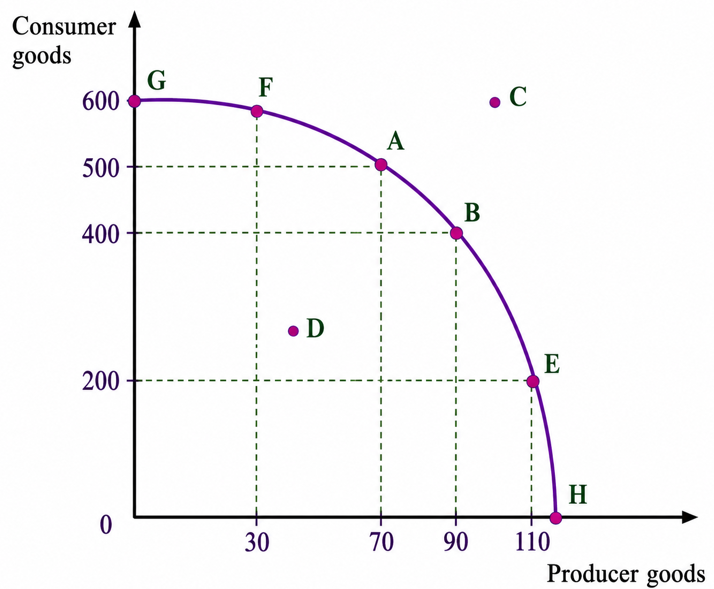
Moreover, the economy may decide to split its resources to produce both consumer and producer goods. For instance, at point A it can produce 500 units of consumer goods and 20 units of producer goods. All points of production along and under the PPF are attainable (G, F, A, B, E, H and D). All points above the PPF are unattainable such as point C. The economy cannot produce goods at point C due to limit of resources it has. Along the PPF, all points are efficient because there is full utilisation or employment of resources. However, point D is an inefficient point because the resources are underutilised or underemployed.
The movement along the PPF explains a trade-off (the opportunity cost) of the resources in the production of one good in terms of another. The concave shape of the PPF reflects increasing opportunity cost. That is to say, one needs to forgo an increasing quantity of consumer good to produce an extra unit of the producer good. If a country decides to move from G to H to produce more units of producer goods, then the economy has to forgo production of more and more units of consumer goods. For example, moving from point A to B, the economy gives up 100 units of consumer goods to add 20 units of producer goods. In addition, moving from E to B, an economy has to give up 20 units of producer goods to obtain 200 units of consumer goods.
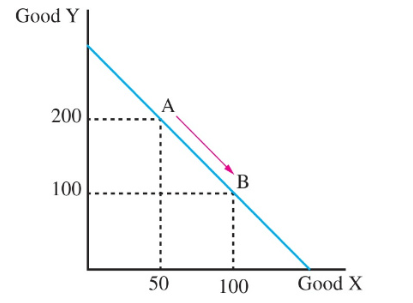
The PPF would also be linear (Figure 1.2) when the opportunity cost is constant. This situation depicts a condition in which resources are not specialised in production of either good. Hence, resources can be perfectly substituted to produce either good. In Figure 1.2, if the economy decides to produce good Y the PPC will be at point A and if it decides to produce less of it the PPC will be at point B.
|
Figure 1.2: Linear production possibilities frontier |
Significance of the concept of opportunity costs
The concept of opportunity cost is very important in any economic decision involving scarce resources which have alternative uses. It is used to depict levels of production and consumption in international trade to determine the country's comparative advantage. For instance, a country may decide to import products that have high opportunity cost and specialise in the production and export of products that have less opportunity cost. A rational producer or consumer will make a choice on how to allocate resources on a good that has low opportunity cost.
Moreover, opportunity cost aids in deciding on different choices when the scarce means have alternative uses. For instance, it shows how consumers could budget their expenditure by analysing what is most important for them and giving up other goods depending on the available resources.
Shift of the PPF curve
Progress in technology can enhance achievement of economic growth through a shift of the PPF. This is possible with relaxation of assumptions with respect to the PPF curve, for example, assumption of fixed resources. If an economy increases resources and/or advances technologically, production will increase and in turn there will be an upward shift of the PPF, which will result in economic growth. In Figure 1.3, when the supply of resources and/or improvement in technology occurs, the PPF curve shifts outwards from point AB to A'B'. On the outer PPF curve that is A'B', the economy can produce more goods and services than on the lower PPF curve.
|
Figure 1.3: Shift of the production possibilities frontier (PPF)-economic growth |
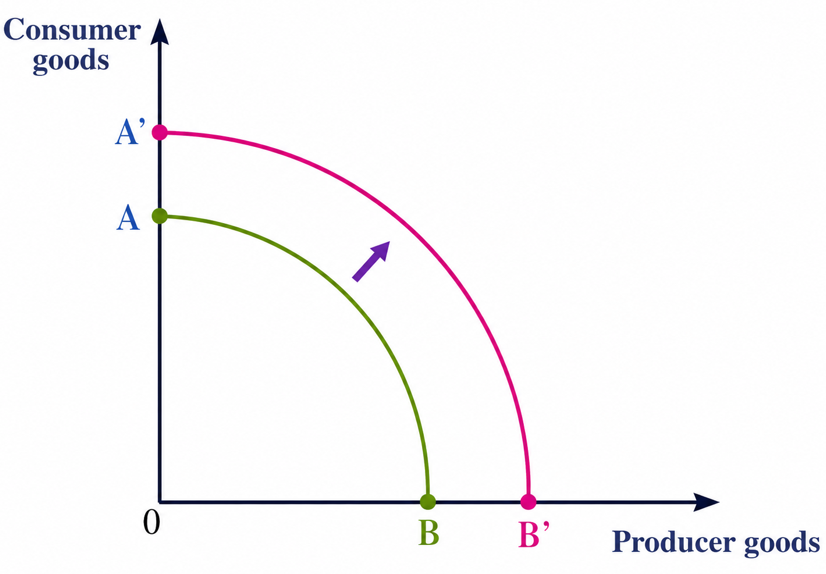
Economic growth (shift of the PPF) can be influenced by an increase in the quantity of natural resources such as discovery of minerals, oil, and gas or by increase in quantity and quality of human resources, technological development, innovations, and capital formation.
Activity 1.6
Construct a production possibilities frontier of an economy showing:
(a) Two goods which are mostly produced in your region and they use the same resources in production, with increasing opportunity cost.
(b) Assume one among the goods you have chosen undergoes resource
(c) Show the points that depict scarcity, efficiency and inefficiency of the economy on the PPF and provide explanations for each point.
(d) What are the economic implications of the region represented by the PPF?
(e) Explain why the PPF is concave to the origin, rather than being convex.
Exercise 1.6
1. The Wenjeib shared an announcement regarding the government’s decision to reallocate resources towards boosting the production of sesame seeds for exportation. However, economists anticipate the decision may lead to shortage of availability of other goods such as rice for domestic consumption. From economic perspective, explain why economists predict shortage of other goods as a result of reallocation of resources? Economics emerge because of the central problem of economics. Discuss.
Chapter summary
1. Economics is a social science that analyzes how individuals allocate their scarce resources to satisfy their unlimited wants. It deals with choices that individuals and businesses make to manage the scarce resources.
2. According to classical economics school of thought such as Adam Smith (1723–1790), defines economics as “a study of the nature and causes of the wealth of a nation.” Also, Neo-classical economists such as Alfred Marshall (1842–1924) defines economics as “a study of mankind in the ordinary business of life.” In contrast, Lionel Robbins in 1932 introduces the scarcity concept and defines economics as “a science which studies human behaviour as a relationship between ends and scarce means which have alternative uses.” Robbins’ definition of economics is superior to that of other economists and philosophers because it does not contain any reference to the material or welfare.
3. Economics is a social science subject that employs similar methods used by other fields of science subjects, such as chemistry, biology, and physics. As art, economics involves practical application of knowledge, principles, and theories in order to achieve desired ends, which may include sustainable economic growth, stable prices and low rate of unemployment.
4. To understand the pattern of society in decision-making under scarcity,economics is divided into two branches of Microeconomics and Macroeconomics. Microeconomics is a branch of economics, which focuses on decision making undertaken by individuals (or households) and by firms. On the other hand, Macroeconomics is a branch of economics that studies the behaviour of the economy as a whole.
5. The fundamental economic problem of any society is scarcity of resources. Scarcity means less than required or limited in supply. Due to scarcity of resources, producers must answer the three basic economic questions of what to produce, how to produce and for whom to produce. The concept of scarcity problem can be well illustrated and explained by using the Production Possibility Frontier (PPF) also known as Production Possibilities Curve (PPC), which shows combinations of output that the economy can produce given the available amount of factors of production and technology.

Hub App
 For Call,Sms&WhatsApp: 255769929722 / 255754805256
For Call,Sms&WhatsApp: 255769929722 / 255754805256  MATOKEO YA KIDATO CHA VI 2026
SECONDARY REGIONAL EXAMS
PRIMARY REGIONAL EXAMS
FORM VI NECTA REVIEWS
FORM IV NECTA REVIEWS
FORM II NECTA REVIEWS
STD VII NECTA REVIEWS
STD IV NECTA REVIEWS
SECONDARY EXAMS SERIES
PRIMARY EXAMS SERIES
PRIMARY SUBJECT NOTES
SECONDARY SUBJECT NOTES
SECONDARY TOPICAL EXAMS
SECONDARY TOPICAL QUESTIONS
PRIMARY TOPICAL QUESTIONS
PRACTICAL EXAMS & NOTES
SECONDARY REGIONAL EXAMS
DOWNLOAD SUBJECT NOTES
SCHEMES OF WORK (PRIMARY & SECONDARY)
LESSON PLAN
SECONDARY LOG BOOKS
PRIMARY LOG BOOKS
LITERARY WORKS / UCHAMBUZI VITABU
METHALI ZOTE ZA KISWAHILI
Vitendawili Vya Kiswahili
FORM VI RESULTS 2024
FORM FIVE SELECTION 2024
Matokeo KIDATO CHA II 2024
Matokeo Darasa IV 2024
MATOKEO KIDATO CHA IV 2023
FORM ONE SELECTION 2024
FORM VI RESULTS 2023
Matokeo Darasa IV 2022
MATOKEO YA KIDATO CHA VI 2026
SECONDARY REGIONAL EXAMS
PRIMARY REGIONAL EXAMS
FORM VI NECTA REVIEWS
FORM IV NECTA REVIEWS
FORM II NECTA REVIEWS
STD VII NECTA REVIEWS
STD IV NECTA REVIEWS
SECONDARY EXAMS SERIES
PRIMARY EXAMS SERIES
PRIMARY SUBJECT NOTES
SECONDARY SUBJECT NOTES
SECONDARY TOPICAL EXAMS
SECONDARY TOPICAL QUESTIONS
PRIMARY TOPICAL QUESTIONS
PRACTICAL EXAMS & NOTES
SECONDARY REGIONAL EXAMS
DOWNLOAD SUBJECT NOTES
SCHEMES OF WORK (PRIMARY & SECONDARY)
LESSON PLAN
SECONDARY LOG BOOKS
PRIMARY LOG BOOKS
LITERARY WORKS / UCHAMBUZI VITABU
METHALI ZOTE ZA KISWAHILI
Vitendawili Vya Kiswahili
FORM VI RESULTS 2024
FORM FIVE SELECTION 2024
Matokeo KIDATO CHA II 2024
Matokeo Darasa IV 2024
MATOKEO KIDATO CHA IV 2023
FORM ONE SELECTION 2024
FORM VI RESULTS 2023
Matokeo Darasa IV 2022
WHATSAPP US NOW FOR ANY QUERY
App Ya Learning Hub Tanzania