STUDENT’S NAME: _____________________
PRIME MINISTER'S OFFICE, REGIONAL ADMINISTRATION AND LOCAL GOVERNMENT
FORM ONE TERMINAL JOINT EXAMINATION
CODE: 012 HISTORY
TIME: 2:30 HRS MAY, 2026
Instructions
- This paper consists of sections A, B, and C with a total of ten (10) questions.
- Answer all questions in the spaces provided.
- All communication devices and any unauthorized materials are not allowed in the examination room.
- Write your Names at the top right corner of every page.
| FOR EXAMINER’S USE ONLY | ||
| Question No | SCORE | EXAMINER’S INITIALS |
| 1. | ||
| 2. | ||
| 3. | ||
| 4. | ||
| 5. | ||
| 6. | ||
| 7. | ||
| 8. | ||
| 9. | ||
| 10. | ||
| TOTAL | ||
| CHECKER’S INITIALS | ||
SECTION A (15 MARKS)
1. For each of the items (i- x), choose the correct answer from among the given alternatives and write its letter in the box provided.
i. The History teacher at Bihaula Secondary School was in the class; and provided the following definition; “Is the study of society’s cultural system, behavior, beliefs and ideologies.” This definition is for which concept among the following?
- Archaeology
- Archives
- Anthropology
- Archaeologist
ii. Ismail is a form one student who believes that “All human beings were originated from the Monkey, Gorilla and Apes” through the theory of evolution of man that was proposed by Charles Darwin. As historian student identify the correct one;
- The theory of creation
- The theory of revolution
- The theory of Darwinism
- The theory of evolution
iii. Aisha’s grandmother was narration a very interesting story about what happened during the movement of Ngoni, we were listening carefully and sometimes asking questions. What source of historical information was used?
- Oral tradition
- Museums
- Historical sites
- Anthropology
iv. Mr Masumbuko is an expert who deals with the study of the ancient and recent human past through materials remains. Through his activities he obtained important historical information. So we can term Mr Masumbuko’s activities as;
- Historical sites
- Archives
- Archeology
- Linguistics
v. The study of events and processes which happened in the past which might influence the past.
- Museum
- Anthropology
- History
- Linguistic
vi. Homo habilis were first man to use tools. As form one student what is the other name of homo habilis
- Able man
- Tool maker
- Clever man
- Hand man
vii. Two students from Morogoro region organized a study tour to Kilimanjaro region where they saw beans, maize, bananas, houses, different primary and secondary schools and many colleges. Which groups of human needs in a life describes above?
- Education, life and sport
- Human enjoyments
- Basic human needs
- Wealthier of Kilimanjaro people
viii. Madam Joan is an environmental professional. She deals with fire programs where she explains the importance of fire to human life. Support her by indicate what man can do with fire among the following
- Burn all forests and make desert
- Cultivate in desert areas
- Run faster than before
- Roast his/her food and live in colder areas.
ix. One of the following statements describes the stone age era correctly;
- When stones were formed in the earth
- When Africans used stones to fight European colonial invasion
- When man used stone technology in his daily life
- All the above.
x. Mr Mwembesongo he don’t know much why Homo Habilis is believed to be a direct ancestor of modern man. As expert of history help him by giving the reason among the following.
- He had bigger brain and he was more systematic
- He walked on two limbs
- He lived with other man
- His brain resembled that of the Chimpanzee.
Answers
| i | ii | iii | iv | v | vi | vii | viii | ix | x |
| . |
2. Match the items in list A with those in list B by writing a letter of the correct response below the corresponding item number in the space provided.
| LIST A | LIST B |
|
|
ANSWER
| LIST A | i | ii | iii | iv | v |
| LIST B | | | | | |
SECTION B (70- Marks)
3. Briefly answer the following questions
- Why did the oral tradition become important source of history
- Why the middle age become very famous stage than old and late stone age?
- How history relates to geography subject
- How to determine dates?
4. Briefly explain five methods of fixing dating historical events
5. Define the following historical terms
- i. History
- Generation
- Millennium
- A century
- A day
6. The following sentences are mixed up. Arrange them in a chronological order from the first to the last. By using number 1 – 5.
- Their specific functions are to preserve old books, files, letters and diaries written by the leaders and so on.
- The earliest example of the written record is the periplus of the Erythraean sea
- Archives are places where old private and public records are kept
- While written records provide information about the past.
- Archives can be managed by individual’s private institutions, religious groups and mostly by the government.
| i | ii | iii | iv | v |
| | | | | |
7. Study this sketch map and respond to the questions below
 |
- Which stage was the first to use fire?
- Name the stages labelled (a – d) above
- Mention three features of stage labelled (d)
8. Mr. Kwang believe that historical events have specific qualities that differentiate them from non – historical events. What do you think were five events to be termed as historical must have unique qualities
9. Mzee Malandu is an old man aged of 89 years old; he always narrates the stories to his grandson about the past events. Show five advantages of the method of obtaining information which is used by Mzee Nyandu.
SECTION C (15 MARKS)
Answer question number ten (10) in this section
10. Halima is a student who is les interests in HISTORY. She claims that History is USELESS and that is DEAD SUBJECT. Explain how Halima can be convinced to learn History by showing her five importances of studying History subjects.
FORM ONE HISTORY EXAM SERIES 269
FORM ONE HISTORY EXAM SERIES 269
STUDENT’S NAME: _____________________
PRIME MINISTER'S OFFICE, REGIONAL ADMINISTRATION AND LOCAL
GOVERNMENT
FORM ONE TERMINAL EXAMINATION
Time: 2 Hours May Year: 2026
INSTRUCTIONS
- This paper consists of sections A, B, and C with a total of ten (10) questions.
- Answer all questions in the spaces provided.
- All writing must be in blue or black ink
- All communication devices and any unauthorized materials are not allowed in the examination room.
SECTION A (15 MARKS)
Answer all questions in this section
1. For each of the items (i)-(x) choose the correct answer from among the given alternative and write its letter beside the correct number.
i) The late president of Tanzania Hon. John Magufuli in one of his public speech insisted that history subject should be taught in all secondary schools because of some reasons:
- To get knowledge and skills in order to have many engineers and doctors
- To promote unity, democracy and development
- To promote democracy and solidarity in the country
- To promote a sense of nationalism, patriotism and understand our history.
ii. Anna's grandmother is 90 years old. She regularly narrates to Anna and her friends on many past political events that took place in the society. Which source of historical information Anna's grandmother use?
- Archaeology
- Historical linguistics
- Oral traditions
- Written records
iii. In which stage of evolution of man did agriculture and domestication evolve?
- Early stone Age
- Iron Age
- Late stone Age
- D. Middle stone Age
iv. Why is it expensive to use archaeology?
- It neglects the use of Carbon 14.
- It rejects the use of fossils as evidence.
- It needs experts and advanced technology.
- It needs historians who can memorize events.
v.Which period did microliths used?
- The late stone age
- The early stone age
- The Iron Age
- The middle stone age
vi. In History there are different ways of patterning a chronological order of historical events. Which one will be the correct set of chronological order?
- Time line, time chart, carbon 14 and family tree
- Language studies, recalling events and associating events
- Time chart, time line, time graph and family tree
- Time chart, potassium argon, family tree and time line
vii. One of the famous historical site in Iringa region in Tanzania is called
- Kilwa Mikindani
- Mikumi,
- Isimila
- Bagamoyo
viii. Which of the following methods was commonly used by man to obtain food during the early Stone Age?
- Hunting and gathering
- Cultivation of cereals
- Exchanging goods for goods
- Iron smelting
ix. Chronological order of events is usually shown in the following except ..
- Time chart
- Time line
- Family tree
- Carbon 14
x. Man started to be skilful and tool maker at the stage of .
- Homo Sapiens
- Homo Habilis
- Homo Erectus
- Modern Apes
2. Match the item in List A with the correct answer in List B by writing its letter below in the box provided
| List A | List B |
|
|
SECTION B (70 MARKS)
Answer all questions in this section
3. Historians have divided time using days, weeks, months, years, generations, centuries, and even millennia. What methods do historian used in determining dates.
4. There is a misunderstanding between Katembo and Johnson, Katembo insists that history subject is related to other subjects, but Johnson rejected. Help Johnson with less than five (05) points to prove the relationship between history subject and other subjects.
5. Many Tanzanians have been reluctant to visit the national museum even through it could be our source of leaning. Explain how a Tanzanian can benefit from visiting the national museum.
6. Study the picture below and name the stages of evolution of man.
- ___________________________
- ___________________________
- ___________________________
- ___________________________
 |
- Name the process shown above ____________________________
7. The discovery of fire during the middle stone age had the same significance as the discovery of the computer in modern society. Explain
8. During the late Stone Age, man had acquired some changes better than the previous eras. In five points show major changes of man’s way of life during this period
9. Historical events have specific qualities that differentiate them from non-historical events. List down five qualities of historical events.
SECTION C (15 MARKS)
Answer question number 10
10. ‘’Studying history wastes time because the subject deals with past events as opposed to contemporary life’’ Argue for or against the statement
FORM ONE HISTORY EXAM SERIES 268
FORM ONE HISTORY EXAM SERIES 268

FORM ONE HISTORY EXAM SERIES 222
FORM ONE HISTORY EXAM SERIES 222
THE PRESIDENT’S OFFICE
REGIONAL ADMINISTRATION AND LOCAL GOVERNMENT
HISTORY FORM ONE TERMINAL EXAMINATION
CODE 012
TIME: 2:30 HOURS
INSTRUCTIONS.
- This paper consists of section A, B and C with the total number of ten(10) questions
- Answer all questions in each section
- Section A carries (15) marks, section B (70) marks and section C carries (15) marks
- All writing must be in blue/black ink except drawing which must be in pencil
- Cellular phones and any unauthorized materials are not allowed in the assessment room.
SECTION A (15 Marks)
Answer all questions in this section
1. For each of the items (i) – (x) choose the correct answer from among the given alternatives and write its letter beside the item number in the answer sheet provided
- The word 'history' is derived from which language?
A. Latin
B. French
C. Greek
D. Arabic
- Which of the following is NOT a reason why studying history is important?
A. Helps us understand different cultures
B. Allows us to learn from past mistakes
C. Gives us a sense of identity
D. Predicts the exact pattern of future events
- An archaeologist finds a piece of ancient pottery. This artifact is considered a:
A. Primary source
B. Secondary source
C. Fossil
D. Myth
- Which of the following is an example of a relative dating technique?
A. Stratigraphy
B. Carbon-14 Dating
C. Potassium-argon Dating
D. Dendrochronology
- The theory that humans and present-day primates evolved from a common ancestor is a central part of:
A. The Theory of Relativity
B. The Theory of Evolution
C. The Theory of Continental Drift
D. The Theory of Plate Tectonics
- The earliest and longest period of prehistoric times is known as the:
A. Neolithic Age
B. Bronze Age
C. Stone Age
D. Iron Age
- Which of these tools was NOT characteristic of the Old Stone Age (Paleolithic)?
A. Hand axes
B. Polished stone tools
C. Choppers
D. Spear points
- The control and use of fire was a major development for early humans because it provided:
A. Warmth and protection
B. A source of light
C. Ability to cook food
D. All of the above
- The transition to the Iron Age brought advantages like:
A. Stronger, more durable tools and weapons
B. Increased agriculture production
C. New technologies
D. All of the above
- One disadvantage of oral histories as sources of information is that they:
A. Are always written down
B. Only exist in ancient times
C. Can change over time as they are passed down
D. Don't provide a perspective on the past
2. Match the stage of human evolution in Column A to its characteristic in Column B.
| Column A | Column B |
|
|
SECTION B: 70 Marks
3. (a) Define the term History
(b) Give five importance of studying history
4. Briefly explain the term below briefly
- Archeology
- Anthropology
- Historical site
- Dating
- Oral traditions
5. (a) What is a museum?
(b) Give the main functions of a Museum
(c ) explain limitations of archeology as a source of history
6. (a) What is human evolution?
(b) Describe the features of the following stages of man’s evolutionary history
- Homo habilis
- Homo erectus
- Australopithecus
- Homo sapiens sapiens
7. (a) What were acheulian tools and Oldwan tools?
(b) Explain how human obtain food in the following stages;
- Earlier stone age
- Middle stone age
- Late stone age
(c) How did man change during the late stone
8. (a) At what stage of development did man discover fire?
(b) How did the discovery of fire change man’s life.
9. (a) Explain how iron was discovered
(b) Briefly explain the advantages that was brought by production and use of iron tools.
SECTION C: 15 Marks
10. (a) Define the term Agriculture
(b) Briefly explain the following agricultural practices
- Shifting cultivation
- Nomadic pastoralism
- Sedentary pastoralism
- Mixed farming
FORM ONE HISTORY EXAM SERIES 170
FORM ONE HISTORY EXAM SERIES 170
PRESIDENT OFFICE REGIONAL ADMINISTRATION AND LOCAL GOVERNMENT
SECONDARY EXAMINATION SERIES
COMPETENCE BASED ASSESSMENT
HISTORY FORM ONE
TERMINAL EXAMS-MAY – 2023
Time: 2:30 Hours
Instructions
- This paper consists of sections A, B and C with a total of ten (10) questions
- Answer all questions
- Section A and C carry fifteen (15) marks each and Section B carries seventy (70) marks
- All writing must be in blue or black in
- All answer must be written in the spaces provided
- Cellular phones, calculators and any unauthorized materials are not allowed in the assessment room
SECTION A (15 Marks)
- For each of the items (i) – (x), Choose the correct answer from the given alternative and write its letter in box provided
- In his archeological work which led to discovery of skull of the first man. Dr Leakey was assisted by:
- Charles Darwin
- Zinjathropus
- Earlier man
- Marry Leakey
- Which of the theory of origin of life below is not scientific?
- Creation theory
- Organic evolution theory
- Big bang theory
- Comorian theory.
- Microliths are:
- Sharper smaller and lighter stone tools of late stone age period
- Small iron age tool found at Olduvai
- Tiny stone age tools of middle stone age
- Stone tools found in Engaruka
- The evidence of middle stone tools is found in parts of:
- East Africa rift valley
- Ukerewe Islands
- Isimila
- None of above
- With fire man could?
- Cultivate desert areas
- Run faster than before
- Roast his food and live in colder areas
- Burn all forest and make desert
- Which of the following was called able man?
- Home Habilis
- Homo Erectus
- Primate
- Zunjathropus
- One disadvantages of linguistic as source of history is that
- Information is from multiple source
- One understands little about communities
- Does not reveal links between people
- Learning a language consume time and money.
- One advantage of written sources of history is that;
- Give right information always
- Record details of important people only
- One can easily get valuable and rare information
- It is limited to few people in society.
- Which is not a measure of time in history?
- Decade
- Century
- Millennium
- Month
- A period of one thousand years is called?
- Life span
- Decade
- Millennium
- Century
- Match the item in LIST A with their correct response from LIST B. Write down letter of correct response in space provided.
| LIST A | LIST B |
|
|
SECTION B. (70 MARKS)
ANSWER ALL QUESTIONS
- (a) Name four uses of tools by man in Old Stone Age period.
(b) Mention three ways used by early man to get food.
- a) Explain how fire was discovered
(b) Explain the contribution of fire to man
- (a) What is Oral tradition?
(b) Write four advantages of Oral traditions
- (a) Write three disadvantages of archival information as a source of history.
(b) Write down two disadvantages of historical sites as source of history.
7. Briefly explain the following terms:
i) Feudalism
(ii)Trans-Saharan Trade
(iii) Umwinyi
(iv) Historical sites
(v) Carbon-14
8. (a) What is local trade?
(b) What were the impacts of local trade?
9. Describe the methods of making salt in traditional African societies.
SECTION C. 15 MARKS
10. Explain six factors that led to the development of trade in African societies during the pre-colonial period
FORM ONE HISTORY EXAM SERIES 132
FORM ONE HISTORY EXAM SERIES 132
THE PRESIDENT’S OFFICE
MINISTRY OF EDUCATION, REGIONAL ADMINISTRATION AND LOCAL GOVERNMENT
COMPETENCE BASED SECONDARY EXAMINATION SERIES
TERMINAL EXAMINATION
FORM ONE
CIVICS
011
TIME: 2:30 HOURS May, 2022

Instructions
1. This paper consists of sections A, B and C with the total of seven (7) questions.
2. Answer all questions in sections A and B and one (1) question from section C.
3. All answers must be written in the spaces provided.
4. All writings must be blue or black ink.
5. All communication devices and calculators are not allowed in the examination room.
6. Write Your Examination Number on the top right of every page.
SECTION A.
1. Multiple choice questions
(i)The following are functions of a Moran, except:
- To protect the whole society
- To travel in search of water and grass
- To defend and expand the protectorate
- To control religion and solve land conflicts
(ii)Which of the following is a modern scientific method of fixing dates?
- Z Before Christ (BC) Method
- A microscope Method
- Anno Domino (AD) Method
- Carbon 14 Method
(iii)The process of handing down the historical knowledge using a word of mouth from one generation to another is called:
- Oral tradition
- Historical information
- Linguistics
- Anthropology
(iv)The following is one of the methods used in obtaining gold in African societies:
- Shaft method
- Pottery
- Ornaments
- Titration
(v)A source of historical information which contains remains that show man's physical development activities and tools he used is:
- Museum
- Oral tradition
- Archives
- Historical sites
(vi)The important effect of iron technology in Africa was:
- Expansion of heavy industries
- Increase of civil wars
- Increase of migration in Africa
- Increase of agriculture and population
(vii)The chronological order of events is usually by the following except:
- Time-chart
- Carbon 14
- Time line
- Family tree
(viii)In evolution of man, the use of tools and bi-pedalism were accompanied by the development of man's:
- Agriculture
- Brain
- Limbs
- Trade
(ix)History is the study of:
- Past, present and future tenses;
- Past selected information;
- Ujamaa in traditional African societies;
- Man's activities against nature through various stages of development.
(x) In evolution of man, the systematic tool maker was:
- Zinjanthropus
- Australopithecines
- Homo Erectus
- Homo Habiiis
2. Match the item in LIST A with their correct response from LIST B. Write down letter of correct response in space provided.
| LIST A | LIST B |
|
|
3. Write TRUE or FALSE against each statement below
- Nature of environment and technology determine the existence of economic activities......
- Olduvai Gorge is found in southern part of Uganda............................
- Iron age existed from around first millennium B.C.......................
- Man discovered fire during late stone age......................................
- The rise of specialization and complex communities were notable effects of early stone age.....
- Australopithecus Africanus had big brain size of about 450 to 550 cubic centimeters compared to other primates......................
- Historians assume homo sapiens to be a true man of today........................
- Early stone age had developed great technology compared to late stone age...
- The only method of determining dates which is done scientifically is carbon 14 method....
- History predicts the future......................
4. Briefly explain the following terms
- Archives
- Historical site
- Homo erectus
- Iron age
- millennium
SECTION B (30 MARKS)
Find this and other free resources at http://maktaba.tetea.org
Answer all questions in this section.
5. Arrange the following sentences in chronological order by writing their letter in the table provided.
- Moved upright and was skillful tool marker
- Was first systematic tool marker and had large brain capacity
- True man with large brain capacity and less thick jaw
- Man body was covered with lots of hair and walked in four limbs
- Used hind limb to stand and balance, he started to design tools
6. Complete each of the following statements with correct historical facts.
- The last stage of man’s evolution in which he had a large brain capacity......
- Tools used during earlier stone age..............
- Famous site for iron smelting..................
- Pre-colonial African societies used a system of exchange based on goods by goods known as …………………………
- A duration of one hundred years is called …………………………
7. Study the figure below and answer questions that follow;
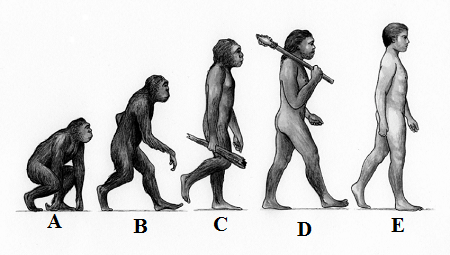
- Name the stages of development of man labelled A-E
- In which stage did man use stones and pebbles
- In which stage did man have the largest brain capacity?
- In which stage was man a systematic tool marker?
SECTION C (30 MARKS)
Answer two (2) questions from this section.
8. Describe the effects of discovery of iron tools
9. Jane and Neema are arguing about the significance of studying history. Jane says that study of history is waste of time and resources. Using six points convince Jane to study history.
10. What are archives? Describe functions of archives as source of history
FORM ONE HISTORY EXAM SERIES 89
FORM ONE HISTORY EXAM SERIES 89
MINISTRY OF EDUCATION, REGIONAL ADMINISTRATION AND LOCAL GOVERNMENT
SECONDARY EXAMINATION SERIES
HISTORY TERMINAL EXAMINATION
FORM ONE-2021
Time: 2:30Hours
Instructions.
- This paper consists of section A, B and C with a total of 10 questions
- Answer all questions in section A and B and TWO questions from section C.
- Section A carries 40 marks, while section B and C carries 30 marks each.
- All answers should be written in the spaces provided.
- All communication devices, calculators and any unauthorized material are not allowed in examination room.
- Write your number on every page of your answer booklet.
SECTION A (35 Marks)
Answer All questions in this section.
- For each of the items (i)-(x), choose the correct answer from the alternatives given.
- Man was able to make and use very simple stone tools during the:
- Middle Stone Age
- Old stone Age
- Late Stone Age
- New Stone Age
- Which among the following include the methods used in showing chronological order of events?
- Famine, epidemics, drought and heavy rains.
- Carbon 14, archives, museums and historical sites
- Periods, generations, millennia and centuries.
- Family trees, time lines, time charts and time graphs.
- Three pre-colonial matrilineal societies in East Africa were:
- Mwera, Makonde and Sukuma
- Chagga, Kikuyu and Kamba
- .Makonde, Sukuma and Chagga
- Kikuyu, Makonde and Kamba.
- During the pre-colonial period, Imbagala and Vimbundu of Angola were:
- professional traders
- abolitionists of slave trade
- pastoral societies.
- early hunters and gatherers.
- The economic factors for interactions among the people of Africa were:
- migration, trade and language
- war, migration and music
- intermarriage, medicine and religion
- trade, agriculture and metal working.
- One of the causes of Mfecane wars was:
- arrival of Portuguese at the Cape of Good Hope
- migration of the Ngoni under Zwangendaba
- rapid population growth in South Africa
- arrival of Sultan Seyyid Said in Zanzibar from Oman.
- Which among the following include the demands of industrial capitalism?
- Piracy, robbery and unequal exchange
- Explorers, traders and missionaries.
- Markets, raw materials and cheap labour
- Robbery, piracy and agents of colonialism

- The feudal system in Zanzibar was known as:
- Busulo
- Nyarubanja
- Ubugabire
- Umwinyi
- Which of the following does not apply to the moran?
- Consists of people who were between youth and adulthood

- Protects livestock against enemies and wild animals.
- Consists of young boys between 8 and 18 years.
- Raids neighbouring herds to increase the size of their herds.
- Who discovered the skull of the earliest ancestors of man in Olduvai Gorge in 1959?
- David Livingstone.
- Louis Leakey.
- Charles Darwin.
- Carl Peters.
- Which were the pastoral societies that existed in pre-colonial East Africa?
- Masai, Nandi, Turkana and Karamajong
- Nandi, Kikuyu, Sambaa and Hadzabe
- Nyakyusa, Nandi, Karamajong and Makonde
- Turkana, Gogo, Sukuma and Kikuyu
- The following were some of the commodities used as currency in precolonial Africa:
- Copper rods, books and bronze
- iron ore, silver and wood
- paper, gold and copper

- salt, cloth and cowrie shells
- Homo-sapiens lived in one of the following periods:
- Early Stone Age
- Iron Age
- Late Stone Age
- Middle Stone Age
- The following was the major form of feudal relations in Rwanda and Burundi:
- Basulu
- Chiefdom
- Ntemiship
- Ubugabire
- One of the problems of written records as a source of historical information is that, they:
- are given by elders

- are mostly reliable
- can be used by literate people only
- serve as stores of variety of information
- Match the items ?n List A with those ?n List B by writing the correct letter against the corresponding question number ?n the table provided.
| LISTA | LISTB |
|
|
- Write true ?f the statement ?s correct or false?f the statement ?s not correct.
- Archaeology ?s the only method of obtaining historical ?nformat?on ___________
- History as a social subject deals with future events________________________
- Meroe and Nok are found ?n East Africa_________________________________
- Tanganyika got independence earlier than Kenya and Uganda________________
- Barter system ?s trade which involves the exchange of goods________________
- A millennium ?s a period of ten (10) centuries_______________________________
- Permanent Agriculture was not practiced ?n the arid and sem?-ar?d areas______
- Zinjathropus reached the stage of making and using tools_____________________
- Science ?s software and technology ?s hardware __________________________
- Agriculture ?s the keeping of animals ___________________________
- Briefly explain the meaning of the following terms
- Oral traditions
- Historical sites
- Archeology
- Archives
- anthropology
5. (a) Name four uses of tools by man in Old Stone Age period.
(b) Mention three ways used by early man to get food.
6. Show the different between tools used by man during the middle stone age and those of old stone age.
7. Discuss the impact of fire to man during the middle stone age
8. Discuss the impact of discovery of iron tools in East Africa
FORM ONE HISTORY EXAM SERIES 57
FORM ONE HISTORY EXAM SERIES 57
THE PRESIDENT’S OFFICE MINISTRY OF EDUCATION, LOCAL ADMINISTRATION AND LOCAL GOVERNMENT
HISTORY- TERMINAL EXAMINATION-MAY
FORM ONE
TIME: 2HRS 2020
NAME:_________________________________CLASS:___________
INSTRUCTIONS
- This paper consists of section A, and B
- Answer ALL questions
- Remember to write your name on each and every page of your answer sheets
SECTION A ( 60 Marks)
1. Read the following statements carefully and write the letter of the correct answer in the box or bracket provided
(i) On history time line, the year "O" stands for:
- The birth of Christ
- The birth of Prophet- Mohamed
- The peak of the Roman Empire
- An unknown year
(ii) We can obtain historical information by using:
- Oral traditions
- Written sources
- Archaeological findings
- Archives, museums and all the above
(iii) The expert whose work are the study of historical remains are called
- Biologist
- Anthropologist
- Archeologist
- Geologist
(iv) Dr. louis Leakey and his wife Mary carried out Archeological research in 1959 in
- Dodoma
- Arusha
- Singida
- Kilimanjaro
(v) One of the following determines the age of historical events beyond 5000 years
- Carbon 14
- Age detector
- Carbon of chemical
- Carbon 13
(vi) Oral traditions can be categorized into two ways of passing historical information these are
- Cultural practice and narration of the past events
- Cultural practice and recalling of events
- Chronology and orders of the events
- Chronology and cultural parts
(vii) A person who study all aspects of human life and culture is known as:-
- Archeology
- Linguistic
- Anthropologist
- Language
(viii) Olduvai Gorge is the historical site found in
- Africa
- Uganda
- Tanzania
- East Africa
(ix) A family tree shows the relationship between
- Members of a family over a period of time
- Father, mother and children
- Members of the family with other families
- Father and children
(x) The basic needs of the human man being are
- Water, cloth and shelter
- Shelter, food and clothing
- Food, shelter and house
- Food, shelter and maize
2. Match the items in List A with those in List B by writing the correct letter against the corresponding question number in the table provided
|
| List A |
| List B |
| (i) Carbon 14 (ii) Oral tradition(iii) Olduvai George (iv) Nelson Mandela(v) Iron working site (vi) Bi- pedalism(vii) Isimila (viii) Archives(ix) Museums (x) Stone age |
| ||
3. Write TRUE for the statement (s) which is correct and FALSE for the wrong statement
- Anthropology is the study of human remains…………………….
- Age, in history is a period based on our great ancestors…………….
- During the period of the Early or old stone age, people had permanent shelters ………………….
- In Tanzania, paintings and drawings in caves in area such as Kondoa- Irangi and some places of Singida give evidence of the activities of a settled community …………………
- Rusinga Island and Nsogezi are the famous historicval sites in Kenya…………………….
- Tools made in the Early stone age were bigger smaller and sharper than those of the middle stone age ……………………
- Kalenga is a historical site and not a national museum……………
- Illiterates cannot benefit from archival information…………..
- Carbon 14 dating finds dates for remains of animals and plants that died beyond 5,000 years ago……………..
- Man distinguished from the other primates by his ability to design tools for specific purposes…… ……………..
SECTION B ( 40 Marks)
4. Define the following historical terms
- History
- Bi- pedalism
- Archives
- A decade
- Primates
5. Differentiate time lines from time charts and family trees from Time graphs
FORM ONE HISTORY EXAM SERIES 15
FORM ONE HISTORY EXAM SERIES 15

DOWNLOAD LEARNING HUB APP NOW

SORRY, YOU CAN'T VIEW THIS MARKING SCHEME PLEASE DOWNLOAD LEARNING HUB APP FROM PLAYSTORE TO GET FULL ACCESS TO ALL MARKING SCHEME!!
Click Here To Download Learning Hub Tanzania App
SAMAHANI, HUWEZI KUFUNGUA MAJIBU YA MTIHANI, TAFADHALI PAKUA APP YA LEARNING HUB TANZANIA ILI KUWEZA KUFUNGUA MAJIBU YA MITIHANI KATIKA TOVUTI HII!!
Bofya Hapa Kupakua App Ya Learning Hub Tanzania
Hub App
 For Call,Sms&WhatsApp: 255769929722 / 255754805256
For Call,Sms&WhatsApp: 255769929722 / 255754805256  Matokeo Darasa VII 2025
Matokeo KIDATO CHA II 2024
Matokeo Darasa IV 2024
SECONDARY REGIONAL EXAMS
PRIMARY REGIONAL EXAMS
FORM VI NECTA REVIEWS
FORM IV NECTA REVIEWS
FORM II NECTA REVIEWS
STD VII NECTA REVIEWS
STD IV NECTA REVIEWS
SECONDARY EXAMS SERIES
PRIMARY EXAMS SERIES
PRIMARY SUBJECT NOTES
SECONDARY SUBJECT NOTES
SECONDARY TOPICAL EXAMS
SECONDARY TOPICAL QUESTIONS
PRIMARY TOPICAL QUESTIONS
PRACTICAL EXAMS & NOTES
SECONDARY REGIONAL EXAMS
DOWNLOAD SUBJECT NOTES
SCHEMES OF WORK (PRIMARY & SECONDARY)
LESSON PLAN
SECONDARY LOG BOOKS
PRIMARY LOG BOOKS
LITERARY WORKS / UCHAMBUZI VITABU
METHALI ZOTE ZA KISWAHILI
Vitendawili Vya Kiswahili
FORM VI RESULTS 2024
FORM FIVE SELECTION 2024
MATOKEO KIDATO CHA IV 2023
FORM ONE SELECTION 2024
FORM VI RESULTS 2023
Matokeo Darasa IV 2022
Matokeo Darasa VII 2025
Matokeo KIDATO CHA II 2024
Matokeo Darasa IV 2024
SECONDARY REGIONAL EXAMS
PRIMARY REGIONAL EXAMS
FORM VI NECTA REVIEWS
FORM IV NECTA REVIEWS
FORM II NECTA REVIEWS
STD VII NECTA REVIEWS
STD IV NECTA REVIEWS
SECONDARY EXAMS SERIES
PRIMARY EXAMS SERIES
PRIMARY SUBJECT NOTES
SECONDARY SUBJECT NOTES
SECONDARY TOPICAL EXAMS
SECONDARY TOPICAL QUESTIONS
PRIMARY TOPICAL QUESTIONS
PRACTICAL EXAMS & NOTES
SECONDARY REGIONAL EXAMS
DOWNLOAD SUBJECT NOTES
SCHEMES OF WORK (PRIMARY & SECONDARY)
LESSON PLAN
SECONDARY LOG BOOKS
PRIMARY LOG BOOKS
LITERARY WORKS / UCHAMBUZI VITABU
METHALI ZOTE ZA KISWAHILI
Vitendawili Vya Kiswahili
FORM VI RESULTS 2024
FORM FIVE SELECTION 2024
MATOKEO KIDATO CHA IV 2023
FORM ONE SELECTION 2024
FORM VI RESULTS 2023
Matokeo Darasa IV 2022