Chapter 01 : Listening
| Introduction Listening is an important skill for you as it lays a foundation for successful communication in English. By practising active listening, you can enhance your understanding and participate appropriately in conversations and discussions. In this chapter, you will participate in various conversations, summarise information from oral presentations and paraphrase spoken information. These competencies will enhance your ability to listen and comprehend spoken information and participate more actively in various communication settings. |
| Think about:
|
Activity 1
Participating in different conversations
(a) Play the Broken Telephone Game using the following steps.
How to play the game
- Start the game by having one person in a group of five to seven whisper one phrase into the ear of the first person in a line or circle.
- The first person then whispers the phrase they heard into the ear of the next person. Each person can only say the phrase once and whisper it quietly so that only that person can hear it.
- Keep passing the message to the next person until it reaches the last person in the line or circle.
- The last person says the message out loud for everyone to hear. Write the message on the board.
- Repeat the process with the remaining phrases until the sentence is completed. Then, compare the final message with the original one.
(b) Role-play the following conversation between Poki and a customer service officer. Then, respond to the items that follow.
Catching the SGR Train to Dodoma
|
|

Poki: Good morning! I'd like to travel to Dodoma by the SGR train. Could you please help me with some information?
Customer service officer: Sure! What would you like to know?
Poki: When is the next train to Dodoma?
Customer service officer: The next train to Dodoma departs at 10:00 a.m., and there’s another one at 2:00 p.m.
Poki: How much is a one-way ticket from Dar es Salaam?
Customer service officer: A one-way ticket in Economy Class on the express train costs TZS 40,000. If you prefer the Royal Class, it costs TZS 90,000.
Poki: Does this train stop at the central station in Dodoma?
Customer service officer: Yes, it does.
Poki: How long does the journey take?
Customer service officer: It takes approximately 4 hours.
Poki: Do you accept cards?
Customer service officer: We accept cash, cards and mobile money payments.
Poki: Are food services available on the train?
Customer service officer: There are catering trolleys where you can buy drinks, snacks and meals on the journey.
Poki: What are the regulations regarding luggage?
Customer service officer: Each passenger can bring one suitcase and one small bag. Additional luggage may incur a fee. Please note that shangazikaja is not allowed on the train.
|
|

Poki: Can I book a ticket online?
Customer service officer: Yes, you can book your ticket online at sgrticket.trc.co.tz or via the SGR App.
Poki: Is there a discount for students?
Customer service officer: No, they should pay the full fare. Only infants travel for free, while children aged 2 to 4 years travel at half the standard rate.
Practice
(i) Reflect on each performance, focusing on fluency and pronunciation.
(ii) Discuss what you have learned from the dialogue.
(iii) Imagine you were Poki. Write a short passage about the journey to Dodoma, focusing on the adventure or challenges.
(c) Participate in a 10-minute interview with a partner using the following guiding questions. Take notes during the interview, as you will need to report to the class what you learned from your partner.
1. What career path interests you? What motivates your choice?
2. What skill or hobby would you want to develop in the future? What is your reason for choosing it?
3. How do you plan to contribute to your community or society in the future?
4. What impact do you think your community would experience if people with your qualities and contributions were missing?
5. Is there any place you would like to visit? What attracts you to this place?
| Activity 2 Summarising information from oral presentations |
(a) Listen to the song "My Favourite Things" and complete the following lyrics by filling in the blanks.
Raindrops on roses and whiskers ____________
Bright copper ____________ and warm woollen mittens
Brown ____________ tied up with strings
These are a few of my favourite things.
Chorus
When the dog bites, when the ____________
When I'm feeling sad
I ____________ my favourite things
And then ____________
Cream ____________ and crisp apple strudels
____________ and ____________ and schnitzel with noodles
____________ that fly with moon on ____________
These are a few of my favourite things
Adapted from "My Favourite Things" by Jullie Andrews
From the song:
(i) Summarise the singer's favourite things in two sentences.
(ii) Write a two-stanza poem about your favourite things.
(b) Listen to a speech about environmental conservation from your teacher. Then, summarise it using the following 5Ws and H graphic organiser.
|
|
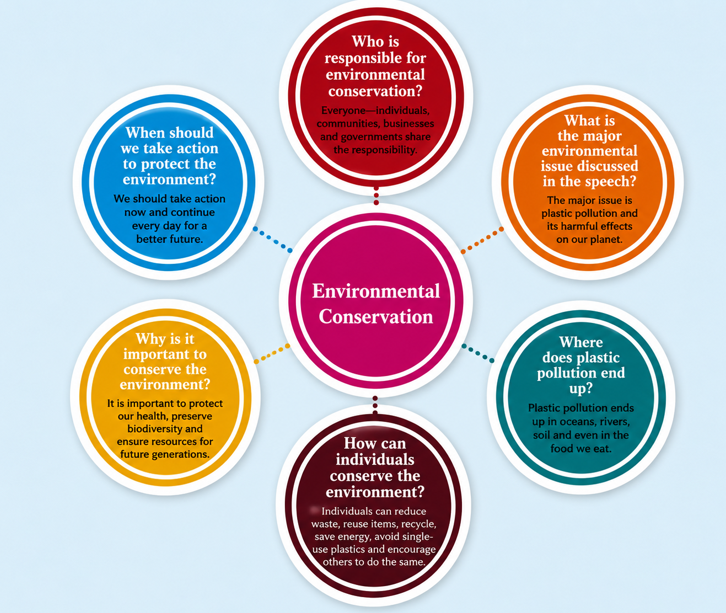
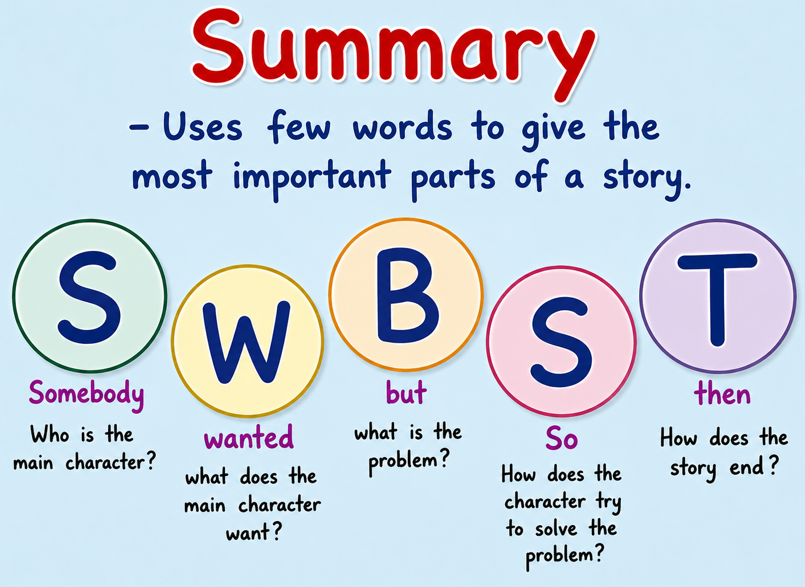
(c) Listen to the short story “The Joys of Life.” Then, summarise it using the Somebody, Wanted, But, So, Then (SWBST) diagram given.
|
|
Activity 3
Paraphrasing oral information
(a) Study the following and answer the questions in (b).
- “Are you saying ___________?”
- “Do you mean ___________?”
- “Did you just say ___________?”
- “If I understand correctly, you are saying ___________?”
- “So, you are saying ___________ Right?”
- “___________ Did I get that right?”
Did you know?
The questions in (a) are known as clarifying questions. These questions are used to confirm the information heard. They increase your ability to collect information, prevent misunderstanding and accurately paraphrase conversations, especially if there is confusion about the meaning.
(b) Practise using the clarifying questions in (a) with the statements provided in the following table. The first statement is provided as an example.
| S/n | Statements | Clarifying questions |
| 1. | I have hesitations about the effectiveness of this plan. | Are you saying we need to change the plan? |
| 2. | I’m worried about this idea. | |
| 3. | I don’t feel safe walking on this road. | |
| 4. | I’m not sure whether I want to study these subjects. | |
| 5. | Maybe we should wait for the teacher to instruct us. | |
| 6. | I’m not sure he made the right decision. |
Here are the appropriate clarifying questions for each statement:
| S/n | Statements | Clarifying Questions |
|---|---|---|
| 1. | I have hesitations about the effectiveness of this plan. | Are you saying we need to change the plan? |
| 2. | I'm worried about this idea. | Do you mean that you have concerns about how this idea will work? |
| 3. | I don't feel safe walking on this road. | Are you saying that this road is dangerous to use? |
| 4. | I'm not sure whether I want to study these subjects. | If I understand correctly, are you saying that you are uncertain about choosing these subjects? |
| 5. | Maybe we should wait for the teacher to instruct us. | So, you are saying that we should not proceed until the teacher gives us directions, right? |
| 6. | I'm not sure he made the right decision. | Are you saying that you think he may have made the wrong decision? |
Note:
Clarifying questions are used to:
-
Confirm understanding of what the speaker means.
-
Prevent misunderstandings.
-
Help listeners paraphrase information accurately.
-
Encourage effective communication.
(c) Listen to a short story from an audio/audio-visual source. Then, retell it in class.
(d) Use a dictionary, thesaurus or online sources to replace the underlined constructions in the email. Share your revised version orally in class.
| To: Hope Subject: The poetry project Hi I’m really happy that we are collaborating on this project. I think we should write a poem about children’s rights. It will be very interesting. What do you think? We need to meet and look for materials to write the poem. Please suggest the location for us to meet as soon as possible. Lugano |
(e) Read the following passage and then paraphrase it.
| Say 'no' to abuse Today, we must reject any form of abuse, whether physical, emotional, or verbal. No one deserves to be treated poorly. Everyone deserves love, kindness and respect. You need to speak up when you are being bullied. Let's say "no" to abuse to protect ourselves. Remember, safety and security are your rights. Don't blame yourself if someone is being mean or cruel to you. It is not your fault. You are not alone. Seek support from trusted individuals like a family member, teacher or friend. Let's stand together against abuse with courage and strength. We all deserve love and care. Say 'no' to abuse. Don't be afraid to ask for support. You deserve to be treated with care and love. Saying 'no' to abuse is not only for our well-being but also for the benefit of our communities. Embrace the power of respect as the first step to a better life. Always remember you have the power to create change. Respect yourself and others, and never tolerate mistreatment. |
(f) Utilise an Artificial Intelligence (AI)-powered tool to paraphrase the passage. Then, compare your paraphrased version with the one produced by the tool.
(g) Identify areas in your paraphrased text that require improvement and explain why these areas need improvement.
www.learninghubtz.co.tz
REVISION EXERCISE
SECTION A: MULTIPLE CHOICE & MATCHING ITEMS QUESTIONS
1. Choose the correct answer and write its letter (A–D).
(i) What is the importance of listening skills in communication?
- They help improve handwriting.
- They lay a foundation for successful communication.
- They replace reading skills.
- They improve drawing skills.
(ii) Which of the following is an example of active listening?
- Interrupting the speaker frequently
- Ignoring important details
- Paying attention and responding appropriately
- Speaking louder than others
(iii) In the Broken Telephone Game, the main purpose is to develop:
- Writing skills
- Listening and message accuracy skills
- Reading speed
- Artistic skills
(iv) According to the SGR dialogue, how long does the journey from Dar es Salaam to Dodoma take?
- 2 hours
- 3 hours
- Approximately 4 hours
- 6 hours
(v) Which payment method was NOT mentioned by the customer service officer?
- Cash
- Cards
- Mobile money
- Cheques
(vi) What is the purpose of summarising information from oral presentations?
- To include personal opinions
- To repeat everything exactly as heard
- To identify and present the main ideas briefly
- To criticise the speaker
(vii) Clarifying questions are used to:
- Confuse the speaker
- Confirm and understand information correctly
- End conversations quickly
- Avoid listening
(viii) Which of the following is a clarifying question?
- What is your name?
- Are you saying we need to change the plan?
- Where do you live?
- Why are you late?
(ix) Paraphrasing means:
- Copying information word for word
- Memorising the original message
- Restating information using different words while maintaining the original meaning
- Translating information into another language
(x) Which strategy can help improve listening skills outside the classroom?
- Listening to English music and conversations
- Avoiding English programmes
- Reading silently all the time
- Ignoring spoken instructions
2. Match the items in List A with the correct responses in List B by writing the letter of the correct answer beside the item number.
| List A | Answer | List B |
|---|---|---|
| (i) Restating spoken information using different words | A. Summarising | |
| (ii) Questions used to confirm understanding | B. Clarifying questions | |
| (iii) Giving the main points of a speech briefly | C. Active listening | |
| (iv) Paying full attention to a speaker | D. Paraphrasing | |
| (v) A game used to practise listening accuracy | E. Broken Telephone Game | |
| (vi) Information collected through attentive listening | F. Notes | |
| G. Pronunciation |
SECTION C: FILL IN THE BLANKS & CLARIFYING QUESTIONS
3. Fill in the blanks using the words in the box below.
| paraphrasing, active listening, summarising, clarifying questions, notes |
(i) __________________ helps learners focus on the speaker and respond appropriately.
(ii) __________________ are used to confirm whether information has been understood correctly.
(iii) __________________ involves writing the main ideas from oral presentations briefly.
(iv) __________________ means expressing information using different words without changing its meaning.
(v) Students should take __________________ during interviews and oral presentations.
4. Write appropriate clarifying questions for each statement in the table below, (i) has been done as an example
| S/n | Statements | Clarifying Questions |
|---|---|---|
| i. | I think we should revise our study timetable. | Are you saying that our current study timetable is not effective? |
| ii. | I'm worried about the upcoming mathematics examination. | |
| iii. | I don't understand the teacher's explanation. | |
| iv. | This project seems too difficult to complete on time. | |
| v. | I think we should practise more before the debate competition. | |
| vi. | I'm not sure whether this route is safe for us. | |
| vii. | Maybe we should ask our parents for advice. | |
| viii. | I don't think this method will solve the problem. | |
| ix. | I'm confused about the instructions for this assignment. | |
| x. | I believe students should participate in environmental conservation activities. |
SECTION D: STRUCTURED QUESTIONS
5. Explain four importance of listening skills in effective communication. (4 Marks)
6. Describe four benefits of using clarifying questions during conversations. (4 Marks)
7. Based on the SGR train dialogue, state four pieces of information Poki obtained from the customer service officer. (4 Marks)
8. Explain four strategies that can help learners improve their listening skills outside the classroom. (4 Marks)
9. Differentiate between summarising and paraphrasing oral information by giving two differences. (4 Marks)
10. Read the statement below and answer the questions that follow:
"I'm worried about this idea."
(a) Write one clarifying question that could be used to confirm the speaker's meaning. (2 Marks)
(b) Explain why clarifying questions are important in communication. (2 Marks)

Hub App
 For Call,Sms&WhatsApp: 255769929722 / 255754805256
For Call,Sms&WhatsApp: 255769929722 / 255754805256  MATOKEO YA KIDATO CHA VI 2026
SECONDARY REGIONAL EXAMS
PRIMARY REGIONAL EXAMS
FORM VI NECTA REVIEWS
FORM IV NECTA REVIEWS
FORM II NECTA REVIEWS
STD VII NECTA REVIEWS
STD IV NECTA REVIEWS
SECONDARY EXAMS SERIES
PRIMARY EXAMS SERIES
PRIMARY SUBJECT NOTES
SECONDARY SUBJECT NOTES
SECONDARY TOPICAL EXAMS
SECONDARY TOPICAL QUESTIONS
PRIMARY TOPICAL QUESTIONS
PRACTICAL EXAMS & NOTES
SECONDARY REGIONAL EXAMS
DOWNLOAD SUBJECT NOTES
SCHEMES OF WORK (PRIMARY & SECONDARY)
LESSON PLAN
SECONDARY LOG BOOKS
PRIMARY LOG BOOKS
LITERARY WORKS / UCHAMBUZI VITABU
METHALI ZOTE ZA KISWAHILI
Vitendawili Vya Kiswahili
FORM VI RESULTS 2024
FORM FIVE SELECTION 2024
Matokeo KIDATO CHA II 2024
Matokeo Darasa IV 2024
MATOKEO KIDATO CHA IV 2023
FORM ONE SELECTION 2024
FORM VI RESULTS 2023
Matokeo Darasa IV 2022
MATOKEO YA KIDATO CHA VI 2026
SECONDARY REGIONAL EXAMS
PRIMARY REGIONAL EXAMS
FORM VI NECTA REVIEWS
FORM IV NECTA REVIEWS
FORM II NECTA REVIEWS
STD VII NECTA REVIEWS
STD IV NECTA REVIEWS
SECONDARY EXAMS SERIES
PRIMARY EXAMS SERIES
PRIMARY SUBJECT NOTES
SECONDARY SUBJECT NOTES
SECONDARY TOPICAL EXAMS
SECONDARY TOPICAL QUESTIONS
PRIMARY TOPICAL QUESTIONS
PRACTICAL EXAMS & NOTES
SECONDARY REGIONAL EXAMS
DOWNLOAD SUBJECT NOTES
SCHEMES OF WORK (PRIMARY & SECONDARY)
LESSON PLAN
SECONDARY LOG BOOKS
PRIMARY LOG BOOKS
LITERARY WORKS / UCHAMBUZI VITABU
METHALI ZOTE ZA KISWAHILI
Vitendawili Vya Kiswahili
FORM VI RESULTS 2024
FORM FIVE SELECTION 2024
Matokeo KIDATO CHA II 2024
Matokeo Darasa IV 2024
MATOKEO KIDATO CHA IV 2023
FORM ONE SELECTION 2024
FORM VI RESULTS 2023
Matokeo Darasa IV 2022
WHATSAPP US NOW FOR ANY QUERY
App Ya Learning Hub Tanzania