Chapter 01 : Atomic structure
| Introduction Substances are made up of tiny particles called atoms. Atoms are the smallest particles of matter that carry an element’s properties. In this chapter, you will learn about the concept of atomic structure and the determination of the atomic number and mass number of an element. The competencies developed will enable you to analyse the composition, behaviour, and properties of different chemical substances, enhancing your understanding of their existence and application in real-life situations. |
| Thinking Atomic structure is the foundation of modern life. |
Concept of atomic structure
Task 1.1
Use an interactive simulation, video, or any other reliable resource to visualise the structure of an atom and examine its sub-atomic particles.
Atoms are fundamental units that make up all matter, forming everything in the surroundings, including air, materials, and objects used daily. Understanding atomic structure helps scientists predict the behaviour of substances and design new materials and cleaner energy. For example, understanding the behaviour of atoms helps in food preservation, water purification, making batteries and medicines. This leads to technological and scientific developments that shape the world.
An atom is composed of smaller particles called sub-atomic particles. These include protons, neutrons, and electrons. The arrangement of these particles within an atom is referred to as the atomic structure. The structure of atoms is understood through the atomic theory, which has been developed over time through experiments and scientific discoveries.
Task 1.2
Use reliable resources to analyse various atomic theory discoveries and come up with an idea about the structure of the atom.
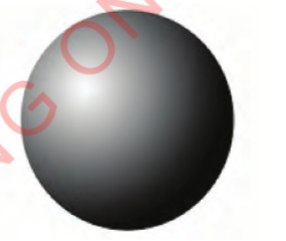
About the year 400 B.C., a Greek philosopher known as Democritus was the first to consider the idea that matter is made up of particles. Such an idea was not accepted because there was no experimental evidence to support it. About 2000 years later, an English man called John Dalton revived the discussion. He used experimental evidence to convince people that matter is made up of particles called atoms. Through that experiment, he deduced Dalton’s spherical model of an atom shown in Figure 1.1. Dalton’s discovery helped scientists understand chemical reactions and how substances combine.
|
Figure 1.1: Dalton’s model of the atom |
Dalton atomic theory
In 1803, Dalton developed the theory about the atom. The four main points (assumptions) of Dalton’s Atomic Theory are summarised as follows:
1. Matter is made up of tiny particles called atoms. (The word atom means ‘indivisible’ in Greek.)
2. Atoms can neither be created nor destroyed.
3. Atoms of the same element are identical and have the same mass and properties. Atoms of a given element are different from those of any other element. Atoms of different elements can be distinguished from one another by their respective relative weights.
4. Compounds are formed by a combination of two or more different kinds of atoms. Atoms combine in simple whole number ratios.
Dalton never imagined that anyone would ever be able to see an atom. However, modern technology has provided direct evidence that shows the positions and patterns of individual atoms. The use of modern technology has enabled scientists to carry out experiments on the atom that Dalton could not. This has led to slight modifications to Dalton’s Atomic Theory and thus formulated the so-called modern concepts of Dalton’s Atomic Theory.
These modifications include the following:
1. Atoms can be either created or destroyed by means of nuclear reactions. The atom can change from through special processes such as nuclear fission (combining the atomic nuclei) or nuclear fission (splitting the atomic nucleus). For example, an atom of uranium-235 can be split into two separate atoms.
2. Some elements have atoms of more than one kind which differ slightly in mass. Such atoms are called isotopes. For example, carbon has three isotopes known as carbon-12, carbon-13, and carbon-14.
3. An atom is made up of smaller sub-atomic particles called protons, neutrons, and electrons.
4. Atoms of different elements may chemically combine in many different ratios to form compounds.
The modern atomic theory builds on Dalton’s original ideas by recognising sub-atomic particles, isotopes, and nuclear reactions while retaining the idea of chemical combinations and reactions. Dalton’s discovery thus helped scientists understand chemical reactions and how substances combine.
Sub-atomic particles
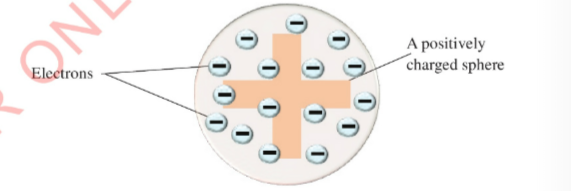
In 1897, J. J. Thomson carried out experiments and described an atom as a sphere of positive charge, with negative particles called electrons spread throughout the sphere. This model of the atom was referred to as a plum pudding model, as shown in Figure 1.2.
|
Figure 1.2: Thomson’s plum pudding model of the atom |
Thomson, however, managed to discover the electron among the three sub-atomic particles. His discovery led to inventions of electronic devices such as televisions, radios and computers. However, another scientist called Ernest Rutherford discovered that Thomson’s model was incorrect, then came up with a new and better model of the atom. He carried out experiments and discovered that most of the mass of an atom is concentrated in the nucleus (central core) of the atom. Within the nucleus, there are positively charged particles called protons. This was the second sub-atomic particle to be discovered. Rutherford’s discovery helped scientists discover nuclear energy used to produce electricity and in radiotherapy.
Rutherford’s findings are summarized as follows:
- Protons, the positively charged particles of an atom, are located in the nucleus.
- Most of the mass of the atom is located in the nucleus.
- The nucleus has a relatively smaller volume compared to the whole atom.
- Electrons have very small masses compared to the nucleus.
- Most of the space in an atom is empty.
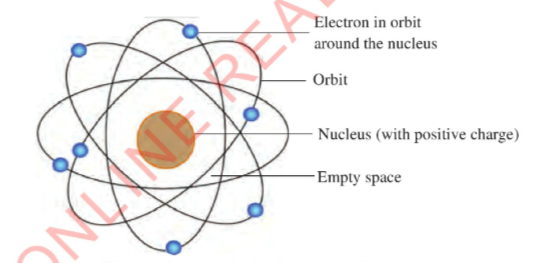
- Electrons are the negatively charged particles in an atom. They move around the nucleus in orbits.
| Rutherford developed the planetary model of the atom shown in Figure 1.3. |
|
Figure 1.3: Rutherford’s planetary model of the atom |
In 1932, a scientist named James Chadwick discovered the neutrons, which also forms part of the nucleus. Figure 1.4 shows the locations of neutrons and other sub-atomic particles in an atom. Neutrons have the same mass as protons but no charge. They are located in the nucleus of an atom. They were the third sub-atomic particles to be discovered. The Chadwick discoveries have made nuclear power possible, helping to produce electricity and develop medical treatments such as cancer therapy.
The properties of neutrons are summarised as follows:
1. They have no charge (are neutral).
2. They have nearly the same mass as the corresponding protons.
3. They have a mass nearly 1840 times the mass of an electron.
|
Figure 1.4: Locations of sub-atomic particles in an atom |
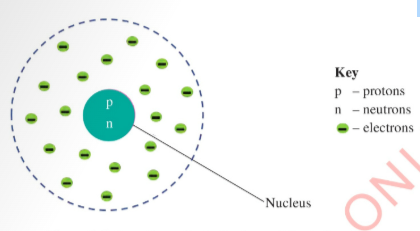
Table 1.1 summarises the properties of sub-atomic particles of an atom.
| Table 1.1: Properties of sub-atomic particles | |||||
| Sub-atomic particle | Symbol | Location | Charge | Real mass (kg) | Relative mass |
| Proton | | p⁺ | In the nucleus | +1 | 1.6726 × 10⁻²⁷ | 1 |
| Neutron | n | In the nucleus | 0 | 1.6750 × 10⁻²⁷ | 1 |
| Electron | e⁻ | Outside the nucleus | -1 | 9.109 × 10⁻³¹ | 1/1840 |
Activity 1.1
Aim: To build a 3D atomic model of carbon
Requirements: Six medium-sized red beads and white beads, small-sized black beads, cardboard, clear glue and string or wire
Procedure
- Build the nucleus by randomly arranging six red beads (protons) and six white beads (neutrons). Then, stick them together using glue to form a tight cluster at the centre.
- Create two circular loops of varying lengths of string or wire to represent the electron shells. Attach two black beads (electrons) on the first shell, and four black beads on the second shell. Ensure they are glued and evenly spaced on the string loops.
- Label the model and attach the entire model to a cardboard base for stability.
Questions
- Why are the electrons arranged in different shells?
- If one more proton is added to the nucleus of this atomic model, would it still be a carbon atom? Explain.
- Why were different colours used for protons, neutrons and electrons in the model?
Electronic arrangement
Task 1.3
Use a reliable interactive simulation to visualise the arrangements of electrons in an atom and explain how the electrons are arranged.
In 1913, Niels Bohr suggested that electrons rotate around the nucleus in special regions called shells or orbits. These shells (also known as energy levels) are at fixed distances from the nucleus. Each shell can only hold a specific number of electrons. The maximum number of electrons held within a shell can be determined by the formula 2n², where n is the position of the shell from the nucleus. This gives the formula:
first shell can hold (2 × 1²) = 2 electrons;
second shell can hold (2 × 2²) = 8 electrons; and
third shell can hold (2 × 3²) = 18 electrons.
The first four shells are represented by the letters K, L, M, and N, respectively as shown in Figure 1.5. Each electron in an atom is in a particular shell and the electrons must first occupy the lowest available shell nearest to the nucleus.
|
Figure 1.5: First four shells of an atom |
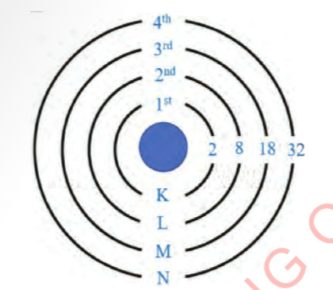
For reasons beyond the scope of this book, the 3rd shell is more stable with 8 electrons. This is why even though the 3rd shell can hold up to 18 electrons, potassium element which has 19 electrons has only 8 electrons in its 3rd shell, and the last electron moves to the 4th shell. This is the same for calcium which has 20 electrons, where the last two electrons move to the 4th shell after the 3rd shell is completely filled with 8 electrons.
A shell which contains its maximum number of electrons is called a fully-filled shell. An atom with fully-filled outermost shell is said to be stable. Some atoms hold a maximum of 2 electrons (helium) or 8 electrons (neon) in their outermost shell. The elements with a maximum of 2 electrons in their outermost shells are said to exhibit a duplet state, while those with 8 electrons are said to exhibit an octet state. Electrons are arranged so that the lowest shells are filled first. This arrangement of electrons in different shells in an atom is called electronic configuration. Figure 1.6 shows the diagrammatic electronic configurations of hydrogen, helium, neon, potassium, and sulfur atoms.
|
Figure 1.6: Electronic configurations of some elements |
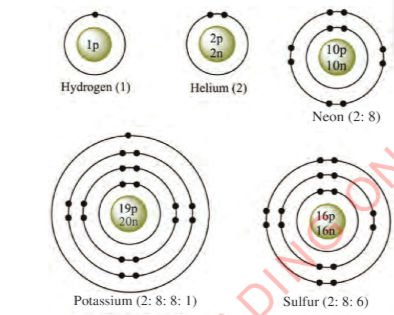
Note that the hydrogen atom has no neutron in its nucleus. Helium and neon atoms have their outermost shells completely filled with electrons, and so they are stable atoms. The electrons are not fixed at particular positions within the shell. Instead, these move extremely fast and can be at any point within the shell.
Bohr’s findings provided more information about elements that are summarised in a table called the periodic table (Appendix 1). The electronic arrangements of the first 20 elements are shown in Table 1.2.
Exercise 1.1
- How did the discovery of the nucleus refine earlier atomic models?
- Why are atoms considered electrically neutral under normal conditions?
- Compare the Rutherford atomic model with the Bohr atomic model.
- The atomic number is unique for each element in the periodic table. Explain.
Table 1.2: Electronic arrangements of the first 20 elements
| Element | Chemical symbol | Number of electrons | Number of electrons in each shell | Electronic configuration (arrangement) | |||
|---|---|---|---|---|---|---|---|
| 1st | 2nd | 3rd | 4th | ||||
| Hydrogen | H | 1 | 1 | 1 | |||
| Helium | He | 2 | 2 | 2 | |||
| Lithium | Li | 3 | 2 | 1 | 2:1 | ||
| Beryllium | Be | 4 | 2 | 2 | 2:2 | ||
| Boron | B | 5 | 2 | 3 | 2:3 | ||
| Carbon | C | 6 | 2 | 4 | 2:4 | ||
| Nitrogen | N | 7 | 2 | 5 | 2:5 | ||
| Oxygen | O | 8 | 2 | 6 | 2:6 | ||
| Fluorine | F | 9 | 2 | 7 | 2:7 | ||
| Neon | Ne | 10 | 2 | 8 | 2:8 | ||
| Sodium | Na | 11 | 2 | 8 | 1 | 2:8:1 | |
| Magnesium | Mg | 12 | 2 | 8 | 2 | 2:8:2 | |
| Aluminium | Al | 13 | 2 | 8 | 3 | 2:8:3 | |
| Silicon | Si | 14 | 2 | 8 | 4 | 2:8:4 | |
| Phosphorus | P | 15 | 2 | 8 | 5 | 2:8:5 | |
| Sulfur | S | 16 | 2 | 8 | 6 | 2:8:6 | |
| Chlorine | Cl | 17 | 2 | 8 | 7 | 2:8:7 | |
| Argon | Ar | 18 | 2 | 8 | 8 | 2:8:8 | |
| Potassium | K | 19 | 2 | 8 | 8 | 1 | 2:8:8:1 |
| Calcium | Ca | 20 | 2 | 8 | 8 | 2 | 2:8:8:2 |
Task 1.4
Use drawings or cut-out pictures to represent different atomic models (Dalton's solid sphere, Thomson's plum pudding, Rutherford's nucleus and Bohr's orbits). Arrange the pictures in an order. Then, write one simple fact about each model.
Determination of atomic number and mass number
Task 1.5
Access an online simulation on how to build an atom. Explore the simulation by adding protons, neutrons, and electrons to form different elements. Observe changes in atomic number, atomic mass, and stability of the atoms.
The sub-atomic particles of an atom, namely protons, neutrons, and electrons, relate to the atomic number and mass number of the atom.
Atomic number
The atomic number is the number of protons in an atom. It is also known as the proton number. For example, the atomic number of hydrogen is 1 since it has only one proton. A sodium atom has 11 protons in the nucleus; therefore, its atomic number is 11. Since the number of protons is equal to the number of electrons in the neutral atom, its atomic number is not only the number of protons but it is also the number of electrons.
Therefore, for the neutral atoms:
Atomic number = Number of protons = Number of electrons
Mass number
Protons and neutrons are found in the nucleus of an atom and are called nucleons. The sum of the protons and neutrons in one atom of an element is called the mass number or nucleon number or atomic mass. This number is actually taken as the mass of the atom since the mass of the electron is negligible.
Thus,
Number of protons + Number of neutrons = Mass number
For example:
(i) Hydrogen has 1 proton and 0 neutrons. Therefore, its atomic number is 1, and mass number is 1 + 0 = 1.
(ii) Boron has 5 protons and 6 neutrons. Its atomic number is 5 and mass number is 5 + 6 = 11.
(iii) Nitrogen has 7 protons and 7 neutrons. Its atomic number is 7 and mass number is 7 + 7 = 14.
It is also possible to calculate the number of neutrons and number of electrons of an atom if its mass number and atomic number are given.
Example 1.1
Atom Q has a mass number of 49 and an atomic number of 24. Calculate the number of neutrons and the number of electrons of atom Q.
Solution
Mass number = 49; atomic number = 24
(a) Neutron number = mass number − atomic number = 49 − 24 = 25
(b) Number of electrons = number of protons = atomic number = 24
Note: For the mass number with fractions, such as chlorine (35.5), calculating the number of neutrons and electrons involves only a whole number. In this case, for chlorine, 35 is used.
Nuclide notation
Atoms of different elements can be represented by chemical symbols that indicate their respective atomic numbers and mass numbers. Using an arbitrary element X, the mass number (A) is placed on its upper left end, while its atomic number (Z) is placed on the lower left end. Thus, element X is represented as ⁴⁹₂₄X. This is known as the nuclide notation. The following are examples of nuclide representations of different atoms:
- Hydrogen ¹₁H
- Boron ¹¹₅B
- Nitrogen ¹⁴₇N
- Oxygen ¹⁶₈O
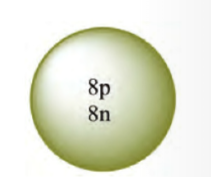
With this information, it is possible to calculate the number of neutrons and electrons in the atom, and to write the electronic configuration. For example, in the oxygen atom, the mass number is 16 and the atomic number is 8. Therefore, the number of electrons is 8 and the number of neutrons is 16 − 8 = 8. The nucleus of the oxygen atom can therefore be represented as shown in Figure 1.7
|
Figure 1.7: The nucleus of the oxygen atom |
Example 1.2
Potassium (K) atom has 19 electrons and the mass number of 39. Work out the:
(a) (i) atomic number, and
(ii) number of neutrons.
(b) Give the nuclide notation.
(c) Show the representation of the nucleus of the potassium atom.
(d) Draw the electronic configuration of potassium.
Solution
(a) (i) Atomic number = number of protons = number of electrons = 19
(ii) Mass number = number of protons + number of neutrons
Number of neutrons = mass number − number of protons
= 39 − 19
= 20
(b) ³⁹₁₉K; where 39 is the mass number and 19 the atomic number.
(c)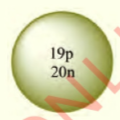
(d)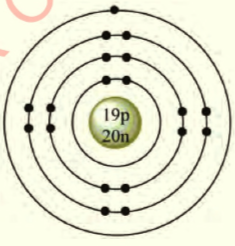
Isotopes
Task 1.6
Watch educational video on isotopes and explain the uses of isotopes in carbon dating, medicine and agriculture.
Atoms of the same element have the same number of protons. However, the number of neutrons in the atoms of the same element may vary. This leads to the existence of more than one kind of atoms that have different mass number but the same atomic number. Such atoms of an element are called isotopes. Isotopes are atoms of the same element that have the same number of protons but different number of neutrons. Another existence of the element is called isotopy. Isotopy is the existence of atoms of the same element having the same atomic number but different mass numbers. It is possible to get the number of sub-atomic particles in a given isotope.
Example 1.3
State the number of protons, neutrons and electrons in the following isotopes:
(a) ¹²₆C and ¹⁴₆C
(b) ¹₁H, ²₁H and ³₁H
Solution
(a) ¹²₆C. Mass number = 12
Number of protons = atomic number = 6
Number of electrons = number of protons = 6
Number of neutrons = 12 − 6 = 6
¹⁴₆C. Mass number = 14
Number of protons = 6
Number of electrons = 6
Number of neutrons = 14 − 6 = 8
(b) ¹₁H. Mass number = 1
Number of proton = 1
Number of electron = 1
Number of neutron = 1 − 1 = 0
²₁H. Mass number = 2
Number of proton = 1
Number of electron = 1
Number of neutron = 2 − 1 = 1
³₁H. Mass number = 3
Number of proton = 1
Number of electron = 1
Number of neutrons = 3 − 1 = 2
Example 1.4
An isotope of carbon has a mass number of 13 and an atomic number of 6.
(a) Write its nuclide notation.
(b) How many neutrons does it have?
(c) How many electrons does it have?
Solution
(a) ¹³₆C
(b) Number of neutrons = 13 − 6 = 7
(c) Number of electrons = atomic number = 6
Many elements that occur naturally usually display isotopy. The most abundant isotope of an element is taken to be the representative of that element. This abundance is usually given in percentage. Examples of common elements that display isotopy are hydrogen, oxygen, carbon, chlorine, nitrogen, and neon (Table 1.3).
Table 1.3: Examples of isotopes and their abundances
| Element | Chemical Symbol | Atomic Number | Isotopes | Abundance |
|---|---|---|---|---|
| Hydrogen | H | 1 | ¹H (protonium or hydrogen) | 99.99% |
| ²H (deuterium) | 0.01% | |||
| ³H (tritium) | Very rare | |||
| Carbon | C | 6 | ¹²C | 98.9% |
| ¹³C | 1.1% | |||
| ¹⁴C | Trace | |||
| Chlorine | Cl | 17 | ³⁵Cl | 75% |
| ³⁷Cl | 25% | |||
| Oxygen | O | 8 | ¹⁶O | 99.76% |
| ¹⁷O | 0.04% | |||
| ¹⁸O | 0.20% | |||
| Neon | Ne | 10 | ²⁰Ne | 90.5% |
| ²¹Ne | 0.3% | |||
| ²²Ne | 9.2% | |||
| Nitrogen | N | 7 | ¹⁴N | 99.6% |
| ¹⁵N | 0.4% | |||
| ¹³N | Very rare |
Applications of isotopes
Isotopes are special forms of elements that can be used in various areas, including research, medicine, industry, and agriculture. Some isotopes are radioactive. Radioactive isotopes are special types of atoms that give off energy called radiation. Even though the emitted radiations are dangerous if not handled properly, these isotopes are very useful in many ways. Scientists use these isotopes in various applications, including determining the age of ancient objects using carbon-14, treating diseases in hospitals, tracking how plants absorb nutrients in the soil, and producing electricity for everyday uses.
Carbon dating: Finding the age of ancient items
Scientists use carbon-14 to determine the age of ancient objects. Carbon-14 is a radioactive isotope of carbon that slowly breaks down over time. When a plant or animal dies, it stops taking in carbon-14 from the air. Scientists measure how much carbon-14 is left in bones, wood, or fossils to estimate the number of years that have passed since the organism died. Carbon dating helps archaeologists and historians learn about the past, including the age of ancient human tools, animal fossils, and historical items.
Tracers in medicine, industry, and agriculture
Some radioactive isotopes are used as tracers that help scientists track movements or processes inside the body, in the environment, or in industrial systems.
(a) Medicine: Diagnosing and treating diseases
Iodine-131 is used in hospitals to check how the thyroid gland works. When a small dose of iodine-131 is administered to a patient, the radiation emitted by the iodine helps to create images of the thyroid. Special machines detect the radiation to help diagnose thyroid problems. The radiation also helps to shrink or destroy damaged thyroids cells leading to the treatment of thyroid related diseases.
(b) Agriculture: Studying how plants absorb nutrients
Phosphorus-32 is used to track how plants take in nutrients from the soil. Scientists use it to improve fertilisers and help farmers grow healthier crops.
(c) Industrial and environmental applications
Some isotopes, such as tritium -3 tracks how water moves underground. This allows scientists to understand the sources of drinking water. Chlorine isotopes are used to study the movements of chlorine in water sources such as rivers, lakes, and underground water. Sodium-24 is used to detect leaks in underground pipes. This isotope is made artificially.
Exercise 1.2
1. Complete the following table by filling in the number of protons, electrons, and neutrons of the atoms. The atomic numbers and mass numbers are given.
| Atom | Atomic number | Mass number | Protons | Electrons | Neutrons |
| Sodium | 11 | 23 | |||
| Oxygen | 8 | 16 | |||
| Beryllium | 4 | 9 | |||
| Fluorine | 9 | 19 |
2. An atom has 10 electrons.
- Show how these electrons would be arranged in the shells around the nucleus.
- Why is it important to know the arrangement of electrons around the nucleus?
3. Carbon has multiple atomic masses, carbon-12, carbon-13 and carbon-14. Why do these forms of carbon have different mass numbers and still belong to the same element?
4. How are isotopes identified based on their atomic number and mass number?
5. Provide two ways in which the knowledge of atomic numbers is useful in chemistry.
6. Write the nuclide notation of an atom with 7 protons, 7 neutrons, and 7 electrons and explain its significance.
7. Isotopes of an element are chemically identical but physically different. Explain.
Relative atomic mass
Task 1.7
Conduct a library search to find the differences between atomic mass and relative atomic mass.
An atom is very small and it would be difficult to measure its actual mass. To overcome this difficulty, chemists developed a simpler way to express the mass of an atom. This involved expressing the mass of an atom in relation to a chosen standard atomic mass. The mass of carbon atom was chosen as the standard atom (reference atom) and its mass was arbitrarily chosen as 12 units (not actual value). Then, using an instrument called a mass spectrometer, all the other atoms were compared to this standard atom. This reference is called the Carbon-12 scale. For example, it was found that:
- magnesium atom was twice as heavy as the reference atom, so its mass was put at 24.
- hydrogen atom was 1/12 as heavy as the reference atom, so its mass was put at 1.
- helium atom was 1/3 as heavy as the reference atom, so its mass was put at 4.
The mass of an atom obtained by comparing it with the arbitrary mass of a carbon-12 atom is called its relative atomic mass (R.A.M or Aᵣ). The relative atomic mass of an element is the average mass of one atom of the element relative to 1/12 the mass of one atom of carbon-12. Therefore, R.A.M may not necessarily be a whole number.
That is,
A=Average mass of atom of an element/1/12 the mass of carbon-12 atom
Table 1.4 gives the atomic numbers and relative atomic masses of the first 20 elements in the periodic table. The relative atomic masses of such elements are obtained by calculating the average mass of all the isotopes of each element.
For isotopic elements, the relative atomic mass (R.A.M) can be calculated using the following formula:
Relative atomic mass (R.A.M.) = Σ isotopic mass × percentage abundance
Note: Σ = Summation
Table 1.4: Atomic numbers and relative atomic masses of some elements
| Element | Atomic number | Relative atomic mass |
| Hydrogen | 1 | 1 |
| Helium | 2 | 4 |
| Lithium | 3 | 6.9 |
| Beryllium | 4 | 9 |
| Boron | 5 | 10.8 |
| Carbon | 6 | 12 |
| Nitrogen | 7 | 14 |
| Oxygen | 8 | 16 |
| Fluorine | 9 | 19 |
| Neon | 10 | 20.2 |
| Sodium | 11 | 23 |
| Magnesium | 12 | 24.3 |
| Aluminium | 13 | 27 |
| Silicon | 14 | 28.1 |
| Phosphorus | 15 | 31 |
| Sulfur | 16 | 32 |
| Chlorine | 17 | 35.5 |
| Argon | 18 | 39.9 |
| Potassium | 19 | 39.1 |
| Calcium | 20 | 40.1 |
Example 1.5
Chlorine has two isotopes:
³⁵Cl (75%) and ³⁷Cl (25%)
The relative atomic mass of chlorine is:
= (35 × 75/100) + (37 × 25/100)
= 2625 + 925 / 100
= 3550 / 100 = 35.5
(b) Neon has three isotopes:
²⁰Ne (90.5%), ²¹Ne (0.3%), ²²Ne (9.2%)
The relative atomic mass of neon is:
= (20 × 90.5/100) + (21 × 0.3/100) + (22 × 9.2/100)
= 1810 + 6.3 + 202.4 / 100
= 2018.7 / 100
= 20.187
It can be noted that for both chlorine and neon, the R.A.M. is very close to the mass number of the isotope with the highest abundance, namely ³⁵Cl and ²⁰Ne respectively.
Chapter Summary
1. An atom is the smallest particle of an element. It can only be split or destroyed by nuclear reactions.
2. There are three major sub-atomic particles, namely:
(a) protons (positively charged),
(b) neutrons (neutral), and
(c) electrons (negatively charged).
3. Protons and neutrons are located in the nucleus of an atom while electrons are found in the shells or energy levels around the nucleus.
4. The arrangement of electrons in different shells of an atom is known as electronic arrangement or electronic configuration.
5. Each shell can contain only a certain number of electrons, with the maximum being 2n², where n is the position of the shell from the nucleus.
6. For any neutral atom of an element:
Number of protons = atomic number
Number of electrons = number of protons = atomic number
Number of neutrons = mass number – atomic number
7. Isotopes are atoms of the same element with the same number of protons but different number of neutrons.
8. The relative atomic mass of an element is the average mass of one atom of the element relative to 1/12 the mass of one carbon-12 atom.
www.learninghubtz.co.tz
Revision exercise 1
1. Choose the correct answer for Questions 1(i)–(viii). For other questions, provide the answers as per the demands indicated.
(i). Which description corresponds to a proton?
- Relative mass = 1, charge = +1
- Relative mass = 1, charge = 0
- Relative mass = 1/1840, charge = –1
- Relative mass = 4, charge = +2
(ii). What are nucleons?
- Neutrons and electrons
- Neutrons and protons
- Electrons and protons
- Protons, neutrons and electrons
(iii) Which atomic property is the basis for the use of carbon-14 in archaeology for dating ancient objects?
- Electronic configuration
- Radioactive decay
- Atomic mass
- Relative atomic mass
(iv) Most atoms are neutral because they have
- nucleus which is only made up of neutrons.
- equal numbers of electrons and protons in the shells.
- neutrons with zero charge.
- the number of electrons which balance out the number of protons in the atom.
(v) Which of these statements is true about isotopes of an element?
- Contain the same number of protons, but different number of neutrons.
- The number of neutrons is the same, but the number of protons is different.
- Proton and neutron numbers are the same, but those of electrons are different.
- Electrons are added to the nucleus, with the same number of protons.
(vi) Which sub-atomic particles are equal in number to protons in a neutral atom?
- Electrons
- Neutrons
- Protons of its ion
- Neutrons of its ion
(vii) The atomic number of an element T is 9. What is its electronic configuration?
- 2:4:3
- 2:5:2
- 2:7
- 2:6:1
(viii) In medical diagnosis and treatment, isotopes are used in
- detecting malaria parasites by using special scans.
- using radioactive tracers for imaging and treating cancer.
- treating typhoid infections by using antibiotics.
- determining a patient’s age by checking body cells.
2. Copy the following table and fill the missing details of the arbitrary elements given.
| Element | Atomic Number | Mass Number | Number of Protons | Number of Electrons | Electronic Configuration |
|---|---|---|---|---|---|
| P | 17 | 35 | |||
| Q | 40 | 20 | |||
| R | 12 | 2:4 | |||
| S | 19 | 4 | |||
| T | 3 | 7 | |||
| U | 23 | 2:8:1 | |||
| V | 31 | 15 |
3. State the number of protons, neutrons and electrons in the following atoms:
(a) ²³₁₁Na
(b) ⁵⁶₂₆Fe
4. An isotope of neon has a mass number of 21 and an atomic number of 10.
(a) Write its nuclide notation.
(b) How many neutrons does it have?
(c) How many electrons does it have?
5. A sugar grain is made up of several atoms. Explain.
6. From O-level science argue that atoms are visible to the naked eye because all objects are made of atoms. Explain this misconception using the atomic theory.
7. Medical doctors sometimes use X-rays to view patients’ bodies. These rays interact mainly with atoms in the patient’s bones.
(a) Which sub-atomic particle is responsible for this interaction?
(b) Why do you think this particle is important in medical imaging?
8. Describe the role of carbon-14 in determining the age of fossils.
9. Why are the relative atomic masses of elements rarely whole numbers?
10. Why is the relative atomic mass considered more practical than actual atomic mass?

Hub App
 For Call,Sms&WhatsApp: 255769929722 / 255754805256
For Call,Sms&WhatsApp: 255769929722 / 255754805256  MATOKEO YA KIDATO CHA VI 2026
SECONDARY REGIONAL EXAMS
PRIMARY REGIONAL EXAMS
FORM VI NECTA REVIEWS
FORM IV NECTA REVIEWS
FORM II NECTA REVIEWS
STD VII NECTA REVIEWS
STD IV NECTA REVIEWS
SECONDARY EXAMS SERIES
PRIMARY EXAMS SERIES
PRIMARY SUBJECT NOTES
SECONDARY SUBJECT NOTES
SECONDARY TOPICAL EXAMS
SECONDARY TOPICAL QUESTIONS
PRIMARY TOPICAL QUESTIONS
PRACTICAL EXAMS & NOTES
SECONDARY REGIONAL EXAMS
DOWNLOAD SUBJECT NOTES
SCHEMES OF WORK (PRIMARY & SECONDARY)
LESSON PLAN
SECONDARY LOG BOOKS
PRIMARY LOG BOOKS
LITERARY WORKS / UCHAMBUZI VITABU
METHALI ZOTE ZA KISWAHILI
Vitendawili Vya Kiswahili
FORM VI RESULTS 2024
FORM FIVE SELECTION 2024
Matokeo KIDATO CHA II 2024
Matokeo Darasa IV 2024
MATOKEO KIDATO CHA IV 2023
FORM ONE SELECTION 2024
FORM VI RESULTS 2023
Matokeo Darasa IV 2022
MATOKEO YA KIDATO CHA VI 2026
SECONDARY REGIONAL EXAMS
PRIMARY REGIONAL EXAMS
FORM VI NECTA REVIEWS
FORM IV NECTA REVIEWS
FORM II NECTA REVIEWS
STD VII NECTA REVIEWS
STD IV NECTA REVIEWS
SECONDARY EXAMS SERIES
PRIMARY EXAMS SERIES
PRIMARY SUBJECT NOTES
SECONDARY SUBJECT NOTES
SECONDARY TOPICAL EXAMS
SECONDARY TOPICAL QUESTIONS
PRIMARY TOPICAL QUESTIONS
PRACTICAL EXAMS & NOTES
SECONDARY REGIONAL EXAMS
DOWNLOAD SUBJECT NOTES
SCHEMES OF WORK (PRIMARY & SECONDARY)
LESSON PLAN
SECONDARY LOG BOOKS
PRIMARY LOG BOOKS
LITERARY WORKS / UCHAMBUZI VITABU
METHALI ZOTE ZA KISWAHILI
Vitendawili Vya Kiswahili
FORM VI RESULTS 2024
FORM FIVE SELECTION 2024
Matokeo KIDATO CHA II 2024
Matokeo Darasa IV 2024
MATOKEO KIDATO CHA IV 2023
FORM ONE SELECTION 2024
FORM VI RESULTS 2023
Matokeo Darasa IV 2022
WHATSAPP US NOW FOR ANY QUERY
App Ya Learning Hub Tanzania