PRIME MINISTER'S OFFICE, REGIONAL ADMINISTRATION AND LOCAL GOVERNMENT
FORM ONE MIDTERM EXAMINATION
025 BOOK-KEEPING
Time: 2:30 Hours Aug./ Sept., 2026
Instructions
- This paper consist of section A, B and C with a total of nine (9)questions.
- Answer all questions in the space provided
- Section A carries fifteen (15)marks, section B forty (40)marks and section C carries forty five (45) marks.
- All writing must be in blue or black ink
- Non programmable calculators may be used.
- Cellular phones and any unauthorized materials are not allowed in the assessment room
- Write your Assessment Number at the top right hand corner of every page.
| FOR EXAMINERS’ USE ONLY | ||
| QUESTION NUMBER | SCORE | EXAMINER’S INITIALS |
| 1. | ||
| 2. | ||
| 3. | ||
| 4. | ||
| 5. | ||
| 6. | ||
| 7. | ||
| 8. | ||
| 9. | ||
| TOTAL | ||
| CHECKER’S INITIALS | ||
SECTION A (15 Marks)
Answer all Questions from this section
1. In the following questions (i) to (x) choose the most correct answer from among the given alternatives writing it against the item number in your answer sheet.
i) Monica is wholesaler at Moshi. She decided to take TZS 2,400,000 from her business to pay school fees for her daughter. In bookkeeping this kind of act is termed as
- Increase of capital
- Misappropriation of funds
- Parental care
- Drawings
ii) Given that Total assets is TZS 1,250,000, and liabilities TZS 450,000. What will be the amount of owner’s equity?
- TZS 1,700,000
- TZS 700,000
- TZS 360,000
- TZS 800,000
iii) Sarah is recording a sales invoice issued to a customer for TZS 100,000. The customer will pay later. In which book of prime entry should Sarah record the sales invoice?
- Sales Journal
- Purchase Journal
- Cash Book
- General Journal
iv) Jackson bought a machine costing TZS 450,000 and made immediate settlement by cash. The two accounts involved in such transaction will be:
- Cash Account and Sales Account
- Purchases Account and Cash Account
- Machine Account and Cash Account
- Purchases Account and Bank account
v) Which of the following best describes the double-entry system of bookkeeping?
- Recording each transaction once
- Recording each transaction twice
- Recording each transaction in two different places
- Recording each transaction in the cash book only
vi) The term “journal entry” in bookkeeping refers to:
- Recording transactions in the general ledger
- A summary of all transactions
- The initial recording of a transaction in a journal
- Closing accounts at the end of the period
vii) The main book of account used for recording business transactions using double entry principle is called
- Cash book
- Bank account
- Ledger
- Journal
viii) Which among the following is not the objective of studying bookkeeping?
- To determine profit or loss of the business
- To control business
- To make fair tax assessment
- To be employed
ix) Which of the following is not correct?
- Assets – Liabilities = Capital
- Capital – Liabilities = Assets
- Assets – Capital = Liabilities
- Capital + Liabilities = Assets
x) Which among the following transactions cannot be classified as purchases in the business?
- Bought goods at TZS 200,000 by cheque
- Bought furniture for use in the business at TZS 450,000
- Bought goods on credit from a Trader at TZS 340,000
- Purchased 20 boxes of pens @ TZS 10,000 for reselling at TZS 500 a pen.
Answers
| i | ii | iii | iv | v | vi | vii | viii | ix | x |
| . |
2. Match the books of prime entry items from (i – v) in List A against corresponding items in List B
| LIST A | LIST B |
|
|
Answers
| List A | i | ii | iii | iv | v |
| List B |
SECTION B (40 Marks)
Answer All Questions
3. Define the following terms
- Book-keeping
- Double entry principles
- Books of Prime entry
- Source Documents
- Drawings
4. You are provided with the following cash transactions of Mr. Chacha, a retailer, for the month of March 2025. Identify account to debit and account to credit
| DATE | TRANSACTION DESCRIPTION | ACCOUNT TO DEBIT | ACCOUNT TO CREDIT |
| Mar 1 | Started business with Cash TZS 300,000 | ||
| Mar 2 | Bought goods for TZS 90,000bycheque | ||
| Mar 4 | Sold goods for cash TZS 130,000 | ||
| Mar 6 | Paid wages TZS 40,000 | ||
| Mar 8 | Received cheque fromAzizaTZS 50,000 | ||
| Mar 10 | Paid for transport TZS 20,000bycheque | ||
| Mar 15 | Withdrew TZS 50,000 cash for personal use | ||
| Mar 17 | Received cash from Salum TZS 35,000 | ||
| Mar 22 | Paid cash to James TZS 60,000 | ||
| Mar 28 | Bought goods for cash TZS 15,000 |
5. Complete the following table of Asset, Liabilities and Capital.
| S/no. | Assets (TZS) | Liabilities (TZS) | Capital (TZS) |
| a) | 230,000 | _________________ | 36,000 |
| b) | _________________ | 408,000 | 220,000 |
| c) | 2,000,000 | 600,900 | _________________ |
| d) | _________________ | 70,300 | 100,000 |
| e) | 1,000,000 | _________________ | 458,400 |
6.Ngosha started a business at Gongolamboto Nature Streat in last two years.During his business activities as a wholesaler faced with so many complains from his client and mostly returned goods after purchasing.From his or her knowledge attained into form one class, what do you think the reasons behind the client of Ngosha returned goods after purchasing?Mention at least 5 reasons.
SECTION C (45 Marks)
Answer all questions from this Section
7. The following transactions were extracted from the books of Christina’s Shop during the month of December 2020.
| DEC | DETAILS |
| 2nd | Credit sales to Saraphina: 5 crates of soda @ TZS 12,000; 3 trays of eggs @ TZS 5,000 and 10 cartons of drinking water @ TZS 3,500. All goods were subject to 5% trade discounts. |
| 11th | Sold goods on credit to Rozalia: 10 boxes of Pen @ TZS 5,000; 15 boxes of table salts @ TZS 250 and 10 boxes of biscuits @ TZS 3,000. |
| 26th | Sold goods to Saraphina: 5 litres of milk @ TZS 500; and 13 kg of White flour @ TZS 1,400. All were subject to 10% trade discounts. |
Required:Prepare Sales Journal to record the given transactions.
8. Benson Enterprise made the following transactions during the month of October 2020.
| Date | Details | TZS |
| Oct 2nd | Cash in hand | 458,000 |
| Oct 3rd | Received cash from debtors | 26,000 |
| Oct 12th | Cash sales to date | 379,060 |
| Oct 16th | Cash purchases | 261,000 |
| Oct 18th | Cash sales | 160,000 |
| Oct 19th | Furniture bought on cash | 210,000 |
| Oct 20th | Paid insurance | 300,000 |
| Oct 21st | Purchased goods | 160,000 |
| Oct 22nd | Cash sales | 288,000 |
| Oct 26th | Bought Motor Van | 450,000 |
| Oct 26th | Paid rent and rates | 40,000 |
| Oct 27th | Cash sales | 251,210 |
| Oct 28th | Bought furniture | 150,000 |
| Oct 29th | Paid tax | 50,000 |
| Oct 30th | Paid business license | 36,000 |
- Open up a single column cash book and balance it as at the end of the month
9. Below are cash transactions recorded by Ujenzi Traders during May 2025:
- May 1: Started the business with TZS 3,500,000 in cash.
- May 3: Bought goods for, TZS 1,200,000 in cash.
- May 5: Paid wages in cash, TZS 250,000.
- May 7: Sold goods for cash, TZS 1,100,000.
- May 10: Bought a computer in cash, TZS 700,000.
- May 13: Paid for rent, TZS 180,000 by cheque.
- May 15: Sold goods for cash, TZS 950,000.
- May 18: Paid salaries in cash, TZS 400,000.
- May 21: Bought more goods TZS 600,000 by cheque.
- May 25: Sold goods and received cheque of TZS 850,000.
Required:Prepare the journal entries to record the above transactions of Ujenzi Traders.
FORM ONE BKEEPING EXAM SERIES 298
FORM ONE BKEEPING EXAM SERIES 298

 3.
3.

FORM ONE BKEEPING EXAM SERIES 210
FORM ONE BKEEPING EXAM SERIES 210
PRESIDENT OFFICE REGIONAL ADMINISTRATION
AND LOCAL GOVERNMENT
SECONDARY EXAMINATION SERIES
COMPETENCE BASED ASSESSMENT
FORM ONE
MID TERM EXAMS-AUG– 2023
062 BOOK-KEEPING
Time: 2:00 Hours August, 2023
Instructions
- This paper consists of sections A, B and C with a total of nine (9) questions.
- Answer all questions.
- Sections carries fifteen (15) marks and B carries forty (40) marks and Section C carries forty-five (45) marks.
- All writings must be in blue or black ink.
- All answers A must be written in the spaces provided.
- Programmable calculators, cellular phones and any unauthorized materials are not allowed in examination room.
SECTION A (15 Marks)
Answer all questions in this section.
- For each of the items (i) – (x), choose the correct answer from among the given alternatives and write its letter in the box provided:
- Form one students were arguing on which primary and basic objective of preparing a trial balance is. Which of the following uses is the basic purpose of preparing a trial balance?
- A trial balance is used as a tool for preparing financial statements
- A trial balance is used to check arithmetical accuracy of double entry
- A trial balance is used to present a list of balances at one place
- A trial balance is used to determine profit or loss of a business
- On 20th July, 2023, Nathan, a sole trader purchased a machinery for cash paying TZS 3,500,000/=. What would be a double entry for this transaction?
- Debit: Cash account, Credit: Machinery account
- Debit: Purchases account, Credit: Machinery
- Debit: Machinery account, Credit: Purchases account
- Debit: Machinery account, Credit: Cash account
- The debit side of the cash account is used to:
- Record amount received in the business
- Record amount of capital
- Record amount paid out of the business
- Recording amount of goods sold on credit
- What is meant by book keeping?
- An art of recording business transactions
- An art of recording cash transactions
- An art of recording bank transactions
- An art of recording credit transactions
- Which of the following is the objective of book keeping?
- Bridge the gap between buyer and seller
- Fair tax assessment
- Paying tax to the government
- Creation of employment
- Posting the transactions in book keeping means:
- Making the first entry of double entry transaction
- Entering items in cash book
- Making the second entry of a double entry
- Recording a transaction once
- ______________ are the books under which the transactions are entered before being posted to their respective ledgers.
- Accounts
- Subsidiary books
- Cash books
- Ledger books
- “A company does not include the value of skills gained by its employees from training programs in its financial records.” Which accounting concept is applied?
- Dual aspect concept
- Matching concept
- Money measurement concept
- Business entity concept
- A subsidiary book that records transactions that owing to their nature are inadmissible to any other book of prime entry is:
- General journal
- Sales day book
- Purchases journal
- Cash book
- _________ is a principle of book keeping which calls for “every business transaction must be recorded twice:
- Journalizing
- Double entry
- Posting
- Trial balance
- Match the items in Column A with the responses in Column B by writing the letter of the correct responses below the corresponding item number in the table provided:
| Column A | Column B |
|
|
SECTION B (40 Marks)
Answer all questions in this section.
- Complete the following table by identifying the account to be credited and debited as well:
| S/N | Transactions | Account to be debited | Account to be credited |
| i | Cash paid to Rahima |
|
|
| ii | A payment of rent by cash |
|
|
| iii | Sales of goods to Mtumzima |
|
|
| iv | Cash received from Julius |
|
|
| v | Purchased goods for cash |
|
|
- Use the knowledge of accounting equation to fill in the gap in the following table
| S/N | ASSETS | CAPITAL | LIABILITIES |
| i | TZS 3,500,000 | TZS 1,700,000 | TZS __________ |
| ii | TZS ___________ | TZS 8,000,000 | TZS 4,100,000 |
| iii | TZS 4,900,000 | TZS _________ | TZS 2,100,500 |
| iv | TZS25,600,000 | TZS 17,900,000 | TZS __________ |
| v | TZS ____________ | TZS 15,500,000 | TZS 3,400,000 |
- Briefly describe the meaning of the following terms as used in book keeping
- Trial balance
________________________________________________________________________________________________________________________________________________________________________________________________________________________________________________________________________________________________
- Book keeping
________________________________________________________________________________________________________________________________________________________________________________________________________________________________________________________________________________________________
- Credit transaction
________________________________________________________________________________________________________________________________________________________________________________________________________________________________________________________________________________________________
- Sales day book
________________________________________________________________________________________________________________________________________________________________________________________________________________________
- Capital
________________________________________________________________________________________________________________________________________________________________________________________________________________________________________________________________________________________________
- Complete the table below by indicating whether the accounts are Nominal account, Real account or Personal account:
| S/N | Name of accounts | Classification |
| i | Building account |
|
| ii | Advertising account |
|
| iii | Noreen account |
|
| iv | Furniture account |
|
| v | Mtumzima enterprises account |
|
| vi | Capital account |
|
| vii | Motor car account |
|
| viii | Sales account |
|
| ix | Salaries and wages account |
|
| x | Abdul-Karim account |
|
SECTION C (45 Marks)
Answer all questions in this section.
- MTUMZIMA, a wholesaler, made the following credit purchases during the month of April 2023:
April 1. Bought goods on credit from Matheo Store:
10 Dozen of vitenge at TZS 80,000 a dozen
25 Dozen of khanga at TZS 100,000 dozen
April 5. Credit purchases from Joshua Suppliers:
12 Pairs of shoes at TZS 20,000 a pair.
20 Pairs of boots at TZS 30,000 a pair
April 12. Credit purchases from Emelda Shop:
70 Dozens of exercise books at TZS 30,000 a dozen
10 Reams of papers at TZS 25,000 each.
April 22: Credit purchases from Nuzart Book store:
20 Advanced leaner’s dictionaries at TZS 20,000 each.
80 Fiction books at TZS 5,000 each.
Record above transactions in the Purchases journal for the month of April 2023.
_____________________________________________________________________________________________________________________________________________________________________________________________________________________________________________________________________________________________________________________________________________________________________________________________________________________________________________________________________________________________________________________________________________________________________________________________________________________________________________________________________________________________________________________________________________________________________________________________________________________________________________________________________________________________________________________________________________________________________________________________________________________________________________________________________________________________________________________________________________________________________________________________________________________________________________________________________________________________________________________________________________________________________________________________________________________________________________________________________________________________________________________________________________________________________________________________________________________________________________________________________________________________________________________________________________________________________________________________________________________________________________________________________________________________________________________________________________________________________________________________________________________________________________________________________________________________________________________________________________________________________________________________________________________________________________________________________________________________________________________________________________________________________________________________________________________________________________________________________________________________________________________________________________________________________________________________________________________________________________________________________________________________________________________________________________________________________________________________________________________________________________________________________________________________________________________________________________________________________________________________________________________________________________________________________________________________________________________________________________________________________________________________________________________________________________________________________________________________________________________________________________________________________________________________________________________________________________
- On 1st Jan 2023, Brayden started a business with Capital TZS. 200,000 in cash:
TZS
Jan 2: Bought gods for cash __________________________ 25,000
Jan 3: Sold goods for cash ____________________________ 60,000
Jan 5: Purchased goods for cash _________________________20,000
Jan 8: Bought furniture for cash _________________________ 50,000
Jan 10: Paid advertising charges __________________________ 8,000
Jan 15: Sold goods for cash ______________________________ 72,000
Required:
Enter above transactions into a Cash Account, balance it and bring down the balance and complete a double entry
____________________________________________________________________________________________________________________________________________________________________________________________________________________________________________________________________________________________________________________________________________________________________________________________________________________________________________________________________________________________________________________________________________________________________________________________________________________________________________________________________________________________________________________________________________________________________________________________________________________________________________________________________________________________________________________________________________________________________________________________________________________________________________________________________________________________________________________________________________________________________________________________________________________________________________________________________________________________________________________________________________________________________________________________________________________________________________________________________________________________________________________________________________________________________________________________________________________________________________________________________________________________________________________________________________________________________________________________________________________________________________________________________________________________________________________________________________________________________________________________________________________________________________________________________________________________________________________________________________________________________________________________________________________________________________________________________________________________________________________________________________________________________________________________________________________________________________________________________________________________________________________________________________________________________________________________________________________________________________________________________________________________________________________________________________________________________________________________________________________________________________________________________________________________________________________________________________________________________________________________________________________________________________________________________________________________________________________________________________________________________________________From the following list of balances of Mtumzima Traders, prepare a trial balance as at 31st March, 2023.
|
| TZS |
| Capital | 70,000 |
| Stock at 1.4.2022 | 25,000 |
| Purchases | 55,000 |
| Sales | 80,000 |
| Insurance | 2,500 |
| Sundry Debtors | 12,000 |
| Creditors | 26,100 |
| Rent | 12,000 |
| Wages and Salaries | 18,000 |
| Motor car | 15,000 |
| Furniture | 10,000 |
| Insurance | 10,500 |
| Commission received | 4,500 |
| Cash at Bank | 20,600 |
|
|
|
________________________________________________________________________________________________________________________________________________________________________________________________________________________________________________________________________________________________________________________________________________________________________________________________________________________________________________________________________________________________________________________________________________________________________________________________________________________________________________________________________________________________________________________________________________________________________________________________________________________________________________________________________________________________________________________________________________________________________________________________________________________________________________________________________________________________________________________________________________________________________________________________________________________________________________________________________________________________________________________________________________________________________________________________________________________________________________________________________________________________________________________________________________________________________________________________________________________________________________________________________________________________________________________________________________________________________________________________________________________________________________________________________________________________________________________________________________________________________________________________________________________________________________________________________________________________________________________________________________________________________________________________________________________________________________________________________________________________________________________________________________________________________________________________________________________________________________________________________________________________________________________________________________________________________________________________________________________________________________________________________________________________________________________________________________________________________________________________________________________________________________________________________________________________________________________________________________________________________________________________________________________________________________________________________________________________________________________________________________________________________________________________________________________________________________________________________________________________________________________________________________________________________________________________________________________________________________________________________________________________________________________________________
Page 1 of 12
FORM ONE BKEEPING EXAM SERIES 146
FORM ONE BKEEPING EXAM SERIES 146
THE PRESIDENT’S OFFICE MINISTRY OF EDUCATION, REGIONAL ADMINISTRATION AND LOCAL GOVERNMENT
COMPETENCY BASED SECONDARY EXAMINATION SERIES
FORM THREE EXAMINATION
062 BOOK-KEEPING FORM ONE
 Time: 2:00 Hours 2022
Instructions
- This paper consists of Section A, B and C with a total of seven (07) questions.
- Answer ALL questions.
- All writing must be in blue or black ink except all drawings which must be in pencil.
- All answers must be written in the spaces provided.
- All unauthorized materials are not allowed in the examination room.
SECTION A (15 Marks)
Answer all questions in this section.
- For each of the items (i) – (x), choose the correct answer from among the given alternatives and write its letter in the box provided:
- Goods returned to a business of TZS 40,000/= by Reginald are recorded in:
- Purchases journal
- Purchases return journal
- Sales journal
- Sales returns journal
- Anna and Nathan were arguing on the primary and basic objectives of recording and keeping accurate financial information of daily business transactions in the books of accounts. Which one of the following is the objective of book-keeping in a business?
- Bridge the gap between buyer and seller
- Fair tax assessment.
- Paying tax to the government
- Creation of employment
- The debit side of a cash book is used to_________
-
Record amount cash received in the business - Record amount of capital
- Record amount of cash paid out of the business
- Recording amount of goods sold or bought on credit
- The act of recording transactions in any subsidiary books is called ________
- Posting
- Book keeping
- Accounting
- Journalizing
- The column in the account which is used to record pages of reference in the books of accounts is called:
- Details
- Amount
- Folio
- Particulars
- Susan bought goods costing TZS 200,000 on credit from Luis Suppliers. Therefore, Susan is a:
- Supplier
- Creditor
- Debtor
- Seller
- A systematic recording of business transactions is called __________
- Book keeping
- Double entry
-
Record keeping - Posting
- The column where the description of a transaction is recorded in the books of accounts is called:
- Details
- Amount
-
Folio - Particulars
- Franklin wants to start up a business dealing with Clothing Wholesale Store, but he does not have enough capital to commence his business. The following can be used as the sources of capital for his business Except:
- Money borrowed from bank
- Money saved for business start up
- Money saved for building a private house
- Cash received from sale of a private car
- If the Assets of the business amounted to TZS 85,000/= and Capital is TZS 60,000/= How much is the amount of Liabilities of the business?
- TZS 45,000/=
- TZS 145,000/=
- TZS 25,000/=
- TZS 85,000/=
- Match the items in Column A with the responses in Column B by writing the letter of the correct response below the corresponding item number in the table provided.
| COLUMN A | COLUMN B |
|
|
| Column A | i | ii | iii | iv | v |
| Column B |
SECTION B (40 Marks)
Answer all questions in this section.
- Gailynn is an international businessperson who imports goods from various nations, last week she received two boxes of Electronic equipments from China. Upon serious investigation, she decided to return some of the equipments back to her supplier.
In five (05) outline the reasons for this to happen.
- ______________________________________________________________________
- ______________________________________________________________________
- ______________________________________________________________________
- ______________________________________________________________________
- ______________________________________________________________________
- Mtumzima is a sole trader, owning a clothing wholesale store in Arusha. He is not knowledgeable of the source documents required to obtain the information which are used in preparation of the books of prime entry. Name five documents used as evidence of transactions in businesses.
- ______________________________________________________________________
- ______________________________________________________________________
- ______________________________________________________________________
- ______________________________________________________________________
- ______________________________________________________________________
- Accounting conceptsare the fundamental rules, ideas and assumptions needed in accounting and book keeping. They are fundamental rules that must be followed while recording transactions in the books of accounts. A clear disclosure must be made in the financial records if these rules are not followed. List down five (05) accounting concepts used in book keeping.
- ______________________________________________________________________
- ______________________________________________________________________
- ______________________________________________________________________
- ______________________________________________________________________
- ______________________________________________________________________
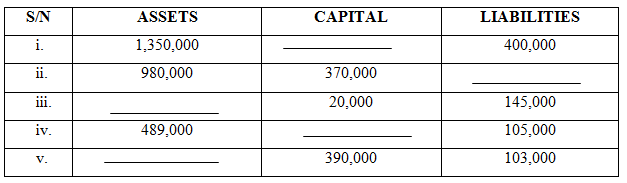
- Use the fundamental accounting equation to complete the table below:
SECTION C (45 Marks)
Answer all questions in this section.
- Gladness Suppliersmade the following credit sales during the month of March 2022.
March11: Sold to Diana Shop:
4 cartons of mango juice TZS 5,000/= each
6 cartons of apple juice TZS 4,000/= each
5 cartons of guava juice TZS 6,000/= each
March 22: Sold to Anneth traders:
10 pairs of socks TZS 3,000/= each
5 pairs of sandals TZS 10,000/= each
March 27: Sold to Felix Shop:
6 bags of wheat flour TZS 10,000/= each.
4 buckets of cooking oil TZS 20,000/= each
Required:
Record above transactions into a Sales day book and post to the respective ledgers.
- Rachel traders made the following transactions during the month of April 2022:
2022
1st April: Returns from Merry stores:
6 bags of salt @ 5,000, under weight
20 bags of sugar @ 7,500, expiry
10th April: Credit note from Nelson Suppliers:
5 boxes of cooking fats @ 17,000, Not suitable for consumption
10 pairs of sandals @ 65,000; wrong size
16th April: Sales returns from Dyness shop:
20 pairs of bed sheets @ 30,000, wrong colour
- T-Shirts @ 5,000; not up to sample ordered
Enter above transactions in the Sales returns day book.
- Princess, a wholesaler, made the following credit purchases during the month of April 2022:
April 1. Bought goods on credit from David Store:
10 Dozen of vitenge at TZS 8,000 a dozen
25 Dozen of khanga at TZS 10,000 dozen
April 5. Credit purchases from Joshua Suppliers:
12 Pairs of shoes at TZS 2,000 a pair.
20 Pairs of boots at TZS 3,000 a pair
April 12. Credit purchases from Dainess Shop:
70 Dozens of exercise books at TZS 3,000 a dozen
10 Reams of papers at TZS 15,000 each.
April 22: Credit purchases from Star Book store:
20 Advanced leaner’s dictionaries at TZS 2,500 each.
80 Fiction books at TZS 500 each.
Record above transactions in the Purchases journal for the month of April 2022.
Page 1 of 8
FORM ONE BKEEPING EXAM SERIES 107
FORM ONE BKEEPING EXAM SERIES 107

DOWNLOAD LEARNING HUB APP NOW

SORRY, YOU CAN'T VIEW THIS MARKING SCHEME PLEASE DOWNLOAD LEARNING HUB APP FROM PLAYSTORE TO GET FULL ACCESS TO ALL MARKING SCHEME!!
Click Here To Download Learning Hub Tanzania App
SAMAHANI, HUWEZI KUFUNGUA MAJIBU YA MTIHANI, TAFADHALI PAKUA APP YA LEARNING HUB TANZANIA ILI KUWEZA KUFUNGUA MAJIBU YA MITIHANI KATIKA TOVUTI HII!!
Bofya Hapa Kupakua App Ya Learning Hub Tanzania
Hub App
 For Call,Sms&WhatsApp: 255769929722 / 255754805256
For Call,Sms&WhatsApp: 255769929722 / 255754805256  MATOKEO YA KIDATO CHA VI 2026
SECONDARY REGIONAL EXAMS
PRIMARY REGIONAL EXAMS
FORM VI NECTA REVIEWS
FORM IV NECTA REVIEWS
FORM II NECTA REVIEWS
STD VII NECTA REVIEWS
STD IV NECTA REVIEWS
SECONDARY EXAMS SERIES
PRIMARY EXAMS SERIES
PRIMARY SUBJECT NOTES
SECONDARY SUBJECT NOTES
SECONDARY TOPICAL EXAMS
SECONDARY TOPICAL QUESTIONS
PRIMARY TOPICAL QUESTIONS
PRACTICAL EXAMS & NOTES
SECONDARY REGIONAL EXAMS
DOWNLOAD SUBJECT NOTES
SCHEMES OF WORK (PRIMARY & SECONDARY)
LESSON PLAN
SECONDARY LOG BOOKS
PRIMARY LOG BOOKS
LITERARY WORKS / UCHAMBUZI VITABU
METHALI ZOTE ZA KISWAHILI
Vitendawili Vya Kiswahili
FORM VI RESULTS 2024
FORM FIVE SELECTION 2024
Matokeo KIDATO CHA II 2024
Matokeo Darasa IV 2024
MATOKEO KIDATO CHA IV 2023
FORM ONE SELECTION 2024
FORM VI RESULTS 2023
Matokeo Darasa IV 2022
MATOKEO YA KIDATO CHA VI 2026
SECONDARY REGIONAL EXAMS
PRIMARY REGIONAL EXAMS
FORM VI NECTA REVIEWS
FORM IV NECTA REVIEWS
FORM II NECTA REVIEWS
STD VII NECTA REVIEWS
STD IV NECTA REVIEWS
SECONDARY EXAMS SERIES
PRIMARY EXAMS SERIES
PRIMARY SUBJECT NOTES
SECONDARY SUBJECT NOTES
SECONDARY TOPICAL EXAMS
SECONDARY TOPICAL QUESTIONS
PRIMARY TOPICAL QUESTIONS
PRACTICAL EXAMS & NOTES
SECONDARY REGIONAL EXAMS
DOWNLOAD SUBJECT NOTES
SCHEMES OF WORK (PRIMARY & SECONDARY)
LESSON PLAN
SECONDARY LOG BOOKS
PRIMARY LOG BOOKS
LITERARY WORKS / UCHAMBUZI VITABU
METHALI ZOTE ZA KISWAHILI
Vitendawili Vya Kiswahili
FORM VI RESULTS 2024
FORM FIVE SELECTION 2024
Matokeo KIDATO CHA II 2024
Matokeo Darasa IV 2024
MATOKEO KIDATO CHA IV 2023
FORM ONE SELECTION 2024
FORM VI RESULTS 2023
Matokeo Darasa IV 2022