Chapter 01 : Threats to world peace from the 17th to 19th centuries
| Introduction From the 17th to the 19th centuries, world peace was threatened by colonial ambitions, religious conflicts, the rise of nation-states, political revolutions, economic rivalries and human rights violations. In this chapter, you will learn about the concept and features of threats to world peace and security. You will also explore the major wars of the period and the new ideas as a result of the Great War. The competencies developed will enable you to apply preventive measures to maintain peace in today’s society. |
| Think A world driven and threatened by various dangers. |
Concept of threats to world peace and security
Threats to world peace and security from the 17th to the 19th centuries were dangers the capitalist world order faced as a result of conventional military confrontations. Capitalism emerged in the 15th century and became a global system by the 17th century. During this period, Western Europe witnessed the rise of nation-states that pursued both internal and external expansion to advance their national interests and maintain their identity. As a result, each nation-state developed its own strategies and means to pursue its national interests. This created competition among nation-states, threatening world peace and security. Traditional security threats were historically rooted in state-centred warfare. They ranged from religious persecution and territorial disputes to economic interests, conventional military conflicts and alliances. Traditional security threats posed to the state’s essential values: territorial integrity and sovereignty, nation-states developed military means, while diplomatic means, such as pacts and alliances, aimed to build strategic relations among states to address traditional security threats.
In essence, the traditional threats to world peace and security are rooted in the rise, development and consolidation of capitalism. For example, in its early phase, capitalism manifested as mercantilism. This was a policy practised by Western European nation-states from the 15th to the mid-18th centuries, based on trade, bullion and plunder with distant societies. A desire for expansion characterized the policy. This competitive drive for foreign expansion created clashes among capitalist powers in Europe, the New World, the Far East, and Africa. Under mercantilism, two forms of expansionism prevailed, namely domestic (at home) and external (outside Europe). The domestic expansionism involved the unification of kingdoms and the pacification of feudal states under absolute kings. The creation of larger political territories was associated with issues such as the adoption of uniform legal systems and standard weights, measures and laws. On the one hand, centralised administration, common taxation, and national defence evolved under capitalism. On the other hand, external expansionism involved the conquest, colonisation, and exploitation of the Americas by Spain, Portugal, England, France, and Holland in the 16th century. Western Europeans also expanded into Africa and Asia through trade, which involved the exchange of slaves, ivory, gold, and spices for European goods such as guns, wine, and clothing.
As previously mentioned, with the rise of nation-states in the 15th century, excessive nationalism and the pursuit of national interests were regarded as the primary objectives. The development of security strategies worldwide aimed to address various threats to national interests, both domestically and internationally, and to defend them against competition from other nations in this era of competition. The measures to safeguard national interests included naval and infantry forces, economic measures, and efforts to pursue political stability and power.
The rise of global powers such as Britain, France, Austria, Russia, Germany, and Italy in the 18th and 19th centuries led to the formation of military alliances to maintain sovereignty and balance power, preventing any single nation from becoming dominant. The global security system of the time was rooted in reality. That is, nations believed that no single nation could protect the national interests of other countries. They also believed that nations have distinct priorities and interests, thereby justifying different strategies to pursue them.
Features of threats to world peace and security
Threats to world peace and security have identifiable characteristics that clearly define the way and reasons for the rise of conflicts. The following are the main features of threats to world peace and security:
Conflict-inducing
Threats to peace typically give rise to violent or non-violent conflicts, whether between states, within societies, or among groups with competing interests. These conflicts may take the form of wars, uprisings, rebellions, civil wars, or insurgencies. For example, the Napoleonic Wars (1803–1815) destabilised much of continental Europe, causing widespread destruction, population displacement and shifts in political boundaries. Similarly, local uprisings against the imposition of colonial rule destabilised communities across Africa. For instance, Samori Touré’s fierce resistance to the French in West Africa (1882–1898) demonstrated that internal resistance can also threaten the peace of a broader region. These conflicts often arose over power, territorial control, or unresolved ownership of resources.
Global or regional impact
Some threats originated in one area but quickly spread to surrounding regions or even continents through alliances, trade, or colonial networks. European colonial expansion into the Americas, Africa and Asia disrupted local political systems, economies, and social structures. For instance, the American Revolution (1776–1783) inspired independence movements across Latin America, underscoring its far-reaching effects. Similarly, the competition for colonies among European powers during the Scramble for Africa in the late 19th century not only destabilised African societies but also created tensions among European nations and influenced global diplomacy and military developments.
Political and economic interests
The pursuit of political power, wealth, and control over strategic territories or resources has driven many past and present threats to peace. Mercantilism, imperialism and competition for colonies from the 17th to the 19th centuries exemplify this. For instance, the Napoleonic Wars were prompted by France’s desire for European dominance. In contrast, British-French rivalries in India and Africa were motivated by competition for control of trade routes, cotton, tea, spices, and markets. The British East India Company, founded in 1600; the Dutch East India Company, established in 1602; and the French East India Company, founded in 1664, became the main trading rivals in the Indian Ocean during the 17th century. Economic exploitation and the unequal distribution of resources often fuels resentment, rebellion and war.
Ideological and religious dimensions
Ideological and religious factors also drive threats to peace and security. Differences in religion, governance, or ideology have historically triggered many conflicts. The Thirty Years’ War in Europe (1618–1648) was primarily a religious conflict between Catholics and Protestants, but it also involved political and territorial ambitions, illustrating how ideology and religion often combine to destabilise. Similarly, the French Revolution (1789–1799), with its ideological challenge to monarchies and the Catholic Church, led to both internal unrest and external wars, influencing global politics and shaping the pursuit of peace and security. These factors often deepened divisions and prolonged conflicts.
Long-term consequences
Threats to peace rarely have short-term effects; their impact can last for decades or even centuries. Wars, slavery, and colonisation, for example, disrupted societies and economies in ways that persisted long after the last conflicts ended. Moreover, threats to peace often cause significant human suffering. Civilians bear the burden through loss of life, displacement, famine and the disruption of basic services, including education, healthcare and trade. For instance, the Latin American wars of independence in the early 19th century caused widespread disruption, reduced agricultural production and affected cities and populations. Likewise, the Trans-Atlantic Slave Trade caused severe demographic loss, social disruption, and economic underdevelopment in Africa, while establishing systemic inequalities in the Americas. Similarly, the Napoleonic Wars reshaped European borders, influenced subsequent alliances and set the stage for 19th-century conflicts. Wars and rebellions erode social cohesion and hinder development, leaving long-term scars on societies.
Resolved or prevented through diplomacy and cooperation
Despite the existence of threats, many conflicts can be mitigated or resolved through negotiation, treaties, and international cooperation. Learning from history, it is essential to prevent the repetition of past mistakes. For example, the Treaty of Westphalia of 1648 ended the Thirty Years’ War and established principles of state sovereignty and diplomacy that influenced later European politics. Similarly, alliances, peace conferences and mediation efforts throughout the 19th and 20th centuries often prevented local disputes from escalating into full-scale wars that would have drawn a region or the world into conflict. Diplomacy and dialogue remain important tools for maintaining global peace.
| Activity 1.1 Read online sources on the 19th century peace efforts, then as a peace ambassador;
|
Great wars from the 17th to the 19th centuries
The great wars of the 17th to 19th centuries were major conflicts that shaped the modern political order, driven by religious tensions, imperial ambitions and the rise of nationalism and liberalism. These conflicts radically reshaped European history in the 19th century and beyond. The wars involved alliances among European powers of the time. The main objectives were to secure political power and maintain the existing balance of power among European countries. European nations sought to protect religious identity and ensure economic prosperity. Examples of wars and conflicts that redefined the map and the history of Europe were the Thirty Years’ War, the Napoleonic Wars and the Franco-Prussian War.
The Thirty Years’ War
The Thirty Years’ War (1618-1648) was a prolonged and devastating conflict among European powers, driven by religious tensions between Catholics and Protestants following the Protestant Reformation and the Counter-Reformation of the 16th century onwards. It began in the Holy Roman Empire, where the Peace of Augsburg (1555) had attempted to provide a framework for religious coexistence. However, it ultimately failed to address the growing influence of Calvinism and the ambitions of the Catholic Habsburgs. The war began with the Bohemian Revolt against Habsburg rule. What started as a religious struggle between Catholics and Protestants quickly evolved into a broader European power struggle. Foreign interventions by Denmark, Sweden and France transformed the conflict into a continental war. Key figures such as the Swedish King Gustavus Adolphus (ruled 1611-1632) and the French Cardinal Richelieu shaped the course of the war, while religious and political forces combined to fuel the prolonged and devastating conflict.
Phases of the Thirty Years’ War
The course of the war is historically divided into four distinct phases: the Bohemian Phase, the Danish Phase, the Swedish Phase, and the French-Swedish Phase. Each phase is marked by shifts in alliances, major participants (Catholic vs. Protestant), and a transformation from religious conflict to political motivations and manipulation.
The Bohemian Phase (1618-1625)
The initial phase of the war, the Bohemian Phase (1618-1625), was marked by the repudiation of Emperor Matthias’s authority. The Evangelical Union sprang into action to denounce the emperor’s closing of Protestant churches. In the early clashes, the Protestants won one victory after another. In early 1619, the Evangelical Union approached Vienna and threatened to lay siege to the Habsburg capital, but it lacked sufficient forces to carry out the blockade. In the same year, the Protestant leader, Elector Frederick V of the Palatinate, son-in-law of King James f of England, was named king of Bohemia; the Catholic claimant was the new Holy Roman Emperor, Ferdinand II, who had replaced Matthias upon his death. Ferdinand II capitalised on growing dissent within the Protestant camp and took the offensive, resulting in the Habsburg victory at the Battle of White Mountain (Weisserberg) on 8th November, 1620. The Protestants were devastated by this defeat, but they regrouped in the spring of 1622 to win the Battle of Wiesloch, their only significant victory in this phase of the war. After the Battle of Wiesloch in April 1622, the imperial Habsburg forces prevailed, the Evangelical Union was dissolved and the Palatinate and Bohemia were returned to imperial control.
The Danish Phase (1625-1629)
Christian IV, king of Denmark and Norway, emerged as the leader of the Protestants cause in 1625, marking the start of the Danish phase of the war. Christian knew that he would benefit from eliminating Habsburg control in northern Germany. From the outset of this phase, however, it was evident that Christian had made a strategic mistake, which would be compounded by a series of tactical errors. Habsburg imperial armies under Albrecht Wenzel von Wallenstein and Count Johan Tserclaes Tilly defeated the Protestant forces at the Battles of Dessau Bridge on 25th April 1626 and Lutter in August 1626. The Edict of Restitution, issued on 5th March 1629, was an imperial decree stating that all land seized from Catholics since the Peace of Augsburg was to be returned to the Catholic family from which it had been seized. The decree also declared that only the Catholic and Lutheran religions were acceptable, while all others were subject to persecution. During 1629-1630, Habsburg imperial armies under Albrecht Wenzel von Wallenstein carried out a violent persecution of Calvinists and other dissenters. The Danish phase of the war ended with the Peace of Lübeck (22nd May 1629). Under the agreement between Ferdinand II and Christian IV, the Danish king regained almost all his lands in exchange for a pledge to withdraw from German political and religious affairs.
The Swedish Phase (1630-1635)
In the summer of 1630, the war resumed when King Gustav II Adolphus of Sweden arrived with an army to advance the Protestant cause. Gustavus refused to accept the Treaty of Lübeck. He sought to secure victory in Pomerania and other northern German coastal areas to secure his earlier acquisitions in Finland and the Baltic Sea. In 1631, Tilly defeated German forces and seized Magdeburg on 20th May. However, the imperial army was defeated at by Gustavus’s Swedes, supported by a Saxon force, at the Battle of Breitenfeld on 17th September. In 1632, Tilly died during the failed defence of Munich, where the Swedes and their allies were operating in Bavaria. Gustavus was killed during the Battle of Lützen on 16th November. Axel Oxenstierna, the Swedish chancellor, assumed command of the Swedish army and continued the offensive, with military assistance from Bernard, duke of Saxe-Weimar. As the offensive progressed, Oxenstierna, a diplomat, recognised the vulnerability of the Swedish position near the Danube and contacted the French chief minister, Cardinal Richelieu. This act eventually transformed the originally religious war into a modern political struggle. Wallenstein, who had alienated many of his officers and troops through his Catholic radicalism, was assassinated
The Treaty of Westphalia (1648)
The Peace of Prague (1635-1648) Even before the Peace of Prague was signed, the fourth and final phase of the Thirty Years’ War began. The first three phases, the French-Swedish phase sometimes called simply the French phase, began as the German cardinal Cardinal de Richelieu, chief minister to King Louis XIII of France, attacked Spain in May 1635. The Habsburgs controlled Spain, and Richelieu believed that French security required the defeat and containment of Habsburg Catholic France went to war with the Catholic Habsburgs in Spain and Central Europe. The terror of the final phase of the war was the 1636, when Spanish military efforts were repelled by French forces, and at Breitenfeld on 2 March 1638, when the Habsburgs were defeated by a Swedish-German coalition.
During the French Swedish phase, there was a realignment of allies. Christian IV and defeated allied with the Habsburgs and threatened in the two-year Swedish-Danish War (1643-1645). Despite occasional setbacks, such as the defeat of the Thirty Years’ War. Another reason for the continued conflict was the manner in which the Peace of Augsburg was applied within the regionally and ethnically diverse Holy Roman Empire. During the reign of Emperor Rudolf II, the Catholic Habsburgs sought to impose their religious views on those under their control, but regional and local Protestant leaders resisted these efforts. Decades of mutual distrust and antagonism crystallized with the formation of the Evangelical (Protestant) Union in 1608 and the Catholic League the following year. This mistrust heightened the conflicts between the two and hence contributed to the outbreak of war.
Therefore, the religious divide between Catholics and Protestants was a primary cause of war. The Protestant Reformation, initiated by Martin Luther in 1517, profoundly ruptured the unity of Christianity in Europe, a development often described as the Great Schism. The Holy Roman Empire, a vast but fragmented political entity, became a battleground for these competing religious factions. The Counter-Reformation, led by the Catholic Church to reclaim territories lost to Protestantism, further intensified the tensions. The situation became increasingly fragile as Protestant states sought to assert their rights and resist Catholic domination.
Moreover, the Thirty Years’ War was fuelled by power struggles among European states. The Holy Roman Emperor, Ferdinand II, sought to strengthen Habsburg authority within the empire, but this ambition met resistance from the Protestant Princes, who valued their autonomy. Additionally, rival powers such as France and Sweden saw the conflict as an opportunity to weaken the Habsburgs and assert their influence in Europe. This interplay of dynastic rivalries and territorial ambitions transformed a local religious conflict into a full-scale European war.
Economic motivations also contributed to the outbreak and escalation of the war. Control of trade routes, resources, and wealth fuelled competition among states. Mercenaries, fighting for financial gain rather than loyalty, became a dominant force in the conflict, thereby exacerbating its destructive impact. The economic strain of maintaining armies and funding campaigns added to the war’s prolonged devastation.
These overlapping causes created a volatile environment that erupted into one of Europe’s longest and most destructive wars, shaping the continent’s political and religious future.
In addition to these long-term factors, an immediate trigger for the war was the Defenestration of Prague. The war was directly caused by events in Bohemia, where the devout Catholic Ferdinand II was crowned king. He immediately restricted the religious freedoms previously granted to his Protestant subjects. In May 1618, Protestant nobles, as an act of rebellion, threw two of Ferdinand’s Catholic representatives out of a window at Prague Castle, an event known as the Defenestration of Prague. The Bohemian rebels then elected the Calvinist Frederick V, Elector Palatine,as their new king, prompting Ferdinand II (who became Holy Roman Emperor in 1619) to declare war to reclaim his rightful throne. This declaration marked the beginning of the Thirty Years’ War in 1618.
Importance of the Thirty Years’ War
As previously argued, the Thirty Years’ War (1618-1648) was not only destructive but also profoundly transformative across Europe and the world at large. In this respect, the war had the following impacts on global peace and security:
Emergence of the Westphalian Peace Treaty
The Westphalia Peace Treaty ended the war in 1648. The peace conference was the first in which decisions were made through congresses of ambassadors. Both the war and the conference revealed Spain’s weakness, showing that it had fallen from its 1500s position of contrast. Sweden and the Netherlands became major powers for the rest of the century. This led to the emergence of the world system of great powers. The treaty also nullified the religious authority that had caused the war. The Habsburg rulers were forced to accept that Protestantism could not be reversed in their German lands; hence, they concentrated on their Austrian holdings, ignoring the Holy Roman Empire. France benefited most from the Thirty Years’ War. The French rulers demonstrated an understanding of power politics by shifting their loyalty from Roman Catholics to Protestants. Even after the religious wars were over, France continued to struggle against Roman Catholic Spain until 1659. Having taken control of France in 1661, Louis XIV launched a series of aggressive wars against various coalitions of European states that lasted until 1713. French foreign policy under Richelieu sought to destroy the Habsburg territories surrounding France. French influence became an essential factor in the political future of the German Empire.
The negotiation to end the Thirty Years’ War were complex and challenging. Although conferences attended and organized were involved, the principal negotiations were between France and Sweden on the one hand, and the Holy Roman Empire on the other. Spain, on the other hand, initiated discussions in 1644 in Münster and Osnabrück, both in Westphalia, and continued intermittently until 24th October 1648, when the Treaty of Westphalia was finally signed.
The specific terms of the peace treaty were as follows:
(a) France received almost all of Alsace, rights of Lorraine, and several small towns along the Rhine.
(b) Prussia and Sweden were granted the right to vote in the Diet (assembly) of the Holy Roman Empire.
(c) Sweden gained control of the Baltic Sea and a foothold in Germany by securing Western Pomerania and the Baltic islands; the Swedes also gained control over Bremen and Verden.
(d) The United Provinces of the Netherlands and the Swiss Confederation were recognized as independent states.
(e) Brandenburg received compensation for the loss of Western Pomerania through the acquisition of several other towns.
(f) The electoral terms of the Peace of Augsburg reaffirmed and extended the principle that the religion of the prince determined the religion to be practiced by the people, and Calvinism was made a recognized form of Christianity.
(g) While the Holy Roman Empire remained as an institution but its dissolution by Napoleon Bonaparte in 1806, its power and influence were greatly shaken in European affairs after 1648.
Human and financial costs of the war
The war, combined with famine and disease, inflicted severe losses on local civilian populations. An estimated 4.5 to 8 million soldiers and civilians died from battle, famine, or disease, while parts of Germany recorded population declines of over 50%. The Holy Roman Empire experienced an overall population decline of roughly 40%, from 18-20 million in 1600 to 11-13 million in 1650, and some regions saw levels fall to 47%. Nearly 50% of these losses occurred during the first period of Swedish intervention, from 1630 to 1635. The high mortality rate was partly due to reliance on foreign mercenaries, often unpaid and required to live off the land. The war had a financial impact on Europe. Great powers spent more money to finance the war, mobilising troops, procuring food, and paying mercenaries. The death toll reduced the labour force, thereby increasing wages in Germany by 40% between 1603 and 1652.
The breakdown of social order caused by the war gave rise to numerous problems. The collapse of local government created lawlessness, who band together to protect themselves from the soldiers on both sides. This led to widespread rebellions in Upper Austria, Bavaria and Brandenburg. Soldiers devastated one area before moving on, leaving large tracts of land empty of people and altering the ecosystem. Rodents worsened food shortages. Wolves overran Bavaria in the winter of 1638, and wild pigs destroyed its crops in the following spring.
Military development
The war played a significant role in accelerating the development of new tactics and technologies. Of greater significance was the need to fund, supply and direct permanent armies for extended periods across war theatres. This required far more sophisticated mechanisms and led to the transfer of organised violence from “contractor” generals to nation-states. In addition to tactics and technology employed by soldiers, the institutions that supported them were also important. Gustavus’s innovations were considered part of the Military Revolution. These innovations sought to increase infantry firepower by moving from a massed column to a line formation. Gustavus reduced the ranks to six and increased the proportion of musketeers to pikemen.
He also enhanced their firepower by providing each unit with quick-firing light artillery pieces on either flank.
Social and cultural impact
Attributed by religious authorities to divine retribution, attempts to identify a supernatural cause led to a series of witch hunts, beginning in Franconia in 1626 and quickly spreading to other parts of Germany. They began in the Bishopric of Würzburg, an area with a history of such events dating back to 1616 and now re-ignited by Bishop Ehrenberg, a devout Catholic eager to assert the church’s authority in his territories. By the time he died in 1631, over 900 people from all levels of society had been executed. The Bamberg Witch Trials, held in the nearby Bishopric of Bamberg from 1626 to 1631, claimed over one thousand lives. The war sparked a revival in German literature, including the formation of societies dedicated to “purging foreign elements” from the German language. One example is Simplizissimus, often regarded as one of the earliest picaresque novels, written by Hans Jakob Christoffel von Grimmelshausen in 1668. It offers a realistic portrayal of a soldier’s life based on his own experiences. Diaries of Peter Hagendorf, a participant in the sack of Magdeburg, whose descriptions of the everyday brutalities of the war remain compelling. For German and, to a lesser extent, Czech writers, the war was remembered as a defining moment of national trauma. The 18th-century playwright Friedrich Schiller was among the many writers who depicted this trauma in their work.
Political consequences
The Westphalia Peace Treaty reconfirmed “German liberties”, ending Habsburg attempts to run the Holy Roman Empire into a centralised state like Spain. Over the next 50 years, Bavaria, Brandenburg-Prussia, Saxony and others increasingly pursued their own policies, while Sweden gained a permanent foothold within the Empire. Despite these setbacks, the Habsburg lands were less affected by war than many others. They also became a far more coherent geographical bloc with the addition of Bohemia and the restoration of Catholicism across their territories.
The Thirty Years’ War had a profound impact on European power relations. The Westphalia Peace Treaty, which ended the war, became a model for global powers to address security threats through diplomacy rather than war.
The Thirty Years’ War was a defining moment in the history of early modern Europe. In the sixteenth century, the Protestant Reformation of Martin Luther, John Calvin, and other reformers, together with the rise of nationalism, transformed Europe in many ways. The medieval unifying concept of Christendom was replaced by competing religious views, often associated with dynastic or national interests.
The reformers opposed one another, and all were targeted by the Catholic Counter-Reformation, shaped by the Council of Trent (1545-1564) and the establishment of new religious orders, such as the Jesuits. At the outbreak of the Thirty Years’ War in 1618, spiritual and religious considerations shaped the motivations and actions of the contenders. Those main factors were central to the second, Danish, phase. However, during the Swedish phase in the 1630s, alignments shifted towards dynastic or national priorities rather than religion. Catholic France allied with Protestant Sweden against the Catholic Holy Roman Empire. After 1648, no major European war was fought along religious lines.
The impact of the Thirty Years’ War was substantial, as it altered the geopolitical orientation of European affairs. French hegemony became far more than two centuries, while Central Europe witnessed a struggle between the Austrian Habsburgs and the Hohenzollerns of Prussia, culminating in the establishment of the Prussian-led German Empire in 1871. The independence of the Netherlands and Switzerland was also recognised in the Peace of Westphalia.
www.learninghubtz.co.tz
Exercise
1. Examine lessons that can be drawn from the threats to peace in Western Europe, and suggest the best strategies that could have been employed to mitigate them.
2. Describe how the formation and rise of nation-states in Western Europe contributed to instability and insecurity at a global level.
3. Using examples from any country of your choice, analyse how economic interests can lead to global instability.
4. Explain the major causes of the Thirty Years’ War in Europe.
5. Using the experience of the Thirty Years’ War, show how religious and political intolerance can lead to prolonged conflicts in contemporary societies.
6. Analyse the lessons that the world today can learn from the Thirty Years’ Wars.
Scientific and intellectual aftermath
The war brought the scientific and intellectual revolution of the seventeenth century, in which the ideas of Francis Bacon, René Descartes, Johannes Kepler, Isaac Newton, Thomas Hobbes, and John Locke transformed the worldview, particularly regarding human values and the hope for a new society grounded in reason rather than religion alone.
Napoleonic Wars
The Napoleonic Wars (1803-1815) were a global series of conflicts fought by a fluctuating array of European coalitions against the French First Republic (1803-1804) under the First Consul, followed by the First French Empire (1804-1815) under the French Emperor, Napoleon Bonaparte. Napoleon Bonaparte seized power in a bloodless coup d’état on 9th November 1799, replacing the Directory with the Consulate and transforming the republic into a de facto military dictatorship. He further reorganised the French military, establishing a large reserve army positioned to support campaigns on the Rhine or in Italy. Russia had already been knocked out of the war, and under Napoleon’s leadership, the French decisively defeated the Austrian in June 1800, crippling Austrian capabilities in Italy. Austria was defeated in Bavaria in December 1800. The war originated in the political forces arising from the French Revolution (1789-1799).
The French Revolutionary Wars (1792-1802) created a period of French dominance over Continental Europe.
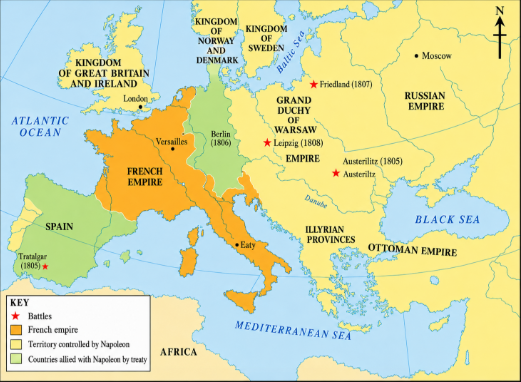
The outbreak of the French Revolution caused great alarm among Europe's continental powers, and this alarm intensified after the execution of Louis XVI and the overthrow of the French monarchy. In 1793, Austria, the Kingdom of Sardinia, the Kingdom of Naples, Prussia, the Kingdom of Spain, and the Kingdom of Great Britain formed the First Coalition to curb the growing power of revolutionary France (see Figure 1). Measures such as mass conscription, military reforms, and total war enabled France to defeat the coalition, despite the concurrent civil war in France. Napoleon, then a general in the French Revolutionary Army, forced the Austrians to sign the Treaty of Campo Formio, leaving only Great Britain opposed to the fledgling Republic.
A Second Coalition was formed in 1798 by Great Britain, Austria, Naples, the Ottoman Empire, the Papal States, Portugal, Russia, and Sweden. The French Republic, under the Directory, suffered from heavy corruption and internal strife. The new Republic also lacked funds and no longer enjoyed the services of Lazare Carnot, the minister of war who had guided France to its victories during the early stages of the Revolution. Napoleon Bonaparte, commander of the Armée d'Italie in the later stages of the First Coalition, launched a campaign in Egypt to disrupt British control of India. Pressed from all sides, the Republic suffered a series of defeats at the hands of revitalised enemies, supported by British financial assistance. After this failure, Bonaparte returned to France from Egypt on 23rd August 1799.
The Napoleonic Wars began with the War of the Third Coalition, the first of the Coalition Wars against the French Republic following Napoleon's accession to power in France. Britain ended the Treaty of Amiens and declared war on France in May 1803. The British were increasingly angered by Napoleon's retention of the international system in Western Europe, particularly in Switzerland, Germany, Italy and the Netherlands. Britain was irritated by Napoleon's assertion of control over Switzerland. Furthermore, British felt insulted when Napoleon stated that Britain deserved no voice in European affairs, even though King George III was an elector of the Holy Roman Empire. For its part, Russia concluded that Napoleon's intervention in Switzerland indicated that he was not seeking a peaceful resolution of his differences with the other European powers.
Britain feared the loss of markets and was concerned about Napoleon's potential threat to its overseas colonies. Britain went to war in 1803, driven by a "mixture of economic motives and to defend national prestige as a great power." Britain had to counter Napoleon's hostile motives and intentions, which threatened its national interests. The deeper British grievance with Napoleon was his attempts to assume personal control over Europe, thereby destabilising the international system and forcing Britain to the sidelines.
Britain enforced a naval blockade of France to starve it of resources. Napoleon responded with economic embargoes against Britain and sought to eliminate Britain's Continental allies to break the coalition arrayed against him. The Continental System formed a League of Armed Neutrality to disrupt the blockade and enforce free trade with France. Britain responded by capturing the Danish fleet at the Battle of Copenhagen, breaking up the league, and later securing dominance at sea at the Battle of Trafalgar in 1805, thereby allowing it to continue its strategic unimpeded.
Napoleon won the War of the Third Coalition at the Battle of Austerlitz, forcing the Austrian Empire out of the war and formally dissolving the Holy Roman Empire in 1806. Within months, Prussia declared war, triggering the War of the Fourth Coalition from 1806 to 1807. This war ended disastrously for Prussia, which was defeated and occupied at the Battle of Jena-Auerstedt. Napoleon then defeated Russia at Friedland, creating powerful client states in Eastern Europe. Thus, Napoleon ended the Fourth Coalition.
Concurrently, Portugal's refusal to continue the Continental System and Spain's failure to maintain it led to the Peninsular War and the outbreak of the War of the Fifth Coalition in 1809. Hoping to isolate and weaken Britain economically through his Continental System, Napoleon invaded Portugal, the only remaining British ally on the continent. After occupying Lisbon in November 1807 and with the bulk of French troops in Spain, Napoleon seized the opportunity to turn against his former ally, depose the reigning Spanish royal family, and declare his brother Joseph I King of Spain in 1808. The French occupied Spain and formed a Spanish client kingdom, ending the alliance between the two. Heavy British involvement in the Iberian Peninsula soon followed, while a British effort to capture Antwerp failed. Napoleon oversaw the situation in Iberia, defeating the Spanish and expelling the British from the Peninsula. Austria, eager to recover territory lost during the War of the Third Coalition, invaded France's client states in Eastern Europe in April 1809. Napoleon defeated the Fifth Coalition at the Battle of Wagram. The Spanish and Portuguese revolt expelled the French from Iberia in 1814 after six years of fighting.
Plans to invade British North America prompted the United States to declare war on Britain in the War of 1812, but it did not become an ally of France. Grievances over control of Poland and Russia's withdrawal from the Continental System led Napoleon's invasion of Russia in June 1812. The invasion was an unmitigated disaster for Napoleon; scorched-earth tactics, desertion, French strategic failures at the Battle of Borodino, and the onset of the Russian winter compelled him to retreat with massive losses. Napoleon suffered further setbacks when French power in the Iberian Peninsula was broken at the Battle of Vitoria in 1812.
The Battle of Victoria led to the War of the Sixth Coalition. Encouraged by defeat, Great Britain, Austria, Prussia, Sweden,and Russia formed the Sixth Coalition and launched a campaign against France. The Coalition decisively defeated Napoleon at Leipzig in October 1813. The Allies then invaded France from the east, while the Peninsular War split into southwestern France. Coalition troops captured Paris in March 1814, forcing Napoleon to abdicate on 6th April 1814. The victors exiled Napoleon to Elba and restored the Bourbon monarchy escaped from Elba in 1815, gathering sufficient support to overthrow the monarchy of Louis XVIII, thereby triggering a seventh coalition against him. Napoleon was decisively defeated at Waterloo on 18th June 1815. He abdicated again on 22nd June 1815. On 15th July, Napoleon surrendered to the British at Rochefort and was permanently exiled to remote Saint Helena Island, where he died in 1821. The Treaty of Paris, signed on 20th November 1815, formally ended the war.
|
Figure 1.1: Napoleonic Empire |
Effects of the Napoleonic Wars
The wars had profound consequences for global history, including the spread of nationalism and liberalism. These included advances in civil law, Britain's rise as the world's foremost naval and economic power, the emergence of independent movements in Spanish America, the subsequent decline of the Spanish and Portuguese empires, the fundamental reorganisation of German and Italian territories into larger states, and the introduction of radically new methods of conducting warfare, which constituted a significant landmark in the aftermath of the Napoleonic Wars. After the end of the Napoleonic Wars, the Congress of Vienna redrew Europe's borders. It brought a relative peace to the continent, lasting until the Revolutions of 1848 and the Crimean War in 1853. Beyond ideology and nationalism, the intellectual transformation in the culture of war emerged during the Age of Enlightenment.
The philosophy of nationalism that emerged early in the war contributed significantly to the later unification of the German states and those of the Italian peninsula. As a direct result of the war, the Kingdom of Prussia rose to political greatness. Napoleon destroyed the Holy Roman Empire and abolished 112 states and 50 Free states. He reduced the number of German political units from 3000 to only 39. These drastic changes created a wave of nationalism. Prussia rose to meet the challenge of throwing off the Napoleonic yoke, and many German nationalists began to look to Berlin for leadership. They created the German Confederation, a loose league of 38 German states, whose government sent delegates to a diet that met in Frankfurt am Main. Political reconstruction of the continent was a primary concern for the governments of Austria, Russia, and Prussia.
The war in Iberia significantly weakened the Spanish Empire, leading to its collapse. By 1833, Spain had lost nearly all of its American possessions. The abandonment of King Charles IV and Ferdinand VII of Spain and the installation of Napoleon's brother as King Jose, provoked civil wars and revolutions, leading to the independence of most of Spain's mainland American colonies. In Spanish America, local elites formed juntas and set up mechanisms to rule in the name of Ferdinand VII, whom they considered the legitimate Spanish monarch. The outbreak of the Spanish-American War of Independence in most of the empire resulted from Napoleon's destabilising actions in Spain. It led to the rise of strongmen. The defeat of Napoleon at Waterloo in 1815 caused an exodus of French soldiers into Latin America, where they joined the armies of the independence movements.
Moreover, the Portuguese Empire also shrank, with Brazil declaring independence in 1822. In contrast, the Portuguese royal family fled to Brazil and established a court there, thereby fostering political stability in Portuguese America. In 1816, Brazil was proclaimed an equal part of the United Kingdom of Portugal, Brazil and the Algarves, paving the way for Brazilian independence in 1822.
French colonies in the Americas declared independence from France. The Haitian Revolution began in 1791 and ended in 1804. France's defeat resulted in the independence of Saint-Domingue, which led Napoleon to sell the territory, known as the Louisiana Purchase, to the United States.
Furthermore, the wars revolutionised European warfare. The application of mass conscription and total war led to campaigns of unprecedented scale, as whole nations committed all their economic and industrial resources to a collective war effort. Tactically, the French Army redefined the role of artillery, while Napoleon emphasised mobility to offset numerical disadvantages. Aerial surveillance was used for the first time in warfare. The highly successful Spanish guerrillas demonstrated the capacity of a people driven by fervent nationalism to resist an occupying force. After 1807, Napoleon's creation of a highly mobile, well-armed artillery force increased the tactical importance of artillery. Rather than relying on infantry to wear away the enemy's defences, Napoleon could now use massed artillery as a spearhead to pound a break in the enemy's line. Once that was achieved, he sent in infantry and cavalry.
Due to the protracted wars, the extent of Napoleon's conquests, and the popularity of the ideals of the French Revolution, the period had a profound impact on European social culture. Ideologies of reform born of the French Revolution were disseminated widely during the Napoleonic campaigns. The drive of privilege, feudalism, and general repression accompanied the spread of French ideas of liberty, equality, and fraternity in the wake of Napoleon's destruction of the social and governmental institutions of the Old Regime during his march across Europe. Many Europeans believed that Napoleon was an imperialist who had given a new face to the existing despotism.
In 1814, the victorious Allied powers sought to restore peace and stability in Europe. By dealing moderately with France and wisely settling their own differences, the Allies laid a foundation for beneficial international cooperation throughout much of the 19th century. The conservative powers, led by Austrian leader Metternich, sought to prevent the spread of subversive ideas and radical changes in domestic politics. However, after 1815, ideas of liberalism, nationalism and socialism developed to challenge the existing order. These forces culminated in the liberal and nationalist revolutions of 1848. Political, economic and social pressures that had been building since 1815 exploded dramatically.
The war also left a military legacy and spurred innovations. For example, the early stages of the Industrial Revolution were closely linked to the expansion of military forces. Mass production of weapons became easier, enabling the equipping of larger forces. Britain was the largest supplier manufacturer of armaments in this period, supplying most of the weapons used by the coalition powers throughout the conflicts. France produced the second-largest total of armaments, equipping its own huge forces as well as those of the Confederation of the Rhine and other allies. Napoleon demonstrated innovative use of mobility to offset numerical disadvantages, as evidenced by the rout of the Austro-Russian forces at Austerlitz in 1805. The French Army redefined the role of artillery, forming independent, mobile units rather than the previous practice of attaching artillery pieces to support troops. The semaphore system had allowed the French War Minister, Carnot, to communicate with French forces on the frontiers throughout the 1790s. The French continued to use this system throughout the Napoleonic wars. Aerial surveillance was used for the first time when the French used a hot-air balloon to survey coalition positions before the Battle of Fleurus on 26 June 1794.
The Napoleonic Wars became total wars. The escalation in size and scope stemmed from two sources. First was the ideological clash between revolutionary egalitarian and conservative/hierarchical belief systems. Second, the emergence of nationalism in France, Germany, Spain, and elsewhere transformed these conflicts into "people's wars" rather than contests between monarchs. The military emerged as a distinct sphere of society, separate from the ordinary civilian world. The French Revolution made every civilian part of the war machine, either as a soldier through universal conscription or as a vital cog in the home-front machinery that supported and supplied the army. "Militarism, the belief that the military role was morally superior to the civilian role in times of great national crisis, emerged. The fighting army represented the essence of the nation's soul. As Napoleon proclaimed, "It is the soldier who founds a Republic, and it is the soldier who maintains it."
The Napoleonic Wars introduced the use of military intelligence. Intelligence played a pivotal role throughout the Napoleonic Wars and changed the tide of war. The use and misuse of military intelligence dictated the course of many major battles during the Napoleonic Wars. Some of the major battles that were shaped by intelligence include the Battle of Waterloo, the Battle of Leipzig, the Battle of Salamanca, and the Battle of Vitoria. A significant exception to the greater use of superior military intelligence to claim victory was the Battle of Jena in 1806. At the Battle of Jena, even Prussia's superior military intelligence was insufficient to counter the sheer military force of Napoleon's armies. One of Napoleon's remarkable military intelligences was Madame d'Oettingen. The use of intelligence varied considerably among the major powers during the war. Napoleon was endowed with greater intelligence than any French general before him. He studied his enemy via domestic newspapers, diplomatic publications, maps, and prior documents of military engagements in the theatres of war in which he would operate. It was this constant study of the enemy which made Napoleon the military mastermind of his time. By contrast, his opponents, such as Britain, Austria, Prussia, and Russia, were much more reliant on traditional intelligence-gathering methods.
Thus, the Napoleonic Wars had profound impacts on European political, military, social, and cultural spheres. European countries began to develop complex military industries for defence and security. In response to the continental blockade, Britain industrialised more than before the war. It was during this period that the military and diplomacy began to work closely to address global threats and promote security.
Activity 1.2
Study the image provided below and interpret its historical significance in the event Sep
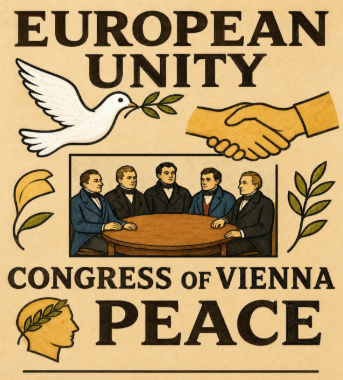
- Examine all parts of the image shown.
- List the main elements you can see in the image.
- For each element, write in your own words what it symbolises.
- Evaluate the importance of the Congress of Vienna in restoring peace after the Napoleonic Wars.
- Design your own poster showing peace and unity in your school, community or country.
The Franco-Prussian War
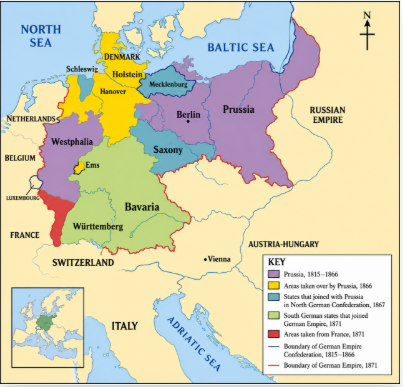
The Franco-Prussian War was fought between 1870 and 1871. It was one of the most consequential conflicts in European history. Though short lived the war not only changed the balance of power in Europe but also created conditions that contributed to the outbreak of the First World War. At its heart, the war was a clash between France, under the leadership of Emperor Napoleon III, and Prussia, led by Otto von Bismarck, who was in the process of unifying the German states into a single empire (See Figure 1.2).
- Examine all parts of the image shown.
- List the main elements you can see in the image.
- For each element, write in your own words what it symbolises.
- Evaluate the importance of the Congress of Vienna in restoring peace after the Napoleonic Wars.
- Design your own poster showing peace and unity in your school, community or country.
Tensions escalated over the candidacy of Prince Leopold of Hohenzollern-Sigmaringen for the Spanish throne, alarming France. Bismarck manipulated diplomatic communications (the Ems Dispatch) to provoke France into declaring war on July 1870. The war was primarily driven by France’s determination to reassert its dominant position in continental Europe, which appeared to be in question following the decisive Prussian victory over Austria in 1866. The war ended on 28th January 1871, with Prussia’s victory over France.
This was not only another war over territory but also a turning point in European history, marking the rise of a powerful German Empire and the decline of France’s dominance. The conflict shaped national identities, military strategies, and international relations, with far-reaching effects across Europe and beyond.
|
Figure 1.2: German Unification |
Causes of the Franco-Prussian War
At the heart of the Franco-Prussian war were two powerful forces: nationalism and ambition. For Prussia, the war was part of Otto von Bismarck's plan to unite the fragmented German states into a single empire. In the 1860s, Bismarck had already led successful wars against Denmark and Austria, and he now sought to defeat France, one of Europe's major powers, to consolidate German power and unity. By contrast, France, under Napoleon III, feared the rise of a unified Germany on its eastern border. For Napoleon, who sought to revive France's glory, victory in war could bolster his regime and restore national pride. However, the French emperor found himself in a perilous situation while France had a strong military tradition, Prussia's growing power posed a serious threat.
The rivalry between the two powers developed over time. For instance, France became the dominant power in continental Europe following the Franco-Austrian War of 1859. During the Austro-Prussian War of 1866, the Empress Eugénie, foreign Minister Drouyn de Lhuys, and War Minister Jacques Louis Randon were concerned that Prussia's power might overtake France's. They unsuccessfully urged Napoleon to mass troops along France's eastern border. At the same time, the bulk of the Prussian armies remained engaged in Bohemia (the westernmost and largest historical region of the Czech Republic, comprising Moravia and Czech Silesia) to signal that no territorial changes in Germany could be made without consulting France.
As a result of Prussia's annexation of several German states that had sided with Austria during the war and the formation of the North German Confederation under Prussia's aegis, French public opinion stiffened and now demanded greater firmness and territorial compensation. Napoleon III accordingly demanded that Prussia restore the French borders of 1814, including the annexation of Luxembourg, most of Saarland, and the Bavarian Palatinate. Bismarck refused, disdainfully calling France's "tipping policy". He then communicated Napoleon III's written territorial demands to Bavaria and the other southern German states of Württemberg, Baden, and Hesse-Darmstadt, hastening the conclusion of defensive military alliances with these states. France had been strongly opposed to any further alliance of German states, which would have threatened France's continental dominance.
The only result of French policy was Prussia's consent to nominal independence for Saxony, Bavaria, Württemberg, Baden, and Hesse-Darmstadt. This was a small victory, and one without appeal to a French public which wanted territory and a French army which wanted revenge. The situation did not suit either France, which unexpectedly found itself next to the militarily powerful Prussian-led North German Confederation, or Prussia, whose foremost objective was to complete the process of uniting the German states under its control. Thus, the war between the two powers since 1866 was inevitable.
In Prussia, some officials considered a war against France both inevitable and necessary to awaken German nationalism in those states, thereby enabling the unification of a great German empire. This aim was epitomised by Prussian Chancellor Otto von Bismarck's later statement: "I did not doubt that a Franco-German war must take place before the construction of a United Germany could be realised." Bismarck also knew that France should be the aggressor in the conflict to bring the four southern German states to Prussia's side, thereby giving Germany numerical superiority. He was convinced that France would find no allies in her war against Germany, for France, the victor, would be a danger to everybody, Prussia to nobody. That is our strong point." Many Germans also viewed France as the traditional destabiliser of Europe and sought to weaken it to prevent further breaches of the peace.
One of the immediate causes of the war was the EMS Dispatch, a diplomatic communication manipulated by Bismarck to provoke French outrage. The dispatch, which was seen as a Prussian insult to French honour, inflamed public opinion in France, prompting Napoleon III to declare war on Prussia in July 1870. However, this proved disastrous for the French. The cause centred on the candidacy of Leopold of Hohenzollern-Sigmaringen to the Spanish throne following the fall of Isabella II in 1868. France feared encirclement resulting from an alliance between Prussia and Spain. The original telegram dispatched by William I after meeting the French ambassador was an accurate account of the diplomatic quarrel over the Spanish succession. Bismarck's version of the EMS was a heavily edited, shorter, and more inflammatory version that portrayed the interaction as a grave insult to Prussia.
A bellicose press and public opinion in France exerted pressure on Napoleon III. He sought war in response to France's diplomatic failures to secure any territorial gains after the Austro-Prussian war. Napoleon III believed he would win a conflict with Prussia. Many in his court, including Empress Eugénie, also wanted a victorious war to resolve growing domestic political problems, restore France as the undisputed leading power in Europe, and ensure the long-term survival of the House of Bonaparte. A national plebiscite held on 8 May 1870, which returned results overwhelmingly in favour of the emperor's domestic agenda, gave the impression that the regime was politically popular and in a position to confront Prussia. Within days of the plebiscite, France's pacifist Foreign Minister Napoleon, Comte Daru, was replaced by Agénor, duc de Gramont, a fierce opponent of Prussia who, as French Ambassador to Austria in 1866, had advocated an Austro-French military alliance against Prussia. Napoleon III's increasing health problems rendered him incapable of reining in Empress Eugénie, Gramont, and the other members of the war party, collectively known as the "mameluks". For Bismarck, the nomination of Gramont was seen as "a highly aggressive symptom."
The EMS telegram of 13th July 1870 had the exact effect on French public opinion that Bismarck had intended. Bismarck wrote, “This text produced the effect of a red flag on the Gallic bull.” Gramont, the French Foreign Minister, felt he had just been slapped. The leader of the monarchists in Parliament, Adolphe Thiers, advocated moderation, arguing that France had won the diplomatic battle and that there was no reason for war, but cries drowned him out, calling him a traitor and a Prussian. Napoleon’s new Prime Minister, Emile Ollivier, declared that France had done all that it could humanly and honourably to prevent the war. A crowd of 15,000 to 20,000 people, carrying flags and patriotic banners, marched through the streets of Paris, demanding war. French mobilisation was ordered early on 15th July. Upon receiving news of the French mobilisation, the North German Confederation mobilised on the night of 15th to 16th July, while Bavaria and Baden did likewise on 16th July and Württemberg on 17th July 1870. On 19th July 1870, the French sent a declaration of war to the Prussian government. The North German Confederation consisted of Prussia, Saxony, Hesse, and 19 smaller states. The southern German states were Bavaria, Württemberg, and Baden. The southern German states immediately sided with Prussia.
Napoleonic France had no documented alliance with other powers and entered the war virtually without allies. The calculation was for a victorious offensive, which, as the French Foreign Minister Gramont stated, was “the only way for France to lure the wary Austrians, Italians and Danes into the French alliance.” The involvement of Russia on the side of France was not considered at all, since Russia made the lifting of restrictions on its naval construction on the Black Sea, imposed on Russia by the Treaty of Paris following the Crimean War, a precondition for the union. But Imperial France was not ready to do this.
France mobilised its army on 15th July 1870, prompting the North German Confederation to mobilise later that day. On 16th July 1870, the French Parliament voted to declare war on Prussia. France invaded German territory on 2nd August. The German coalition mobilised its troops more effectively than the French and invaded northeastern France on 4th August 1870. German forces were superior in numbers, training, and leadership, and made more effective use of modern technology, particularly railways and artillery.
A series of hard-fought Prussian and German victories in eastern France, culminating in the Siege of Metz and the Battle of Sedan, resulted in the capture of the French Emperor Napoleon III and the decisive defeat of the Second Empire’s army. A Government of National Defence was formed in Paris on 4th September and continued the war for another five months. German forces fought and defeated new French armies in northern France, then besieged Paris for over four months before it fell on 28th January 1871, effectively ending the war.
During the final days of the war, with victory for Germany almost certain, the German states proclaimed their unification as the German Empire under King William I of Prussia and Chancellor Bismarck. Except for Austria and German Switzerland, most German-speaking areas united into a single nation-state for the first time. Following an armistice with France, the Treaty of Frankfurt was signed in May 1871. It awarded Germany billions of francs in war indemnity and ceded most of Alsace and parts of Lorraine, which became the Imperial Territory of Alsace-Lorraine.
It is worth noting that this immediate cause of the war is a clear example of how diplomacy, or the lack of it, can lead to war. Bismarck deliberately manipulated the content of the message to make it appear that the Prussian king had insulted the French ambassador, knowing that this would provoke France into war.
Impact of the Franco-Prussian War
The Franco-Prussian War marked a turning point in European history, and its impacts on France and Germany were far-reaching and long-lasting. Some of this impact include:
Shift in the European balance of Power:
By hastening German unification, the war significantly altered the balance of power on the continent, with the new German state supplanting France as the dominant European power. Bismarck maintained considerable authority in international affairs for two decades, developing a reputation for Realpolitik that raised Germany’s global stature and influence. In France, the war brought an end to imperial rule and initiated the first lasting republican government. Resentment over the French government’s handling of the war and its aftermath triggered the Paris Commune in 1871, a revolutionary uprising that seized and held power for two months before its suppression; the event would influence the politics and policies of the Third Republic. In general, the defeat of France led to the collapse of the Second French Empire and the rise of the French Third Republic. France’s political instability persisted for decades, marked by deep internal divisions between monarchists and republicans.
Proclamation of the German Empire
The war began with a series of German victories, including the Battle of Sedan, where the French Emperor Napoleon III was captured. The defeat led to the collapse of the Second French Empire. The Siege of Paris, following the fall of Sedan, forced France to surrender in January 1871. On 18th January, 1871, the German states proclaimed the establishment of the German Empire at the Palace of Versailles, with King Wilhelm I of Prussia as its emperor. It was a significant event in European history, resulting in the establishment of the German Empire and altering the balance of power on the European continent. It reshaped Europe, establishing Germany as a dominant power and changing the course of history for both Germany and France.
Political Shifts
The war marked the end of French hegemony in Europe and the rise of a powerful German state, thereby fundamentally altering Europe’s political order.
Territorial Changes
France lost Alsace-Lorraine to Germany in the Treaty of Frankfurt. The province, with its mixed French and German population, became a symbol of national humiliation for France, fueling a desire for revenge that persisted until the outbreak of the First World War. Thus, the annexation of Alsace-Lorraine by Germany is a clear example of how territorial disputes can create long-lasting tensions between nations. The French slogan “Revanche pour Alsace-Lorraine” (“Revenge for Alsace-Lorraine”) became a rallying cry for nationalists, contributing to the entry that later led to a fierce scramble for colonies and, more importantly, the First World War.
Military Innovations
The conflict demonstrated the advantages of military technology and tactics in the German army’s victory over the railways and superior artillery play a crucial role in its victory. The innovations in warfare brought about a more efficient military system that caused huge losses to the enemy. Military innovations led to more advanced military weapons.
The Franco-Prussian war not only facilitated the unification of Germany but also set the stage for future conflicts in Europe. The harsh terms imposed on France in the Treaty of Frankfurt on 10th May 1871, together with the subsequent rise of nationalism, created a volatile political environment that ultimately led to WWI. The Franco-Prussian War began with a series of German victories, including the Battle of Sedan, where the French Emperor Napoleon III was captured. The defeat led to the collapse of the Second French Empire. Following the fall of Sedan, German forces besieged Paris, which surrendered in January 1871.
The Franco-Prussian War was a pivotal event that reshaped Europe, establishing Germany as a dominant power and altering the course of history for both nations involved. It marked the end of French rule on the continent and led to the creation of a unified Germany. This shift redirected imperial competition in Europe towards the scramble for and partition of Africa.
| Activity 1.3 Design a historical timeline of the Great Wars from 1600 to the 1870s in Europe. Follow the following procedures:
|
www.learninghubtz.co.tz
Exercise
1. Examine the relationship between Napoleon's military conquests and the rise of nationalism in Germany and Italy.
2. Assess the success of the Congress of Vienna in maintaining peace and security in Europe.
3. Imagine you are a diplomat at the Congress of Vienna: propose ways to prevent future conflicts in the globe.
4. Using the concept of Realpolitik by Bismarck, explain how leaders today pursue their interests in global politics.
5. Analyse the extent to which the Franco-Prussian War set the stage for World War I.
6. Propose a peace strategy that could have prevented the outbreak of the Franco-Prussian War.
New ideas as a result of the Great Wars
The Great Wars reshaped international relations by redefining diplomacy, military power, and global security. Although the Westphalia Peace Treaty of 1648 had earlier established the principles of sovereignty and the balance of power as foundations of the state system, the World Wars exposed their limitations. The conflicts also reinforced the importance of military alliances as tools to both deter violence and escalate conflict, as seen in the alliance systems before World War I. The concept of “the balance of power,” with rival alliances emerged as central to understanding the post-war order and their effects could still be felt today.
The Westphalian Treaty
The Westphalia Peace Treaty refers to a series of treaties signed in October 1648 in the Westphalian cities of Osnabrück and Münster, which ended the Thirty Years’ War (1618-1648) and established a new order in the Holy Roman Empire. The treaties involved the Holy Roman Emperor Ferdinand III, the kingdoms of France and Sweden, and their respective allies among the princes of the empire, with a total of 109 delegations representing the belligerent states, although not all were present at the same time. The conflict had largely been between the Catholic Habsburgs and their allies on one side, and Protestant powers such as Sweden and certain German principalities, allied with France, on the other. The Westphalia Peace Treaty laid the foundation for modern international diplomatic relations, establishing principles known today as Westphalian sovereignty.
Preliminary negotiations began in Cologne in 1636 but were delayed by Cardinal Richelieu of France, who insisted on including all French allies. Further negotiations took place in Hamburg in 1641, where Sweden, France, and the Holy Roman Empire agreed on preliminary terms. The main negotiations were held in the neutral, demilitarised cities of Münster and Osnabrück. Münster, a strictly Catholic city since 1535, hosted negotiations between the Holy Roman Empire and France, and between the Dutch Republic and Spain, which signed a separate treaty ending the Eighty Years’ War. Sweden, preferring a Protestant environment, conducted talks in Osnabrück, a city with both Lutheran and Catholic communities.
Treaties
The Westphalia Peace Treaty comprised two main treaties. The Treaty of Münster was signed between the Holy Roman Empire and France, along with their respective allies, while the Treaty of Osnabrück was signed between the Holy Roman Empire and Sweden, along with their respective allies. These treaties formally ended hostilities within the empire and among the major European powers, setting terms for territorial adjustments, religious settlements, and constitutional reforms. The principal of jus reformandi (Latin for “right to reform”), which required subjects to follow their ruler’s religion, was abolished. Rulers could now choose between Catholicism, Lutheranism, and Calvinism, but could no longer impose their religion on their subjects. Ecclesiastical property was to be restored to its 1624 condition, and the Imperial Chamber Court (Reichskammergericht) was to include Protestant judges, although financial constraints prevented full implementation. France and Sweden were recognised as guarantors of the imperial constitution, with the right to intervene in the empire’s affairs.
Territorial adjustments favoured France, Sweden, and their allies. France retained Metz, Toul, and Verdun, along with several cities in Alsace and Pignerol near Milan, thereby strengthening its western frontier. Sweden received an indemnity of five million talers, Western Pomerania, the port of Wismar, and the Prince-Archbishopric of Bremen and bishopric of Verden, securing strategic control of the Baltic Sea and its river estuaries. Ambiguities in the treaties led to subsequent disputes over Bremen and Pomerania, but Sweden’s influence in northern Europe was substantially increased. Bavaria retained the Upper Palatinate’s electoral vote, while the Palatinate was divided between the Protestant Elector Palatine Charles Louis and the Catholic Duke Maximilian of Bavaria. Brandenburg-Prussia gained eastern Pomerania and smaller bishoprics, while the Prince-Bishopric of Osnabrück alternated between Catholic and Lutheran bishops. The 359 Confederacy attained formal independence, and the United Provinces of the Netherlands were confirmed as sovereign. Trade barriers erected during the war were removed, and free navigation on the Rhine was guaranteed.
The Westphalia Peace Treaty extended religious toleration to Lutherans, Catholics, and Calvinists, guaranteeing private worship, freedom of conscience, and the right of emigration for religious minorities. However, non-Catholics in the Habsburg hereditary lands remained excluded. To settle disputes over ecclesiastical lands, 1624 was designated the “standard year” for determining ownership. Princes forfeiting their lands for religious reasons curtailed further expansion of the Reformation or Counter-Reformation. Papal protests against the treaties were declared null and void, thereby reducing Rome’s influence in German affairs.
Constitutionally, the treaties significantly shifted power within the Holy Roman Empire. The sovereignty of approximately 300 princes was recognised, enabling them to make treaties with one another and with foreign powers, leaving the emperor and the imperial diet with only nominal authority. Germany became a central theatre of European diplomacy and conflict, thereby delaying the development of national unity. At the same time, new powers emerged within the empire, including Austria, Bavaria, and Brandenburg, which benefited from the reshaped political order.
Not only did the empire’s central authority effectively dissolve, but it also lost around 400,000 square miles of territory and developed a vulnerable frontier facing France. Sweden and France, as guarantors of the treaties, acquired rights of intervention, and Sweden obtained a voice in imperial councils. While the treaty marked the end of the old imperial order, it facilitated the growth of representative powers. It became a fundamental law of the German constitution, serving as the basis for subsequent treaties, until the Holy Roman Empire’s dissolution in 1806.
Impact of the Treaty of Westphalia on modern international relations
The treaty left important legacies in modern international relations. Before the Peace of Westphalia, great empires such as the Holy Roman Empire exerted considerable influence over much smaller states. The negotiations at Westphalia overturned this system by recognising the sovereignty of all territories, regardless of size. The treaties encouraged the practice of negotiating peace through diplomacy rather than warfare.
The negotiations for the Westphalia Peace Treaty began in 1644 and involved the diplomatic discussions. Representatives from all major European powers, namely the Holy Roman Empire, Spain, France, Sweden and Denmark, gathered in the Westphalian cities of Münster and Osnabrück. Many important states within the Holy Roman Empire also participated. This was the first time such a wide range of participants engaged in a diplomatic effort to end a major conflict. Cardinal Mazarin of France and Axel Oxenstierna of Sweden became key figures in the discussions, as they sought to create a more stable and balanced political order in Europe. Delegates from France, Sweden, Spain, and the Holy Roman Empire debated fiercely over territorial and political issues.
The Westphalia Peace Treaty marked a significant development in international law. It recognised the need for mutual recognition and legal equality among all states. It established a set of principles that norms that continue to guide contemporary international relations. Consequently, the treaties set a precedent for the modern nation-state system and for sovereign states’ recognition of each other’s boundaries and authority without interference.
Moreover, the Treaty laid the foundation for the observance of human rights during wartime. The war’s brutality included the use of mercenary armies, caused widespread devastation, disease and famine. This raised moral questions about warfare. Innocent civilians should be protected during wars.
The treaty also marked the beginning of the development of the balance of power in international relations. The aim was to prevent any one country from becoming too powerful, so that it could not misuse its power to conquer weaker nations. This was intended to maintain the balance of power in international relations. Smaller states that the Holy Roman Empire had previously dominated gained greater autonomy. Consequently, the Westphalia Peace Treaty marked the beginning of the slow decline of the Holy Roman Empire’s influence in Europe, which would reach its climax during the era of Napoleon. France, a dominant power in Europe at the end of the 17th and 19th centuries, was perceived as a destabiliser of peace in Europe and the world at large. Britain had to ensure that France was not too powerful in Europe. France also feared Prussia’s rise as a threat to its continental dominance. The creation of the German Empire in 1871 disrupted the European balance of power maintained by France and Britain.
Furthermore, the Westphalia Peace Treaty significantly advanced religious tolerance in Europe and, subsequently, worldwide. One of the most critical developments of these treaties was the guarantee of protection for Protestant and Calvinist rights within the Holy Roman Empire. For the first time, Calvinism received the same legal status as Lutheranism and Catholicism. The treaties ultimately allowed rulers to determine the official religion of their own states, reaffirming the principle of cuius regio, eius religio. As a result, many Protestant states also gained greater autonomy without fear of punishment from larger countries, thereby reducing the Holy Roman Empire’s control over religious matters in their regions. In the 19th and 20th centuries, few European countries had a state religion; for example, Britain had the Anglican Church, and Sweden and Denmark were Protestant. In France and Italy, the Catholic Church was the state religion. In the 20th century, many European countries moved towards secularism. In modern times, religion has remained a personal matter.
Many of the provisions of the Westphalia Peace Treaty focused on reorganising the Holy Roman Empire, the main battleground of the Thirty Years’ War. Emperor Ferdinand III was stripped of some power and transferred it to the rulers of the Imperial states. However, the emperor retained significant power in the Imperial Diet. Central authority was still maintained through institutions such as the Aulic Council. Westphalia guaranteed the right to practise any recognised denomination: Catholicism, Lutheranism and Calvinism. Calvinism was finally recognised as an official religion. The independence of the Dutch Republic, which practised religious toleration, also provided a safe place for European Jews. Contrary to common belief, the Westphalia Peace Treaty did not necessarily confirm the status quo established by the Peace of Augsburg (particularly the principle of cuius regio, eius religio); instead, it offered a reinterpretation.
Sovereignty
Etymology
From the Latin superanus and the French suverainete. The concept was originally intended to denote supreme power. It signified the ultimate authority of the state’s decision-making over the welfare of society and the maintenance of order. However, its practical application departed from this traditional meaning.
Historical context of sovereignty
The origin of the word sovereignty is traced to ancient Greek and Roman civilisations, where monarchs held absolute power over their citizens, embodying both political and divine authority. The concept took root in Ancient Greece, particularly in the city-states, or polis. Aristotle, in his seminal work “Politics,” argued that the state possesses supreme power over its citizens. He maintained that the polis was the highest form of community, existing for the sake of a good life, and thus deserved absolute authority over individual citizens. In ancient Athens, popular sovereignty was practised, with the demos (the people) holding ultimate power through direct democracy. Citizens gathered in the agora to debate and decide on matters of state, effectively exercising collective sovereignty. This early form of sovereignty was limited to free male citizens and excluded women, slaves and foreigners. The Roman Empire later expanded this concept, developing the notion of imperium—the supreme executive power held by magistrates. The Romans emphasised the practical exercise of sovereign power through law and administration, concepts that later influenced European political thought.
During the medieval era, the concept of sovereignty was fragmented by the feudal system, in which power was dispersed among various lords and vassals. The Church’s influence also complicated the notion of a single, supreme authority. The medieval period presented unique challenges to the development of sovereignty. The feudal system created a complex web of loyalties and obligations that fragmented political authority. Instead of a single sovereign power, authority was distributed across multiple levels, from local lords to kings to the Holy Roman Emperor. The Catholic Church emerged as a powerful competing authority, claiming divine sanction for its temporal power. The Pope’s authority often rivalled that of kings, leading to conflicts such as the Investiture Controversy. This period saw the development of the concept of “divine right” in which kings demand that authority derived directly from God.
Medieval thinkers, including Thomas Aquinas, sought to reconcile religious and political authority, arguing that temporal power should serve spiritual ends. This produced a dual sovereignty system in which both Church and state claimed supreme authority within their respective spheres, a tension that persisted for centuries.
Major transformations in Western Europe during the 16th century shaped the concept of sovereignty to meet the needs of nation-states which began centralized. Jean Bodin produced his masterwork, “Six Books of the Republic,” in 1576, during the tumultuous French religious wars. He defined sovereignty as “supreme power of citizens and subjects unrestricted by laws.” He argued for sovereign authority, characterized sovereignty as supreme, perpetual, and absolute. Bodin’s concept was revolutionary, establishing three key characteristics of sovereignty: unity, its perpetual nature. Sovereignty could not exist while the state was under foreign control. It had to continue through the state’s institutions. This meant that sovereignty was not personal but institutional. Second, it was not personal but institutional. Second, absolute power. The sovereign stands above the law and cannot be limited by existing legal frameworks. This does not mean arbitrary rule; rather, the sovereign is the ultimate source of law. Third, indivisible authority. Unlike medieval feudalist, sovereignty cannot be shared or divided. There must be one ultimate authority within a territory. Bodin’s work emerged from practical necessity, as France required a strong central authority to end religious conflicts and maintain order. His theory provided intellectual justification for absolute monarchy, influencing rulers across Europe.
The Westphalia Peace Treaty of 1648 established the principle of state sovereignty, recognizing each state as possessing the exclusive right to govern its territory and people without external interference. It laid the foundation for the modern international system of nation states. This marked a significant shift from the medieval period where sovereign institutions of the state and liberal democracies.
In the 17th and 18th centuries, sovereignty came to denote the government’s right, in principle, to do whatever it wishes within its own territory. Thomas Hobbes, writing in the aftermath of the English Civil War, revolutionized theories of sovereignty in his work “Leviathan” (1651). Hobbes argued that sovereignty emerged as a social contract in which individuals surrendered their natural rights to a sovereign authority in exchange for protection and order. His logic said that sovereignty was artificially created by human agreement rather than by divine appointment. In his famous description of the state of nature, he argued that rational individuals would willingly submit to absolute sovereign power to escape chaos. This sovereign, whether a person or an assembly, would possess unlimited power to maintain peace and security.
Jean-Jacques Rousseau, writing a century later, offered a different perspective in “The Social Contract” (1762). While accepting the contractual basis of sovereignty, Rousseau argued that sovereignty belonged to the people collectively rather than to a monarch. His concept of the “general will” held that true sovereignty lay in the common good as expressed through democratic participation. Rousseau’s theory of popular sovereignty became particularly influential during the French Revolution, providing intellectual justification for the overthrow of monarchical authority. His ideas about the inalienable nature of popular sovereignty continue to influence democratic theory today.
States are separate and autonomous, and answer to no higher authority. In principle, states are equal in status, though not in power. Sovereignty requires states to interfere in the internal affairs of other states. Although states seek to influence one another to exert control over trade, war, alliances, investments and other areas, they are not permitted to meddle in the internal politics and decision-making processes of other states. Since the world lacks a global police force, armed forces, or government, states rely on one another to facilitate a peaceful and enforce rules of international agreements governing the maintenance of worldwide peace and security, trade and the economy. This led to an idealist approach to sovereignty.
The rise of nation-states in Europe fostered competition among them. The conflict between global powers, namely France, the Holy Roman Empire, Britain, Russia, Prussia, Spain, the Netherlands, Denmark, Austria, and the Papal States, led to frequent wars, including the Thirty Years’ War. The French Revolution (1789-1799) marked a watershed in the evolution of sovereignty. Revolutionary leaders explicitly rejected divine-right monarchy, proclaiming that sovereignty resided in the nation. The Declaration of the Rights of Man and of the Citizen stated that “the source of all sovereignty resides essentially in the nation,” thereby establishing popular sovereignty as a fundamental principle. This revolutionary concept spread across Europe and beyond, challenging traditional monarchical authority. The idea that government derive their legitimacy from the consent of the governed became a powerful force for political change, influencing independence movements and democratic revolutions worldwide. The Industrial Revolution of the 18th and 19th centuries fundamentally altered the context in which sovereignty operated. Economic changes created new social classes and increased the importance of national markets, requiring a stronger central authority to regulate commerce and maintain order.
Sovereignty and maintenance of global peace and security
Nation-states expanded their armed forces to protect sovereignty and advance national interests in an era of interstate competition. The nation-state used two principles: the principle of state sovereignty articulated in the Westphalia Peace Treaty in 1648, which recognises the right of states to govern their territories without external interference, and the principle of national sovereignt which recognises the right of national communities to govern themselves. National sovereignty, in turn, is based on the moral-philosophical principle of popular sovereignty, according to which states belong to their peoples. Nations developed their own interests. Nation-states waged wars to protect their sovereignty and expand their territories in the Americas. This pattern is also evident in the Thirty Years’ War and the Franco-Prussian War. In the 19th century, European powers established colonies in Africa and Asia, driven by the need for foreign markets, investment, and raw materials. The rise of the Industrial Revolution intensified struggles among global powers. The Scramble for Africa threatened global peace, as major powers displayed signs of conflict possibility war.
| Activity 1.4 Read the text and online sources about the ideas of Aristotle, Jean Bodin, Thomas Hobbes, and Jean-Jacques Rousseau on sovereignty theory. (a) Identify the ideas of each thinker on sovereignty. (b) Create a table with rows for thinkers and columns titled: Thinker/philosopher, historical period, ideas on sovereignty and impact on modern politics. (c) Write reference to the thinkers, but fill out the table with information required in all columns. |
www.learninghubtz.co.tz
Exercise
1. Using the example of the Westphalian Treaty, explain how historical treaties can still influence modern international relations.
2. Analyse the core objectives of the Westphalian Peace Treaty and reinterpret them in your own words to show how they addressed the conflicts of that time.
3. Evaluate the long-term impact of the Westphalian Treaty on the development of today’s global political system.
4. Describe how the feudal system affected the exercise of sovereignty during the medieval period.
5. Examine the reasons why sovereignty became central to the nation-state system after 1648.
6. Suggest ways modern African states can strengthen sovereignty while participating in global politics.
Balance of power
The Balance of Power in Europe is a diplomatic strategy designed to prevent any single nation from becoming overly powerful, thereby maintaining stability and peace among the central European states. From the 16th to the 19th century, Europe saw the formation of complex alliances and treaties as countries such as Germany, France, Britain, Austria-Hungary, and Russia entered into agreements to prevent the dominance of any single power. The balance was critical in shaping international relations. It has been a constant point of reference in European political life since the 16th century, although its forms and guarantors have changed over time. Europe’s great powers are those most involved in preserving this balance, even though their own quests for power can also put it at risk.
Although the concept of a balance of power can be found in ancient Greece, it was only in the 16th century that it became a fundamental principle in international relations. It is an alternative to the ideal of empire, inherited from the Roman period, which held that the stability of a political system comprising several states implied dominance by one and the subjection of the others. But in political Europe that emerged from the Middle Ages, based on the model of a secular republic of sovereign states, all equal in right and dignity, the very idea of peace through force was no longer acceptable. Henceforth, the struggle against the hegemony of a single great power and the fight for balance became issues that transcended the singularity of each European state.
In late 15th-century Italy, divided among several rival nation-states, the notion of a balance of power was first put into practice. In the following century, this became evident on a larger scale in the struggle between the Valois and Habsburg dynasties. King Henry VIII of England alternated his continental alliances and goodwill between King Francis I of France and Emperor Charles V of the Habsburg Empire, depending on how the power relationship between the two most powerful princes of the age evolved. He thereby adopted the principle of a balance of power, which remained the cornerstone of English and later, British policy towards continental Europe for centuries to come.
In the 16th and 17th centuries, the European balance of power was taken to mean one weight and one counterweight, which should counsel each other out. The establishment of equilibrium between powers was considered a factor in maintaining peace on the continent. Article 2 of the Anglo-Spanish Peace treaty signed at Utrecht in July 1713 specified that its aim was “to settle and establish the peace and tranquillity of Christendom by an equal balance of power.”
In the 18th century, however, geopolitical shifts and changes in the hierarchy of powers did not allow balance to be understood in the same terms, even if the principle itself remained. Firstly, the Concert of the Great Powers (Austria, France, Great Britain, Prussia, Russia) made it necessary to regard the European balance as the product of alliances rather than as one-on-one rivalries. Also, the inclusion of economic and commercial factors in the definition of power, coupled with the globalisation of international issues, meant that overseas territories were drawn into calculations of the European balance. Finally, with the French Revolution, ideological models also entered into the complex equation of European equilibrium.
After their victory over Napoleon and dismantling of his empire, the principal European monarchies sought a new international order capable of redressing past imbalances. The wars of the Revolution and Empire seemed to show that disunity among legitimate monarchies could allow a troublemaker to emerge and disrupt European peace. In particular, it was necessary to prevent any other significant power from being subjugated, as had previously happened to Prussia and Austria, which were reduced to the status of Napoleonic vassal states. In 1815, the powers sought, in sum, to guarantee their security through the establishment of a system that, though not renouncing war, would limit its scale: each power had to be able, if necessary, to take up arms to defend its own interests, but all the great powers sought to avoid a generalised war that none could be certain of surviving intact.
While no detailed plan for preventing international relations was agreed upon, the atmosphere was generally conducive to reconciliation and strongly opposed to revolution, which could threaten existing hierarchies among states. Among various proposals to restore the European balance of power, Tsar Alexander I’s “allied notability to turn Europe into a Christian nation.” These philosophical ideals, rooted in cultural conventions, coexisted with more pragmatic views, especially in Great Britain, which focused on maintaining stability in Europe to support its global expansion.
Between the Congress of Vienna (1815) and the uprisings of the peoples’ (1848), the European balance of power was embodied in regular diplomatic meetings that brought together the major European powers. More often than not, these meetings merely gave a European blessing to unilateral decisions taken in the interests of individual states. All powers faced nascent nationalisms, which threatened to alter state boundaries and thereby disrupt the European equilibrium. A belief in the “spirit of the people” gave rise to the idea, particularly among democrats, of a new balance of power based on the federation of Europe’s peoples, organised into national republics, as Victor Hugo famously put it, within a “United States of Europe.” But the revolutionary turmoil unleashed by the “springtime of the peoples” of 1848 revealed the impossibility of carving up the European continent into clearly delineated nation-states. Between 1848 and 1850, the revived union of Europe’s monarchs put an end to the various national and democratic experiments that had flourished on the continent.
In the second half of the 19th century, the development of nationalism, together with industrialisation, profoundly disrupted the European balance of power. The 1850s, 1860s and 1870s witnessed several large-scale conflicts, from which new hierarchies between nations emerged. It became increasingly clear that industrial and demographic power was the key to military supremacy. In the 1850s, France again dominated European international relations, but time by playing the European balance-of-power game: at the time, Russia appeared to pose the greatest threat, with its ambitions in the Near East. In the 1860s, Prussia, which until then had been the weakest of the great powers, became an economic heavyweight through industrialisation, enabling it to pursue the unification of Germany in its own interests. The war of 1870-1871 left France and Germany facing each other alone: the Concert of Powers was unable to prevent France from being nearly annihilated by Germany. Russia’s and Great Britain’s concerns gradually allowed France to regain its footing. This recovery, however, did not prevent France from being profoundly isolated, owing to its persistent refusal to participate in the new system of international relations reorganised in Germany. Indeed, the German Chancellor, Bismarck, formed a network of bilateral alliances that enabled him to serve as the mediator of Europe. The 1878 Berlin Congress, for instance, avoided a widespread war by forcing Russia to renounce its claims to supremacy in the Balkans.
Increasingly, factors in the European balance of power were found outside Europe: the 19th century was a period of globalisation, which meant not only colonialism but also the massive emigration of Europeans overseas and the establishment of worldwide networks of exchange. The European powers endeavoured at that time to expand their power beyond Europe by developing spheres of influence on a global scale. While the European balance of power was still guaranteed through diplomatic conferences charged with resolving the great issues of the day, decision-makers and public opinion often held that the only genuine guarantee of survival would come from the scramble for power. Abroad, the European powers found natural resources, labour, financial capital, commercial opportunities, troops and allies. For instance, in 1902, Britain allied with Japan, the primary non-Western industrial power. Meanwhile, the United States, already the world’s foremost industrial power, continued to pursue its domestic interests and avoid European rivalries. However, this did not prevent it from constructing its own empire and thereby participating in the formation of the global balance of power that gradually replaced the European system.
However, it was the question of European power relations that led to the outbreak of the general war, which, though feared for decades, had hitherto been avoided through diplomacy. In the summer of 1914, each of the major European states was ready to take the risk of a “great war,” all living under the illusion that the balance-of-power stood in their favour while at the same time fearing that this would not remain the case indefinitely, the long series of economic, social, political and cultural changes having rendered the hierarchy of powers so unstable. It was, in fact, precisely the balance of power between the Entente and the Central Powers that led to their becoming bogged down in a European war, the First World War, which rapidly became a global one.
Very quickly, the new levels of violence witnessed in this war led belligerents to reflect on the conflict’s origins and on how to prevent it from happening again. With the principle of balance having failed, the great powers attempted to replace it in the 20th century with the principle of collective security, embodied by the League of Nations and then by the UN. However, the functioning of these institutions has nevertheless been shaped precisely the same issue of a balance of power, albeit now a truly global one.
The imperative of a balance of power arose in response to fears of domination by a single hegemonic power. This situation could only be avoided through the redistribution of other states, whether they liked it or not. In this respect, peace was guaranteed by meeting strength with strength, rather than through the ironic, legal ideal of a formal community of nations. The search for equilibrium is considered by some historical scholars the first is the need to create a counterweight against the state that is most powerful and therefore assumed to be the most ambitious; the second is the need for other powers to unite to safeguard their interests. The European balance of power is simultaneously an organising principle and the consequence of states and peoples’ search for peace and stability.
The European balance of power in the 19th century: The shaping of the geopolitical landscape
The European balance of power in the 19th century was a crucial factor shaping the geopolitical landscape of the period. The balance of power played a significant role in preserving stability and preventing major conflicts in Europe during the 19th century. It served to maintain peace and prevent such nation’s interests. The Congress of Vienna in 1815 was a key event that sought to restore the balance following the Napoleonic Wars.
The major powers of the time, such as Great Britain, France, Russia, Austria, and Prussia, sought to secure their interests by maintaining a delicate balance of power. Diplomatic negotiations and alliances were employed to achieve this goal. For instance, the Concert of Europe, an informal coalition of major European powers, sought to maintain the balance by convening regularly to discuss key issues and prevent any one country from gaining excessive power.
Established by a series of treaties signed after the Napoleonic Wars, the Concert of Europe was a diplomatic framework to maintain continental peace, stability, and the balance of power through cooperative diplomacy, thereby preventing major conflicts until World War I and influencing subsequent bodies, including the UN. The Concert of Europe sought to preserve the existing territorial arrangements, avoiding drastic changes that could disrupt the equilibrium. However, this system was not without flaws and eventually encountered challenges that contributed to the First World War.
The events and conflicts of the 19th century, such as the Crimean War of 1853 to 1856 and the unification of Italy and Germany, greatly impacted the balance of power. These events highlighted the fragility of the system and led to shifts in alliances and realignments of power. The rise of nationalism and the quest for self-determination also posed challenges to the existing balance of power.
In the 19th century, European powers sought to maintain a balance of power through various means. Diplomacy played a crucial role, as nations negotiated, formed alliances, and conducted treaties to prevent any single power from becoming overly dominant. The Congress System, established after the Napoleonic Wars, aimed to maintain this equilibrium by convening regular meetings among the major European powers to address issues and resolve conflicts. Additionally, the Concert of Europe was formed to promote cooperation and collective decision-making.
The balance of power began to crumble towards the end of the 19th century as new imperial powers, such as Germany and the United States, emerged. This shift, coupled with the breakdown of the Concert of Europe, marked the beginning of a new era in international relations.
The European balance of power in the 19th century was a crucial element in shaping the geopolitical landscape. It served to prevent any one country from dominating Europe and was maintained through diplomacy, alliances, and strategic calculations. However, the shifting dynamics of the time led to its downfall, marking the end of an era and the beginning of a new world order.
Maintenance of the balance of power in Europe in the 19th century
The balance of power in 19th century was maintained through a combination of diplomatic negotiations, alliances, and military capabilities. These mechanisms enabled major powers to limit the influence of any single nation and preserve stability in Europe. The Congress of Vienna in 1815 played a crucial role in re-establishing stability in Europe after the Napoleonic Wars. It sought to prevent any single power from dominating the continent and relied on a system of checks and balances. Important decisions were made collectively by the major European powers, including Britain, Austria, Prussia, and Russia.
Alliances were a key tool for maintaining the balance of power. Nations formed alliances to counterbalance potential threats and ensure their security. For example, the Quadruple Alliance of 1815, comprising Britain, Austria, Prussia, and Russia, sought to preserve the status quo and suppress revolutionary movements. The Concert of Europe, which included more nations, aimed to preserve peace and intervene in conflicts to maintain the balance of power.
Military capabilities also played a crucial role, another essential aspect of maintaining the balance of power. The major powers invested heavily in their armed forces, ensuring they had the strength to defend their interests and deter aggression. European nations invested heavily in their armed forces and sought to maintain parity of military strength. This was partially achieved through the development of new technologies, including advanced weaponry, the modernisation of their armies and navies, and the industrialisation of production, which enhanced their industrial capacities and expanded their colonial empires.
Diplomatic negotiations were essential to maintaining the balance of power. Congresses and treaties, agreements, and regular diplomatic communication helped resolve disputes and manage conflicts peacefully. Significant issues, such as territorial boundaries, trade agreements, and colonial possessions, were negotiated to prevent escalation.
Colonialism also played a significant role in maintaining the balance of power. European powers competed for colonies, thereby securing resources, markets, and strategic locations. The acquisition of colonies enabled these powers to project their influence and expand their spheres of control, thereby maintaining their economic and political dominance. The Franco-Prussian War of 1871, for example, ended in France’s defeat. Germany occupied France’s two valuable provinces, Lorraine and Alsace. To maintain the balance of power, France sought to acquire additional colonies to compensate for the loss of these two provinces.
Furthermore, the Great Power politics of the 19th century centred on maintaining the balance of power. The Concert of Europe sought to preserve the existing territorial arrangements, preventing drastic changes that could disrupt the equilibrium. However, the system was not without flaws and eventually faced challenges that culminated in the First World War.
In the 19th century, European powers maintained a balance of power through diplomacy, military capabilities, colonial acquisitions, and the establishment of international systems such as the Congress System and the Concert of Europe. These efforts aimed to prevent any single nation from becoming overly dominant and to ensure stability amid rapid change and competition. However, the balance of power was not always maintained perfectly. Conflicts such as the Crimean War and the Franco-Prussian War disrupted the equilibrium, as did the emergence of new powers, including Germany and Italy.
European powers as superpowers in the 19th century
In the 19th century, several European powers emerged as superpowers. These nations were characterised by expansionist policies, military dominance, economic prowess, and political influence. The major European superpowers of the 19th century were Britain, France, Russia and Germany.
Britain was a colonial territories spanning Asia, Africa, Latin America, and the Pacific, the British Empire was undoubtedly the most powerful nation of its time. Its naval supremacy, industrial revolution, and economic influence made it the dominant global power during the era.
Russia was a Eurasia wielded significant influence in the 19th century. It had the largest territory of any European power and expanded its dominions into Central Asia and East Asia, reaching the Pacific Ocean and bordering Mongolia and China. The Russian Empire’s military strength and imperial ambitions secured its status as a major superpower.
French Empire
Despite its decline after the Napoleonic Wars, France retained considerable influence throughout the 19th century. It maintained a strong military and continued to wield political and cultural power in Europe. French colonial possessions, particularly in Africa, also contributed to its superpower status. While other European nations, such as Prussia, later Germany, and Austria-Hungary, held regional significance, they did not match the global reach or influence of the British, Russian, and French empires in the 19th century.
The shift in the European balance of power during the 19th century
The European balance of power underwent during the 19th century as a result of several significant events and developments. During the 19th century, the European balance of power underwent substantial shifts. One important development was the rise of nationalism, followed by a wave of revolutions and nationalist movements that swept across Europe. These movements challenged existing power structures, leading to the fragmentation of empires and the formation of new nation-states with distinct identities.
The Napoleonic Wars were pivotal in reshaping the balance of power in Europe. At the beginning of the century, Napoleon Bonaparte’s conquests significantly reshaped Europe’s political map, consolidating power under the French Empire. However, his defeat at the Battle of Waterloo in 1815 led to the Concert of Europe, a system established by the major European powers (Austria, Russia, Prussia, and later Britain) to maintain peace and restore stability.
Throughout the century, industrialisation and economic growth also shifted the balance of power. Britain, with the world’s leading industrial and naval power, expanded its empire and exerted significant influence over world trade. Meanwhile, Germany was unified in 1871 under Otto von Bismarck’s leadership, becoming a major player in European affairs. Another essential shift was the decline of the Ottoman Empire and the emergence of the “Eastern Question.” This term referred to the political and territorial issues arising from the weakening Ottoman Empire, which sparked rivalries and power struggles among European nations seeking to gain influence in the Balkans and the eastern Mediterranean.
The 1870s and 1880s also saw the Scramble for Africa, as European powers competed to colonise and exploit African territories. This further altered the balance of power as countries such as Britain, France, Germany, and Belgium expanded their colonial empires.
Overall, the European balance of power in the 19th century was shaped by the rise of nationalism and liberalism, the aftermath of the Napoleonic Wars, industrialisation, the decline of empires, and the race for colonial territories. These developments reshaped the political order and set the stage for further geopolitical shifts in the 20th century.
| Activity 1.5 Read the text and reliable online sources on the aims of the 1814-1815 Vienna Congress. (a) Create a visual representation (digital or drawn) of the negotiations and involving Britain, Austria, Russia, Prussia, and France as participants. (b) Clearly label each country’s role. (c) Identify the common objectives shared by all five powers by writing them at the centre of your diagram. (d) Write a two-page explanatory note discussing how the negotiations, strategies and agreements reached during the Congress of Vienna contributed to reshaping the balance of power for future wars in Europe. |
Exercise
1. Examine the significance of diplomacy in maintaining peace in 19th century Europe.
2. Analyse how the rise of nationalism affected the functioning and long-term stability of the European balance of power.
3. Using lessons from the 19th century European balance of power, propose ways African nations today could promote and maintain regional peace and stability.
ANSWERS TO THE EXERCISE
1. Examine the significance of diplomacy in maintaining peace in 19th-century Europe.
Diplomacy played a major role in maintaining peace in Europe during the nineteenth century, especially after the defeat of Napoleon in 1815. European powers used negotiation, conferences, alliances and consultation to prevent another continent-wide war.
(i) Diplomacy restored political order after the Napoleonic Wars.
The Congress of Vienna of 1814–1815 brought together the major European powers to reorganise the continent after years of war. Through negotiation, borders were redrawn, monarchies were restored and a new political order was created.
(ii) Diplomacy promoted the balance of power.
The major powers tried to ensure that no single state became strong enough to dominate Europe. France was contained, while Austria, Britain, Prussia and Russia were strengthened to create a balance.
(iii) Diplomacy created the Concert of Europe.
The Concert of Europe was a system through which the major powers consulted one another on important political issues. Regular meetings and conferences helped states settle disputes before they developed into large wars.
(iv) Diplomacy reduced the desire for revenge against France.
Although France had caused widespread destruction under Napoleon, the victors did not permanently exclude it from European affairs. France was later readmitted into the diplomatic system, which reduced resentment and promoted cooperation.
(v) Diplomacy helped manage territorial disputes.
European states used conferences and agreements to discuss disputes over territories, borders and spheres of influence. This prevented some disagreements from immediately leading to war.
(vi) Diplomacy encouraged collective action.
The major powers agreed that threats to European stability should be addressed collectively. This reduced unilateral military action and encouraged consultation.
(vii) Diplomacy helped contain revolutions.
Conservative governments cooperated to prevent revolutionary movements from spreading across Europe. Although this sometimes suppressed popular demands, it temporarily protected the existing political order.
(viii) Diplomacy enabled peaceful settlements.
Several crises were managed through agreements rather than prolonged warfare. Britain, Austria, Russia, Prussia and France often used diplomatic negotiations to avoid direct conflict.
(ix) Diplomacy promoted communication among rival powers.
Continuous communication reduced suspicion and allowed rulers to understand one another’s interests. This made compromise easier.
(x) Diplomacy preserved relative peace among the great powers.
Although Europe experienced several wars in the nineteenth century, there was no conflict equal in scale to the Napoleonic Wars until the First World War. Diplomacy contributed greatly to this period of relative stability.
(xi) Diplomacy had limitations.
The system mainly represented the interests of powerful monarchies and often ignored the wishes of smaller states and nationalist groups. It could delay conflicts but could not permanently eliminate their causes.
(xii) Conclusion.
Diplomacy was significant because it promoted negotiation, collective security, communication and balance of power. However, its long-term success was weakened by nationalism, imperial rivalry and exclusion of ordinary people from political decision-making.
2. Analyse how the rise of nationalism affected the functioning and long-term stability of the European balance of power.
Nationalism was the belief that people sharing a common language, culture, history and identity had the right to form and govern their own nation. Its rise transformed Europe and gradually weakened the balance of power established after 1815.
(i) Nationalism challenged the Vienna settlement.
The Congress of Vienna had arranged Europe according to dynastic and strategic interests rather than the wishes of national groups. Nationalists opposed this arrangement and demanded self-government.
(ii) Nationalism weakened multinational empires.
Empires such as Austria, Russia and the Ottoman Empire contained many different ethnic groups. Nationalist movements among Hungarians, Italians, Slavs, Greeks and others threatened the unity of these empires.
(iii) Nationalism contributed to revolutions.
The revolutions of 1820, 1830 and 1848 were partly driven by nationalist demands. These uprisings disturbed the conservative order and made Europe less stable.
(iv) Nationalism encouraged the unification of Italy.
Italian nationalists sought to unite the separate Italian states into one country. The emergence of a united Italy changed the political map and introduced a new power into European affairs.
(v) Nationalism led to the unification of Germany.
Prussia used nationalism, diplomacy and war to unite the German states. The creation of the German Empire in 1871 significantly altered the balance of power because Germany became economically and militarily strong.
(vi) Nationalism weakened Austria.
Austria lost influence in both Italy and Germany. Its defeat by Prussia in 1866 removed it from German affairs and weakened its position among the major powers.
(vii) Nationalism encouraged wars.
Nationalist goals were often achieved through armed conflict. The wars of Italian and German unification disrupted diplomatic cooperation and increased military competition.
(viii) Nationalism increased rivalry between France and Germany.
France’s defeat in the Franco-Prussian War and the loss of Alsace-Lorraine created lasting hostility. French desire for revenge became a major source of tension.
(ix) Nationalism intensified the Balkan crisis.
Slavic and other nationalist movements sought independence from the Ottoman and Austro-Hungarian empires. Rival powers supported different groups, making the Balkans a centre of instability.
(x) Nationalism encouraged militarism.
Governments used national pride to justify larger armies, compulsory military service and military expansion. This made diplomatic compromise more difficult.
(xi) Nationalism weakened international cooperation.
States increasingly placed national interests above collective European stability. The spirit of cooperation associated with the Concert of Europe declined.
(xii) Nationalism contributed to alliance formation.
Fear and rivalry encouraged states to form opposing military alliances. These alliances divided Europe into hostile camps.
(xiii) Nationalism promoted imperial competition.
European states sought colonies to demonstrate national greatness and gain economic advantages. This increased rivalry outside Europe and affected relations within the continent.
(xiv) Nationalism had some positive effects.
It helped people achieve political unity, independence and cultural identity. However, when combined with aggression and superiority, it became a threat to peace.
(xv) Conclusion.
Nationalism initially helped create unified states and challenged foreign domination. In the long term, however, it weakened multinational empires, promoted wars, increased rivalry and undermined the balance of power. It was therefore both a force of liberation and a major source of instability.
3. Using lessons from the nineteenth-century European balance of power, propose ways African nations today could promote and maintain regional peace and stability.
African nations can learn both positive and negative lessons from the nineteenth-century European balance of power. Cooperation and consultation helped preserve peace, while secret alliances, aggressive nationalism and rivalry eventually weakened stability.
(i) Strengthening regional organisations.
African states should strengthen institutions such as the African Union, the East African Community, the Southern African Development Community and the Economic Community of West African States. These organisations can mediate disputes and coordinate peace efforts.
(ii) Promoting regular diplomatic consultation.
Heads of state, ministers and diplomats should meet regularly to discuss emerging threats. Continuous dialogue can prevent misunderstandings from developing into conflicts.
(iii) Establishing effective early-warning systems.
Regional institutions should monitor election tensions, border disputes, armed groups, hate speech and resource conflicts. Early intervention can prevent violence.
(iv) Resolving border disputes peacefully.
African countries should use negotiation, arbitration, mediation and international courts instead of military force when dealing with disputed boundaries.
(v) Respecting sovereignty and territorial integrity.
States should avoid supporting rebel groups or interfering unlawfully in the internal affairs of neighbouring countries. Respect for sovereignty promotes trust.
(vi) Developing collective security mechanisms.
African nations should cooperate against terrorism, piracy, illegal arms trafficking and cross-border crime. Joint peacekeeping forces can help restore stability where necessary.
(vii) Avoiding secret military alliances.
Secret alliances created fear and suspicion in Europe. African security agreements should be transparent and designed to protect peace rather than threaten neighbours.
(viii) Promoting fair economic cooperation.
Regional trade, shared infrastructure and joint development projects can reduce rivalry. Countries that benefit from cooperation are less likely to go to war.
(ix) Managing shared natural resources jointly.
Rivers, lakes, oil fields, minerals and grazing lands should be managed through agreements that ensure fair access. This can prevent resource-based conflicts.
(x) Discouraging aggressive nationalism.
Patriotism should not be used to promote hatred against neighbouring countries or ethnic groups. Education should encourage African unity, tolerance and peaceful coexistence.
(xi) Encouraging inclusive governance.
Governments should include different ethnic, religious, regional and political groups in decision-making. Exclusion often produces rebellion and instability.
(xii) Promoting democracy and the rule of law.
Free and fair elections, independent courts, accountable leadership and respect for human rights reduce political grievances.
(xiii) Controlling the spread of arms.
African states should cooperate to prevent illegal trade in small arms and light weapons. The availability of weapons makes local disputes more violent.
(xiv) Using neutral mediation.
Respected African leaders, regional bodies and neutral states can mediate between conflicting parties. Neutral mediation increases the chances of compromise.
(xv) Protecting smaller and weaker states.
Regional peace should not be based only on the interests of powerful countries. Smaller states should receive equal respect and protection under regional agreements.
(xvi) Addressing the root causes of conflict.
Peace initiatives should deal with poverty, unemployment, corruption, inequality, land disputes and political exclusion. Military solutions alone cannot create lasting peace.
(xvii) Promoting cultural and educational exchanges.
Student programmes, sports, trade fairs and cultural exchanges can reduce prejudice and strengthen regional identity.
(xviii) Building professional peacekeeping forces.
African states should train and equip regional peacekeeping units capable of protecting civilians and supporting peace agreements.
(xix) Limiting foreign interference.
African countries should cooperate to prevent external powers from exploiting local conflicts, natural resources or political divisions for their own interests.
(xx) Conclusion.
African nations can maintain peace through diplomacy, regional cooperation, collective security, fair economic relations and inclusive governance. Unlike nineteenth-century Europe, they should avoid hostile alliances, aggressive nationalism and competition for dominance. Regional stability must be based on justice, trust and shared development.
Factors that influenced the European balance of power in the 19th century
Napoleonic Wars: The Napoleonic Wars (1803-1815) significantly affected the balance of power in Europe. Napoleon’s conquests and his attempt to establish hegemony led to the reorganisation of several European states and the emergence of new powers.
Congress of Vienna: The Congress of Vienna, held in 1814-1815, sought to restore stability and maintain the balance of power in Europe after the Napoleonic era. The major European powers negotiated territorial adjustments and established a system of alliances to prevent any single state from dominating the continent.
Effect of the Vienna Congress
The Congress of Vienna, held in 1814-1815, aimed to establish a stable balance of power in Europe following the Napoleonic Wars. While it achieved some stability in Europe during the early 19th century, it faced numerous challenges. Ultimately, it failed to maintain a long-term balance of power.
The desire for self-determination and independence led to the unification of Germany and Italy, as well as various other nationalist conflicts that reshaped the balance of power.
Industrial Revolution: The Industrial Revolution brought significant economic and technological advances, which reshaped the balance of power. Industrialised nations such as Great Britain, France and Germany experienced rapid growth. They became dominant powers, whereas countries that lagged, such as Spain and Portugal, struggled to maintain their position.
Colonialism and Imperialism: The scramble for colonies and the establishment of empires were crucial in shaping the European balance of power. European powers competed for resources, markets, and territorial control, leading to conflicts and rivalries that affected the balance of power.
Emergence of new powers: In addition to traditional powers such as the United Kingdom, France and Austria-Hungary, the 19th century witnessed the rise of new powers, including Germany, Italy and Russia. These emerging powers sought to assert themselves on the international stage, thereby contributing to the shifting balance of power.
Overall, the 19th-century was characterised by a complex interplay of political, economic, and social forces that reshaped the European balance of power. The effects of the Napoleonic Wars, the Congress of Vienna, nationalism, industrialisation, colonialism and the rise of new powers together shaped the period’s geopolitical landscape.
Military alliance
A military alliance is a legally binding treaty between two or more states, under which the parties agree to provide mutual military protection in the event of armed conflict. Military alliances differ from coalitions, which are formed in response to a specific crisis and last until the situation is resolved. They can be bilateral or multilateral. Numerous forms of military and defensive alliances have existed between states since early human history.
The history of military alliances dates back to antiquity, when city-states and empires formed coalitions to enhance their military strength. Notable examples include the Delian League, led by Athens, which sought to defend against Persian invasions and various Roman alliances that enabled expansive territorial control. Throughout the Middle Ages, alliances became pivotal in shaping power dynamics, often dictated by royal marriages and territorial disputes. This period laid the groundwork for the eventual rise of nation-states seeking formalised alliances, driven by the desire for stability amid constant warfare and territorial ambitions.
The evolution of military alliances continued into modern history, particularly through the establishment of diplomatic treaties in Europe. The interplay of nationalism and imperialism led to the formation of significant alliances, underscoring the centrality of military cooperation in addressing shared threats and advancing strategic interests.
The evolution of military alliances has profoundly shaped international relations throughout history. These strategic partnerships, often formed in response to shared threats, have evolved to reflect the geopolitical landscape and the technological advances of each era. From early state agreements to contemporary coalitions addressing global challenges the transformation of military alliances reveals the complexities of diplomacy and warfare. The following sections examine key moments in this evolution, highlighting influential alliances and their impact on global stability.
Due to the development of capitalism in the 17th and 19th centuries, nations became involved in a complex web of competing interests, colonial rivalries and nationalist tensions. Countries raised that going it alone in this increasingly dangerous world was no longer an option. Therefore, military alliances were important for nations seeking to build strong armies and consolidate power before declaring war on their enemies.
Military alliances of the 17th and 18th centuries responded to threats to peace and to the political challenges of the time. These include religious wars, the rise of Emperor Napoleon Bonaparte, the decline of Spain and Portugal as global powers, the rise of the Netherlands and Britain as new global powers and the need for German states to unite.
The formation of these alliances was a calculated response to the shifting balance of power in Europe. The newly unified Germany, under Otto von Bismarck, had emerged as a formidable power, while traditional powers such as France and Austria-Hungary reassessed their positions. Meanwhile, the declining Ottoman Empire created power vacuums that all sought to fill, and the scramble for colonies was intensifying across Africa and Asia.
The 17th and 19th centuries witnessed the emergence of significant military alliances in Europe that shaped global politics and warfare. These alliances were often forged in response to shifting power dynamics, territorial conflicts, and the need for collective security among states. Notable examples of these military alliances in Europe between the 17th and 19th centuries include the Holy Alliance, the Triple Alliance, the Holy Alliance, formed in 1815 among Russia, Austria, and Prussia, sought to preserve the conservative order established at the Congress of Vienna. It sought to suppress revolutionary movements and promote monarchist principles across Europe, thereby stabilising the region.
The Holy Alliance marked a significant development in the evolution of military alliances in the early 19th century. The motivations behind the Holy Alliance were to maintain peace and prevent revolutionary movements. The member states believed that by uniting under a common religious and political banner, they could effectively counter the spread of liberalism and nationalism. This was achieved through a series of congresses that facilitated collaboration.
The Holy Alliance had notable implications for European politics, as it sought to shape the post-war order. Its primary objectives were to suppress revolutionary activity, coordinate military efforts against uprisings, and establish a conservative status quo across Europe. Although it did not function as a traditional military pact, its influence was profound, setting a precedent for future collaborative efforts among states. Overall, the legacy of the Holy Alliance reflects the complexities in the evolution of military alliances and their responses to political challenges.
The Triple Alliance was established in 1882, comprising Germany, Austria-Hungary, and Italy. This military pact was intended to counter the perceived threat posed by France and its allies, with a primary focus on mutual assistance in the event of conflict. It was a serious military commitment. Germany, under Bismarck’s careful orchestration, sought to prevent France from building a coalition against it while keeping Russia isolated. Think of Germany as trying to create a protective wall around itself, using its allies as bricks. Both alliances exemplify the evolving nature of military alliances, marking a shift towards more organised collective security measures during the 19th century. The agreement aimed to provide mutual support in the event of an attack by France or Russia. Each member nation sought to enhance its security and assert its influence in the European stage. Germany played a pivotal role, ensuring to isolate France diplomatically and militarily after the Franco-Prussian War. Austria-Hungary, facing rising nationalist movements, sought German backing against potential threats from Serbia and Russia. Italy, seeking to secure its territorial ambitions, joined the alliance to strengthen its position in a potentially hostile environment.
The alliance served as a counterbalance to the Franco-Russian Alliance, highlighting the shifting dynamics of European power relations. Although it initially served its purpose, internal tensions among its members proved detrimental, particularly during World War I, prompting a reevaluation of military alliances and strategies. The evolution of military alliances, as exemplified by the Triple Alliance, illustrates how geopolitical interests can shape cooperative agreements.
The Triple Alliance was particularly significant because it brought together three major European powers with complementary strengths. Germany provided industrial might and military innovation, Austria-Hungary controlled crucial territories in southeastern Europe, and Italy offered access to the Mediterranean. However, each country also brought its own baggage and potential opposition.
Despite their cooperation in response to the perceived threat, internal tensions persisted within the Triple Alliance. These were nations had competing interests. Austria-Hungary and Italy, for instance, had territorial disputes in the Balkans and along their shared border. Italy’s inclusion in the alliance was always precarious and only recently unified as a nation and was still finding its place in European politics. These internal tensions would later prove crucial when hostilities began in World War I. Germany’s position as the dominant partner in the alliance also bred resentment. While Germany benefited from having allies, Austria-Hungary often felt like a junior partner, dragged into conflicts that served German rather than Austrian interests. This dynamic had devastating consequences when the assassination of Archduke Franz Ferdinand in Sarajevo lit the fuse that would explode into World War I.
In response to the Triple Alliance, France began building its own coalition. The result was the Triple Entente, formed between France, Russia, and Britain. It was not initially a formal military alliance like the Triple Alliance, but rather a series of agreements and understandings that gradually solidified into a powerful counterweight. Its goal was to encircle the Triple Alliance powers.
The Franco-Russian Alliance of 1894 was the foundation of this opposing camp. France, still smarting from its defeat in the Franco-Prussian War and the loss of Alsace-Lorraine, needed a powerful ally to counter German power. Russia, facing pressure from Austria-Hungary in the Balkans and in need of French investment for industrialisation, was a natural partner despite the ideological differences between republican France and autocratic Russia.
Britain’s entry into this alliance system marked a significant shift in European politics. For centuries, Britain had pursued a policy of “splendid isolation,” remaining distant from continental entanglements. However, Germany’s growing naval power and its challenge to British global supremacy forced Britain to reconsider its position.
The Entente Cordiale between Britain and France was signed in 1904, followed by the Anglo-Russian Entente in 1907, which completed the Triple Entente. Suddenly, Germany found itself potentially encircled by hostile powers, creating precisely the nightmare scenario Bismarck had worked so hard to prevent. This encirclement would become a key factor in German decision-making as tensions escalated towards war.
The rise of systematic alliance-building was driven by the development of capitalism from merchant to industrial to monopoly capitalism. Each phase of capitalism posed distinct threats to peace in Europe and the world at large, owing to its expansionist nature, which fostered economic competition among European powers. Unlike the pre-17th century, when alliances were often temporary arrangements for specific conflicts, these new partnerships were designed as long-term strategic relationships. Countries began signing treaties committing them to come to each other’s aid in the event of an attack, thereby creating a domino effect that could turn any regional conflict into a continental war. These alliances also reflected deeper ideological and cultural divisions. Democratic and constitutional monarchies found themselves on one side, while more autocratic empires gravitated towards each other. Economic interests played a significant role: countries that traded heavily with one another often became allies, whereas those competing for the same markets viewed each other with suspicion.
www.learninghubtz.co.tz
Revision exercise
1. Discuss the reasons for the changing nature of threats to world peace and security from the 17th century to the 19th century.
2. Examine how the Peace of Passau (1552) and the Peace of Augsburg (1555) influenced the outbreak of the Thirty Years’ War.
3. Evaluate the significance of the Westphalian Treaty of 1648 in addressing threats to European stability.
4. Substantiate why the balance of power was more important in Europe in the 19th century than before.
5. Explain the significance of military alliances in maintaining global peace in the 19th century.
6. Assess the contribution of the great wars which took place between the 17th and 19th centuries to the development of military technologies.
7. Explain why countries form military alliances and mention any two advantages they get from them.
8. Do you think military alliances today contribute to peace or to conflict? Justify your answer using historical examples.
9. To what extent was the Congress of Vienna successful in establishing and maintaining a stable balance of power in Europe throughout the 19th century? Give reasons for your answer.

Hub App
 For Call,Sms&WhatsApp: 255769929722 / 255754805256
For Call,Sms&WhatsApp: 255769929722 / 255754805256  MATOKEO YA KIDATO CHA VI 2026
SECONDARY REGIONAL EXAMS
PRIMARY REGIONAL EXAMS
FORM VI NECTA REVIEWS
FORM IV NECTA REVIEWS
FORM II NECTA REVIEWS
STD VII NECTA REVIEWS
STD IV NECTA REVIEWS
SECONDARY EXAMS SERIES
PRIMARY EXAMS SERIES
PRIMARY SUBJECT NOTES
SECONDARY SUBJECT NOTES
SECONDARY TOPICAL EXAMS
SECONDARY TOPICAL QUESTIONS
PRIMARY TOPICAL QUESTIONS
PRACTICAL EXAMS & NOTES
SECONDARY REGIONAL EXAMS
DOWNLOAD SUBJECT NOTES
SCHEMES OF WORK (PRIMARY & SECONDARY)
LESSON PLAN
SECONDARY LOG BOOKS
PRIMARY LOG BOOKS
LITERARY WORKS / UCHAMBUZI VITABU
METHALI ZOTE ZA KISWAHILI
Vitendawili Vya Kiswahili
FORM VI RESULTS 2024
FORM FIVE SELECTION 2024
Matokeo KIDATO CHA II 2024
Matokeo Darasa IV 2024
MATOKEO KIDATO CHA IV 2023
FORM ONE SELECTION 2024
FORM VI RESULTS 2023
Matokeo Darasa IV 2022
MATOKEO YA KIDATO CHA VI 2026
SECONDARY REGIONAL EXAMS
PRIMARY REGIONAL EXAMS
FORM VI NECTA REVIEWS
FORM IV NECTA REVIEWS
FORM II NECTA REVIEWS
STD VII NECTA REVIEWS
STD IV NECTA REVIEWS
SECONDARY EXAMS SERIES
PRIMARY EXAMS SERIES
PRIMARY SUBJECT NOTES
SECONDARY SUBJECT NOTES
SECONDARY TOPICAL EXAMS
SECONDARY TOPICAL QUESTIONS
PRIMARY TOPICAL QUESTIONS
PRACTICAL EXAMS & NOTES
SECONDARY REGIONAL EXAMS
DOWNLOAD SUBJECT NOTES
SCHEMES OF WORK (PRIMARY & SECONDARY)
LESSON PLAN
SECONDARY LOG BOOKS
PRIMARY LOG BOOKS
LITERARY WORKS / UCHAMBUZI VITABU
METHALI ZOTE ZA KISWAHILI
Vitendawili Vya Kiswahili
FORM VI RESULTS 2024
FORM FIVE SELECTION 2024
Matokeo KIDATO CHA II 2024
Matokeo Darasa IV 2024
MATOKEO KIDATO CHA IV 2023
FORM ONE SELECTION 2024
FORM VI RESULTS 2023
Matokeo Darasa IV 2022
WHATSAPP US NOW FOR ANY QUERY
App Ya Learning Hub Tanzania