Chapter 02 : Wars and conflicts from the late 19th century to the 1940s
| Introduction The late 19th century to the 1940s were highly sensitive periods marked by imperial expansions, global wars, revolutions and economic depression which negatively affected the world peace. In this chapter, you will learn about the background of conflicts during this era, the wars and tensions that undermined world peace, and the major intervention to address these issues. The competence developed will enable you to design informed strategies for conflict prevention and promotion of peace consistent with today’s society |
| Think A world without wars and conflicts |
Background of wars and conflicts from the late 19th century to the 1940s
The closing decades of the 19th century and the constitution of nation states and the rise of monopoly capitalism. The capitalism then competitive to monopoly capitalism produced a series of crises within the world capitalist system. These crises were driven by overproduction and underconsumption of industrial goods, leading to intense competition for industrial raw materials and markets. Domestic markets were flooded with industrial goods and warehouses were overstocked, so some of the goods were discarded into the seas and oceans. Businesses developed at a profit margins declined, and capitalists could no longer achieve the enormous profits they had previously earned. The general decline in profits forced European capitalists nations to expand beyond their borders in search of markets for their goods, cheap industrial raw materials, and new areas for investment. These economic demands compelled European nations to rush to acquire new spheres of influence in Africa and elsewhere.
The territorial scramble consequently led European powers to conquer foreign territories in Africa and Asia. In Africa, three tensions threatened peace, the Berlin Conference was convened in 1884–1885 by Chancellor Otto von Bismarck to establish rules and procedures for the partition of Africa. By 1914, Britain controlled vast territories stretching from India to Africa. France dominated a large part of North and West Africa, while Belgium, under King Leopold II, notoriously exploited the Congo Free State.
As noted earlier, the scramble for colonies fuelled rivalries that heightened tensions among the European imperial powers. Wars and conflicts over colonial possessions also erupted in Asia. The rise of Japan, following its victories over China in 1895 in the Sino-Japanese War (Treaty of Shimonoseki) and over Russia in 1905 in the Russo-Japanese War (Treaty of Portsmouth), reshaped power dynamics and signalled the decline of Western influence.
Wars and tensions undermining world peace
The aforementioned wars, conflicts and rivalries significantly undermined world peace. These wars and conflicts will be discussed in detail in the subsequent sections, focusing on how they undermined world peace and security in the 20th century.
Colonial rivalries
Rivalries over territorial acquisitions, or the “Scramble for Africa,” began in the late 19th century, sparking diplomatic crises. As elsewhere, the imperial race for colonies in Africa led to serious conflicts among the European imperial powers. As will be seen later, these conflicts partly contributed to the outbreak of the First World War, which proved to be one of the most serious threats to world peace in the 20th century. For instance, the 1898 Fashoda incident brought Britain and France to the brink of war in the Sudan before a peaceful settlement was reached. Similarly, the Morocco, Germany challenged French influence during the First Moroccan Crisis (1905) and the Second Moroccan Crisis (the Agadir Crisis) (1911), thereby intensifying Franco-German hostility.
Conflicting imperial interests in Africa not only led to tensions among imperial powers but also contributed to the outbreak of the First World War. The result was that territorial or national conflicts between imperial powers in Africa quickly escalated into a global war. Further threatening world peace. In these conflicts, Africa’s independent existence, its cultures, interrelated exchanges, and economy were besieged and crushed by European imperial expansion. It is important to recognise that, while the history of European conquest and rivalries in Africa was taking shape, the history of European conflicts and problems in Europe, which were also exported to Africa, is sometimes overemphasised by historians. This attention somehow overshadows African suffering through enslavement, colonisation, and the loss of self-determination and sovereignty. The partition of Africa at the 1884–1885 Berlin Conference was a watershed in the history of African marginalisation through European-imposed Western education, values, and political thought.
The First World War (1914–1918)
The First World War, also known as the Great War, was a devastating global conflict between two opposing alliances: the Triple Entente, comprising France, Britain, Russia, and later the U.S., and the Central Powers, led by Germany, Austria-Hungary, the Ottoman Empire, and Bulgaria. The war was characterised by the modernisation of military technology and unprecedented levels of carnage, which fundamentally reshaped military technology and international diplomacy relations. It claimed the lives of millions of soldiers and civilians. Triggered by the assassination of Archduke Franz Ferdinand in Sarajevo in 1914, the war escalated due to a complex web of military alliances.
Causes of the First World War
Complex long and short-term factors contributed to the outbreak of the First World War. The long-term causes included nationalism, imperialism, militarism and secret agreements. The immediate cause of the war was the assassination of Archduke Franz Ferdinand.
Long-term causes
Imperialist activities in Africa and the Far East laid the groundwork for the outbreak of the First World War. Although the Berlin Conference of 1884–1885 resolved some conflicts among European powers over the scramble for colonies, other grievances remained unresolved. Capitalist nations were struggling and quarrelling over colonial territories, thereby violating the principles established at the Berlin Conference. Capitalist powers sought additional investment opportunities and strategic areas even after the Berlin Conference. Imperial rivalries over colonies in Africa and Asia continued, resulting in deep hostilities that contributed to the outbreak of the war. Critical points in Africa that heightened tensions among the European powers and contributed to the outbreak of the First World War included the Fashoda incident of 1898 between the British and French in the Sudan and the Anglo-Boer War of 1899–1902 in South Africa. Moreover, the Moroccan crisis of 1905 and 1911 contributed to the long-term conflict between France and Germany.
Before the Berlin Conference, European powers had shown increasing interest in Africa, driven by economic motives, including access to resources, strategic advantages, and national prestige. The 19th century saw notable explorations by European individuals such as David Livingstone (1813–1873) and Henry Morton Stanley (1841–1886), who revealed important information about the continent’s resources. These efforts accelerated the colonisation of Africa to exploit its economic potential. For example, Britain sought to secure trade routes to India via Egypt and the Suez Canal and to control Southern and Eastern Africa. France likewise expanded westward and northward in Africa (including Senegal, Mali, Mauritania, Côte d’Ivoire, Guinea, Madagascar, Algeria, Tunisia, and Morocco). Germany, under Chancellor Otto von Bismarck, sought colonies to enhance national prestige and economic interests in the newly unified nation. Moreover, Portugal sought to link Angola and Mozambique but clashed with British ambitions over overlapping claims, making conflict seem inevitable.
Furthermore, colonial boundaries drawn by imperial powers gave rise to conflicts over their accuracy and geographical scope. This effectively granted a colonial power in a coastal territory the right to claim political influence over an indefinite extent of inland territory. Such claims could further complicate already tense relations among the European imperialist powers.
Although the Berlin Conference legitimised the occupation and colonisation of Africa, Germany and Britain held opposing views on the scope of the Principle of Effective Occupation. For example, the British saw the Germans as a new competitor in Africa who would likely acquire new colonial possessions and outshine them. The new possessions acquired by the Germans were apparently more valuable than those under British control. In addition, German colonial policy in Africa partially contradicted British policy, thereby complicating political tensions between the two. Both believed that no colonial power should have a legal right to a territory unless the state exercised effective political control over it.
In theory, the principle of effective occupation required that newly acquired colonies be notified to other imperial powers already in Africa; effective administrative machinery be put in place; and transport infrastructure, such as railways, be constructed. This embarrassed Britain and France. For example, Britain sought to maintain its territorial presence in Africa by minimising responsibilities and administrative costs. Thus, the expansion of Germany’s colonial possessions in Africa intensified tensions among the European imperialist powers. Britain and France feared that German imperial possessions in Africa could threaten their prosperous colonial enterprise. Such expressions of mutual fear among imperial powers fuelled discontent and demands for the redrawing of Africa’s borders. This mutual fear and tension among European imperialist powers ultimately culminated in the First World War.
The First World War was therefore imperialist, with the rival imperial powers seeking to acquire new colonies in advance of their economic and political interests and to annex new territories. They rushed to acquire new territories to promote their financial interests and expand their national influence beyond European boundaries. For example, Germany sought to annex colonies from Great Britain and France. It also sought to annex territories, including Ukraine, Poland, and the Baltic provinces, from Russia. Despite her economic and naval hegemony, Britain feared that Germany’s rise as an economic and naval power would endanger her position as a superpower. Britain also sought to annex Mesopotamia and Palestine from the Ottoman Empire and to secure Egypt to consolidate its maritime supremacy and safeguard its overseas markets in India. By contrast, Russia sought to seize Turkey, the Black Sea, the Strait of Constantinople, and Galicia, then part of Austria. France intended to annex the iron Germany the Saar Basin and the iron and coal-rich provinces of Alsace and Lorraine, which had been lost to Germany during the Franco-Prussian War of 1870–1871.
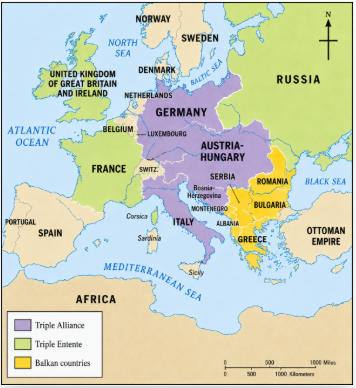
Militarism and secret alliances among the European powers were developments that not only led to the outbreak of the First World War but also threatened world peace to an unprecedented extent. The military alliances among the European powers heightened tensions and fears of an imperialist war. For example, Germany defeated France in the Franco-Prussian War of 1870–1871 led France to surrender Alsace and Lorraine, its iron- and coal-rich provinces, to Germany. That situation prompted Germany to fear that France might seek to re-annex and retaliate against Britain to avenge the defeat. Germany’s immediate action was to conclude a dual military alliance with Austria-Hungary in 1879. Italy joined the Alliance in 1882, leading to the formation of the Triple Alliance (see Figure 2.1).
The naval race between Britain and Germany. The German government had been greatly influenced by the writings of the American Alfred Mahan, who argued that sea power was the key to building a great empire. It followed, therefore, that Germany needed a much larger navy capable of challenging the world’s greatest sea power - Britain. Following Admiral Tirpitz’s 1897 Navy Law, Germany made a determined effort to expand its navy. The rapid growth of the German fleet probably did not worry the British too much at first, as they had an enormous lead. However, the introduction of the powerful British “Dreadnought” battleship in 1906 changed all this, as it made all other battleships obsolete. This meant that the Germans could begin building “Dreadnoughts” on equal terms with Britain. The resulting naval arms race was the principal source of contention between the two until 1914. For many Britons, the new German navy could mean only one thing: Germany intended to wage war against Britain.
France, Britain, and Russia formed a military alliance known as the Triple Entente in 1907. The common factor behind the formation of military alliances was the desire to uphold imperialist gains against rival military groups. The alliances became heavily armed and mutually antagonistic as they pursued their territorial ambitions. The formation of alliances led to aggression, as some European powers regarded themselves as superior to others. Although these alliances were formed to strengthen the security of the member countries, they generated tension and fear in Europe and worldwide. The existence of two antagonistic military camps led to recurrent conflicts among the powers involved. Eventually, the situation escalated, leading to the outbreak of the First World War in 1914.
|
Figure 2.1: European military alliances before and during the First World War |
Moreover, the First World War emerged from nationalist movements in Europe, particularly in the Balkans, including Serbia, Montenegro, Kosovo, Albania, Macedonia, Bulgaria, Greece, and Romania. These countries were characterised by religious and cultural diversity, with both Christians and Muslims living there. Some were under the rule of the Austro-Hungarian Empire, while others were under the Ottoman Sultan. By the early 1900s, the people in those countries had formed the Balkan League, which sought to free themselves from colonial rule by the Austro-Hungarian and Ottoman Empires. In their struggle for independence, they received support from European countries aligned with the two rival military alliances. The quest for freedom in the Balkans was characterised by military competition, which, in turn, contributed to the outbreak of the First World War.
The First Balkan War was fought in 1912, in which Bulgaria, Serbia, Greece, and Montenegro defeated the Ottoman Empire. In the Second Balkan War of 1913, Serbia defeated united against Bulgaria and defeated it. While the Balkan Wars were underway, Russia supported the Serbs against the Austro-Hungarian Empire. Austria-Hungary, for its part, sought to undermine Serbia's military capacity, but Serbia did not surrender. Instead, they formed a secret movement, the Black Hand, to oppose the Austro-Hungarian intrusion.
The German militarian spirit of 1914 was yet another factor that precipitated the First World War. Militarism is a belief held by a religious, political, or social group or movement that a significant transformation will occur, every participant in this will change. Germany's participation in the First World War was strongly motivated by the belief that the Spirit of 1914 was high, which widespread support among the German population for entering the war. The German government believed that the outbreak of war and its support for Austria-Hungary were to preserve its position as a leading power. Such a belief was inherent in German nationalism and the monarchical system.
Germany's success in the opening battles of the First World War provided a platform for the German government to position itself as a unified, nationalist state. However, this millenarianism was short-lived, as Germany was unprepared for a long war, which exacted a dramatic and demoralising toll on its people and later set the stage for the rise of the Third Reich.
Short-term (immediate) causes
The assassination of Archduke Franz Ferdinand and his wife, Sophie Chotek of Austria-Hungary, prompted the outbreak of the First World War. The Archduke and his wife were assassinated in Sarajevo, Bosnia and Herzegovina, by Gavrilo Princip, a Bosnian Serb nationalist, on 28th June 1914. The assassination was driven by the desire of Bosnia and other Balkan states to achieve freedom from Austro-Hungary and the Ottoman Empire.
Following the assassination, Serbia was accused the ultimatum. Firstly, she was ordered to stop encouraging nationalist propaganda against Austria-Hungary. Secondly, she was ordered to allow Austrian officials and police into Serbia to help crush revolutionary movements. Thirdly, she was ordered to dismiss and punish all those involved in the murder of the Archduke and to prevent the import of arms and explosives through the Bosnian border. The Serbians accepted all the conditions but refused to allow Austrian officials and police into their country. The refusal to investigate the murder angered Austria-Hungary, which then attacked Serbia on 28th July 1914.
Following the events above, World War I escalated from 1914 to 1918 and ended with the signing of the Treaty of Versailles, which concluded peace between the Central Powers and the Allied Powers. However, the treaty imposed punitive measures on Germany that further destabilised Europe and paved the way for the Second World War.
| Activity 2.1 Use various sources of information including online, especially on the causes and major events which resulted in the First World War:
|
Impact of the First World War
As far as world peace and security are concerned, the First World War profoundly damaged them by causing widespread bitterness and economic instability, crippling empires, and indirectly contributing to the outbreak of the Second World War. Significantly, the war led to the collapse of the Austro-Hungarian, Ottoman, and Russian empires. This led to the redrawing of the map of Europe and the Middle East, creating new nations but also border disputes and ethnic tensions that fuelled further conflicts. The Treaty of Versailles, which formally ended the war, imposed heavy reparations and restrictions on Germany, fostering resentment that extremist groups later exploited.
Economically, the war caused widespread devastation and debt. European nations struggled to recover, and Germany’s economic difficulties contributed to global instability. The United States emerged as a major economic power, shifting the global financial centre from London to New York.
An effort to prevent future wars, the League of Nations was established in 1920. It was the first international organisation created for collective security and the diplomatic resolution of conflicts. However, the League’s effectiveness was limited by the absence of major powers such as the United States, and by a lack of enforcement capacity. It ultimately failed to prevent regional crises, including the Manchurian Crisis and Italian aggression in Ethiopia, which led to the outbreak of the Second World War.
The Manchurian Crisis (1931-1933)
The Manchurian Crisis of 1931-1933 was another international conflict in the first half of the 20th century. It played a significant role in the events that led to the Second World War.
The origins of the crisis date to Japan's rise as a powerful nation following the Meiji Restoration of 1868, which aggressively modernised Japan's economy along Western principles. The reforms transformed Japan from an agrarian economy into an industrial giant. Japan was then able to pursue imperialistic policies within and beyond its borders.
It was the First Sino-Japanese War (1894-95) and the Russo-Japanese War (1904-05), which gave it land, influence, and international respect. These victories also helped Japan gain control of the South Manchuria Railway. Manchuria was important to Japan because it contained rich iron and coal resources. It was also strategically significant in Northeast Asia.
The crisis began on 18th September 1931 with the Mukden Incident. Japanese soldiers staged an explosion on the railway line blamed Chinese troops. Using this pretext, the Japanese Kwantung Army invaded Manchuria without approval from Japan's civilian leaders. By early 1932, Japan had established the puppet state of Manchukuo, installing Puyi, the last Qing emperor of China, as its nominal ruler. Unable to stop Japan by force, China turned to the League of Nations for help.
The League responded by sending the Lytton Commission in 1932. The report criticised Japan's actions and refused to recognise Manchukuo. However, it did not propose punitive measures or military action. The weak response exposed the League's inability to stop aggression. In 1933, Japan left the League, turning its back on international cooperation.
Several factors were at play in this conflict. Japan faced domestic economic problems and saw Manchuria as a solution, owing to its coal and iron ore resources and markets. The Japanese army, which had gained significant influence, strongly advocated expansion. Manchuria was also viewed as a buffer zone against both Chinese nationalism and Soviet threats. By contrast, China was weak and divided, making it hard to resist Japan. The consequences were serious. Manchukuo was established under Japanese control, and the League of Nations lost much of its credibility. For Japan, the success of the occupation encouraged even greater militarism and expansion, culminating in a full-scale invasion of China in 1937 and Japan's participation in the Pacific War. For China, the loss of Manchuria fuelled nationalism and strengthened anti-Japanese resistance, and deepened its internal struggles.
The crisis had a global impact. It showed that the peace system established after the First World War was breaking down. Other aggressive powers, such as Italy and Germany, noted the League's weakness and followed Japan's example. In Asia, Japan became the dominant power, and the crisis set the stage for larger wars in the region.
Therefore, the Manchurian Crisis was more than a regional dispute. It signalled the collapse of peace between the wars and exposed the failure of international cooperation through the League of Nations. Japan's occupation of Manchuria and withdrawal from the League of Nations showed the world that aggressors could act with impunity, which ultimately led to the outbreak of the Second World War.
The Second World War (1939-1945)
The Second World War (WWII) was a global conflict lasting from 1939 to 1945. It was the deadliest war in history, involving nearly every part of the world. The war has its origins in the Treaty of Versailles (1919), which ended the First World War. The Versailles Peace Treaty of 1919 imposed harsh reparations on Germany, sowing resentment and economic hardship. Adolf Hitler exploited these grievances, and with the Nazi rise to power in 1933, Germany pursued rearmament and territorial expansion. The invasion of Poland on 1st September 1939, following the Nazi-Soviet Pact (23rd August 1939), triggered the Second World War, as Britain and France declared war on Germany. The conflict soon spread across Europe, Africa, and Asia, with the Axis Powers (Germany, Italy, and Japan) pitted against the Allies (Britain, the Soviet Union, the United States, and others).
www.learninghubtz.co.tz
Exercise
1. How did colonial competition and the European powers contribute to the First World War?
2. Analyse how colonial rivalries and the rise of nationalism within colonised regions in Europe contributed to global conflicts and tensions in the modern world.
3. Examine the legacy of colonial rivalries and competition before the World War I to contemporary African problems.
4. Examine how African participation in the Second World War inspired ideas for independence movements.
5. Using historical evidence, defend or dismiss the claim that the Second World War emerged from unresolved tensions created by the First World War.
6. Analyse the major global outcomes of the Second World War and explain how they transformed international relations and the balance of power in Europe and globally.
Causes of the Second World War (1939-1945)
The events that led to the Second World War began soon after the First World War and reached a critical, almost irreversible point by 1939. The signs of the outbreak of the Second World War were evident. Germany rejected the terms of the Versailles Peace Treaty and adopted a political philosophy centred on extreme nationalism and rearmament. The Versailles Peace Treaty, signed by Britain, France, and the USA at Versailles in 1919 to guarantee global peace and security, order, and justice, appeared unfair to Germany.
For example, the terms imposed on Germany required it to surrender all its colonies to Britain, France, Belgium and South Africa. The size of her army was limited to 100,000 soldiers. She was not permitted to possess tanks, heavy artillery, military aircraft, warships, or poisonous gases. Germany's navy was prohibited from using submarines and was allowed to have only six obsolete battleships. France ordered Germany to surrender the two provinces of Alsace and Lorraine, which had been conquered during the Franco-Prussian War. The loss of the areas led to a decline in her population, wealth, prestige and power. Finally, she was ordered to pay war reparations amounting to US$56 million (GDP 6.6 million). Such terms caused considerable distress among the Germans; they sought strong leaders who could subvert the Versailles Peace Treaty. The Versailles Treaty has been blamed for filling the Germans with bitterness and the desire for revenge. In 1933, Adolf Hitler became the Chancellor of Germany and became one of those conditions.
The aggressive behaviour of Adolf Hitler of Germany and Benito Mussolini of Italy was another cause of the Second World War. Before becoming Chancellor, Hitler had organised a military coup to overthrow the Weimar government. The Germans disliked that government because it had accepted the terms of the Versailles Peace Treaty. Thus, in 1923, Hitler unsuccessfully attempted to overthrow the Weimar government; as a result, he was arrested and jailed. While in jail, he wrote a book entitled Mein Kampf (My Struggle). In this book, he argued that the Germans had suffered for three reasons: the unfair terms of the Versailles Peace Treaty, France's hatred of Germany, and the presence of Jews in Germany, who held many posts at the expense of unemployed Germans. In 1934, Hitler launched campaigns to restore Germany to its 1913 state. He began to seize territory from neighbouring countries. He invaded Czechoslovakia and Austria in 1938. His invasion of Poland in 1939 sparked the Second World War.
Likewise, Benito Mussolini contributed to the Second World War primarily through his aggressive expansionist foreign policy in the 1930s, which destabilised international relations; his role in forming the Axis alliance with Hitler; and his opportunistic involvement in the war in 1940, which opened new fronts in the Mediterranean and North Africa. Mussolini's actions in the years leading up to the war helped create conditions that increased the likelihood of a global conflict. For instance, Italy's invasion and annexation of Ethiopia in 1935 demonstrated the ineffectiveness of the League of Nations in preserving peace, as the international body's sanctions were weak and not fully enforced. This failure encouraged other aggressor nations, including Germany, to annex other countries. Another example was Italy's intervention in the Spanish Civil War (1936-1939), in which Italy's extensive military support for General Francisco Franco's Nationalist forces served as an ideological and against communism and a testing ground for new tactics and weaponry, further aligning Italy with Germany and elevating itself from its Western liberal democracies. Fascist Germany and Italy became authoritarian regimes, banning other political parties.
Military alliances for security and protection, on the other hand, contributed to the outbreak of war. Britain, France, Yugoslavia, and Poland formed a secret military alliance to counter German aggression. In 1936, Hitler and Benito Mussolini formed a military coalition known as the Berlin-Rome Axis. Japan joined the Berlin-Rome Axis. The formation of these military alliances strengthened confidence of the opposing blocs, heightening tensions and ultimately contributing to the outbreak of the Second World War.
Militant and chauvinistic ideologies (extreme nationalism), which rose in Germany, Italy and Japan, were factors that caused the Second World War. Such a nationalist spirit fostered imperialist expansion. The three nations combined their efforts to seize new lands. Germany invaded and occupied parts of Czechoslovakia and Austria. Japan invaded and occupied Manchuria in China. Italy invaded Ethiopia. These invasions caused political tensions among the imperialist powers and triggered the outbreak of the Second World War.
The Second World War was also caused by the Spanish Civil War of 1936-1939. It pitted the socialist government, supported by the USSR, against the dictatorship of General Francisco Franco, backed by Hitler and Mussolini. Germany and Italy used the war to test their newly developed weapons, which they found effective, particularly the Luftwaffe and the Panzer tanks. The war also brought Germany and Italy closer and later paved the way for the formation of the Berlin-Rome Axis, before Japan joined them to form the Berlin-Rome-Tokyo Axis.
The weakness of the League of Nations were also responsible for the outbreak of the Second World War. The League of Nations failed to prevent the growing militarism and armament of Germany, Japan and Italy. It was unable to use its political power to act against aggressors. Its lack of enforcement greatly encouraged these countries to pursue militarism and expansionism, which became catalysts for the Second World War.
The effects of the Great Economic Depression also contributed to the outbreak of the Second World War. The problems caused by the Great Economic Depression became an added burden on Germany, which was also facing the unfair terms of the Versailles Peace Treaty of 1919. The economic problems of that Great Depression created instability in some European countries. Such events prompted the rise of dictators across Europe, notably Benito Mussolini of Italy in 1922 and Adolf Hitler of Germany in 1933, who initiated the Second World War.
Another cause of the Second World War was the policy of appeasement adopted by France and Britain towards Germany and Italy. The two countries failed to oppose Hitler and Mussolini's aggressions. For example, when Hitler invaded Poland on 1st September 1939, Britain and France declared war on Germany on 3rd September 1939, as Poland was their ally. This declaration marked the beginning of the war.
Impact of the Second World War
World War II's effects included immense human loss and destruction, the rise of the United States and the Soviet Union as superpowers, leading to the Cold War, the division of Germany, the formation of the United Nations to prevent future conflicts, and the spread of new military technologies, such as atomic bombs. Millions were killed or displaced, becoming refugees, leading to a decade of food and fuel shortages for many and a lasting global economic and social impact. The Holocaust, which resulted in the death of 6 million European Jews, led to the division of Europe and into democratic Western Europe and Communist Eastern Europe. Germany was split into two separate countries: the Federal Republic of Germany and the German Democratic Republic. Berlin was divided into zones administered by the occupying powers: the USA, the United Kingdom, France, and the Soviet Union. The USA occupied Japan; Britain, France and other European states lost their colonial empires due to a growing wave of nationalism; the development of the Cold War politics; a desire to foster global cooperation in the areas of trade, health, and education through the creation of the United Nations; social changes, such as eating habits and fashion, and an increase in the rights and opportunities for women; and technological innovations such as the jet engine, radar, and general-purpose computers.
| Activity 2.2 (a) Watch a video or documentary on World War I and World War II. (b) Suggest ways through which modern world countries can learn from World War I and World War II in dealing with regional and internal conflicts. |
Efforts to overcome threats to world peace
Wars and tensions have greatly undermined world peace. Many nations recognised the importance of working together to prevent future conflicts. As a result, several efforts were made to ensure international cooperation, mutual understanding and security. Since the 19th century, various treaties and agreements have been concluded to address multiple threats to world peace, as explained in the subsequent section.
The Berlin Conference (1884–1885)
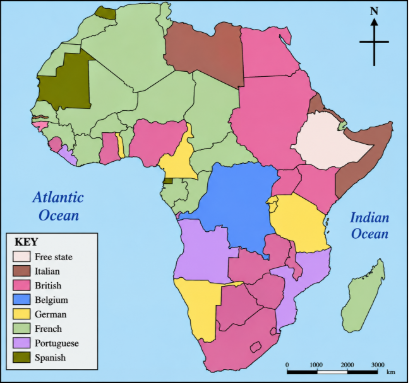
The Berlin Conference held from November 1884 to February 1885 under German Chancellor Otto von Bismarck, was one of several international efforts by European imperial powers to prevent conflicts among themselves. The conference aimed to regulate European colonisation and trade in Africa amid ongoing rivalries among European powers during the Scramble for Africa. In the 1870s and early 1880s it produced the General Act of Berlin, a short diplomatic text that formalised principles used by European powers in partitioning Africa. Two Articles were particularly key to the partitioning of Africa. These were Article 34, known as the Doctrine of Effective Occupation. No African rulers attended the conference. The USA participated in the conference as an observer. Although the conference aimed to promote peace and order, it established formal colonial boundaries among European powers. Its legacy continues to influence geopolitical boundaries and socio-economic conditions in Africa today. Figure 2.2 depicts the European occupation of various regions in Africa following the Berlin Conference.
|
Figure 2.2: Africa after the Berlin conference and other Bilateral Agreements |
| Activity 2.3 Peruse various sources of information, including online, published and documentary information on Berlin Conference, then: (a) Prepare for an interschool debate on the motion “the Berlin Conference fueled future conflicts rather than promoting peace” (b) Write down well-reasoned arguments to support your position. |
www.learninghubtz.co.tz
Exercise
1. Compare and contrast the causes and the outbreak of the First and Second World Wars.
2. Assess the impact of the Second World War on African nationalism.
3. To what extent did the Second World War contribute to the rise of the United States and the Soviet Union as global superpowers?
4. Examine how the Agreements of the Berlin Conference contributed to the ‘balkanisation process of the African continent.
5. Evaluate the weaknesses of the Berlin Agreements in the context of African today.
6. Suggest the alternative strategies that the Europeans could have used in the effort to create peace among themselves instead of the infamous agreements in the Berlin Conference.
Versailles Peace Treaty (1919)
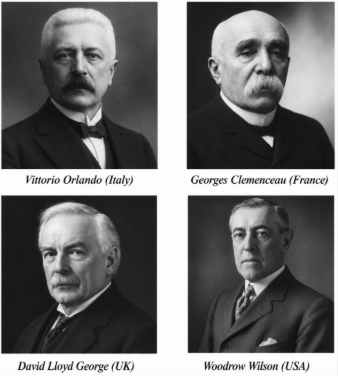
The Treaty of Versailles was another effort to address threats to world peace. It was signed in the devastation of the First World War. The Treaty was signed on 28th June, 1919, at the Palace of Versailles in Paris, France. It was drafted primarily by the “Big Four”, namely Woodrow Wilson (USA), David Lloyd George (Britain), Georges Clemenceau (France) and Vittorio Orlando (Italy) (see Figure 2.3). Each had distinct objectives: Wilson sought a fair peace based on his Fourteen Points; Clemenceau aimed to ensure France’s security and weaken Germany; Lloyd George sought to balance punishment of Germany with preservation of its economic stability; and Orlando sought territorial gains for Italy. However, Wilson’s vision of a just peace through his Fourteen Points, including the establishment of the League of Nations, was only partially realised.
In this regard, the Treaty of Versailles was a complex and controversial peace settlement that aimed to end the First World War and prevent future conflicts. It also sought to weaken Germany militarily and economically and to prevent future wars. Provisions included the loss of Alsace-Lorraine by Germany to France, the demilitarisation of Germany, and the imposition of reparations amounting to 132 billion gold marks.
Furthermore, the Treaty of Versailles achieved some successes, including the redrawing of European borders and the establishment of the League of Nations in 1920. It resolved international disputes, promoted collective security, and facilitated the creation of new nations such as Czechoslovakia and Yugoslavia, reflecting the principle of self-determination. However, its harsh terms for Germany and its failure to address underlying issues contributed to the rise of radicalism and global conflicts within just two decades, culminating in the outbreak of the Second World War. Overall, the treaty revealed the complexities of peacemaking and the importance of addressing the root causes of conflict.
| Activity 2.4 Read different sources, including online publications on Wilson’s Fourteen Points, then:
|
|
Figure 2.3: The “Big Four” leaders at the Versailles Peace Treaty of 1919. |
Exercise
1. The Versailles Peace Treaty was a complex and controversial peace settlement that aimed to end the First World War and prevent future conflicts. Justify how its approach sowed the seeds of future conflict rather than fostering lasting peace.
2. If you were Woodrow Wilson at the Versailles Conference, propose a negotiation plan that could have provided fairness for Germany while allied security needs.
3. To what extent can Wilson’s Fourteen Points be considered a realistic blueprint for lasting world peace?
ANSWERS TO THE EXERCISE
1. The Versailles Peace Treaty was a complex and controversial peace settlement that aimed to end the First World War and prevent future conflicts. Justify how its approach sowed the seeds of future conflict rather than fostering lasting peace.
The Treaty of Versailles was signed in 1919 after the defeat of Germany in the First World War. Although it was intended to restore peace and prevent another war, many of its terms created resentment, economic hardship and political instability. For this reason, the treaty contributed to conditions that later encouraged the outbreak of the Second World War.
(i) Germany was excluded from the negotiations.
German representatives were not allowed to participate meaningfully in drafting the treaty. They were presented with the final terms and forced to accept them. This made Germans regard the settlement as an imposed peace rather than a negotiated agreement.
(ii) The war guilt clause humiliated Germany.
Article 231 placed responsibility for the war and its damages on Germany and its allies. Many Germans considered this unfair because the outbreak of the war had resulted from the actions of several European powers.
(iii) Heavy reparations weakened the German economy.
Germany was required to pay large financial reparations to the victorious powers. These payments placed pressure on the economy and contributed to debt, inflation, unemployment and declining living standards.
(iv) Territorial losses created bitterness.
Germany lost territories in Europe and all its overseas colonies. Alsace-Lorraine was returned to France, while other areas were transferred to neighbouring states or placed under international control.
(v) The treaty separated German-speaking populations.
Some German-speaking communities were placed under the control of other states. This contradicted the principle of national self-determination and created demands for future border revision.
(vi) Military restrictions caused national humiliation.
The German army was reduced, conscription was prohibited, and Germany was denied an air force, submarines and certain heavy weapons. Germans viewed these restrictions as an attack on national pride and sovereignty.
(vii) Disarmament was applied unequally.
Germany was forced to disarm, but the victorious powers did not reduce their own military capabilities to the same extent. This created a sense of injustice and inequality.
(viii) The settlement weakened the Weimar Republic.
The new German democratic government was blamed for accepting the treaty. Political opponents described its leaders as traitors, weakening public confidence in democracy.
(ix) Economic suffering encouraged political extremism.
Unemployment, inflation and poverty caused many Germans to lose faith in moderate political parties. Extremist movements gained support by promising to reject the treaty and restore German strength.
(x) Adolf Hitler exploited resentment against Versailles.
Hitler gained popularity by promising to cancel the treaty, rebuild the armed forces, recover lost territories and unite German-speaking peoples.
(xi) The treaty applied self-determination selectively.
The principle was applied to some European peoples but ignored in many other cases, particularly in colonies and territories where different ethnic groups were placed within the same states.
(xii) The new boundaries created minority problems.
Several new states contained ethnic minorities that did not identify with the ruling national group. These tensions became sources of political instability.
(xiii) The League of Nations was structurally weak.
The treaty created the League of Nations to preserve peace, but the organisation lacked its own military force and depended on the willingness of member states to enforce decisions.
(xiv) The United States did not join the League of Nations.
The absence of the United States weakened the League politically, economically and militarily. This reduced its ability to respond effectively to aggression.
(xv) The treaty prioritised punishment over reconciliation.
A durable peace required cooperation and reintegration of Germany into the international system. Instead, many terms were designed to punish and weaken Germany, creating a desire for revenge.
(xvi) It failed to address the deeper causes of war.
Militarism, imperial rivalry, aggressive nationalism, economic competition and secret diplomacy were not completely eliminated. Therefore, important threats to peace remained.
(xvii) Conclusion.
The Treaty of Versailles restored peace in the immediate aftermath of the First World War, but it did not create a fair and stable European order. Its punitive terms, economic burdens, territorial changes and political humiliation created resentment in Germany and weakened democratic government. To a large extent, it sowed the seeds of future conflict rather than establishing lasting peace.
2. If you were Woodrow Wilson at the Versailles Conference, propose a negotiation plan that could have provided fairness for Germany while meeting Allied security needs.
As Woodrow Wilson, I would propose a settlement based on justice, reconciliation and collective security. Germany would be held responsible for specific damages, but it would not be humiliated or economically destroyed. At the same time, the Allied powers would receive credible guarantees against renewed German aggression.
(i) Include Germany in the peace negotiations.
German representatives should participate in discussions about territorial, military and economic terms. Their participation would increase the legitimacy of the settlement and reduce the claim that the treaty was dictated by the victors.
(ii) Replace the war guilt clause with shared responsibility.
The treaty should recognise that the war resulted from several causes, including alliances, nationalism, militarism, imperial competition and diplomatic failures involving several powers.
(iii) Set reparations according to Germany’s ability to pay.
Compensation should be limited to clearly identified civilian damages and reviewed regularly by an independent international commission.
(iv) Allow flexible payment arrangements.
Germany should be permitted to pay through manageable instalments, goods, industrial products and reconstruction assistance rather than through impossible immediate financial demands.
(v) Protect German economic recovery.
The Allies should recognise that a stable German economy was necessary for European trade and political stability. Germany should therefore retain enough productive capacity to recover and support its population.
(vi) Apply self-determination consistently.
Plebiscites should be held in disputed territories so that local populations could decide which state they wished to join.
(vii) Avoid unnecessary territorial punishment.
Territorial changes should be based on security, ethnicity and the wishes of inhabitants rather than on the desire to weaken Germany permanently.
(viii) Establish a temporary security zone instead of permanent humiliation.
The Rhineland could remain demilitarised for a fixed and clearly stated period under international supervision. The arrangement should be reviewed once Germany demonstrated peaceful behaviour.
(ix) Introduce balanced disarmament.
Germany should reduce its military forces, but other European powers should also participate in a gradual and verifiable programme of arms reduction.
(x) Permit Germany to maintain a defensive force.
Germany should retain a limited army sufficient for border protection and internal security, but not large enough to conduct aggressive war.
(xi) Create effective international inspections.
An impartial commission should inspect military facilities and investigate suspected violations in all participating states rather than focusing only on Germany.
(xii) Strengthen the League of Nations.
The League should have clear procedures for mediation, sanctions, collective defence and peaceful settlement of disputes.
(xiii) Guarantee German membership in the League.
Germany should be admitted after a short transitional period if it accepted the treaty and demonstrated peaceful conduct. Inclusion would encourage cooperation rather than isolation.
(xiv) Secure firm American participation.
The United States should join the League and guarantee support for France and other states if Germany committed aggression.
(xv) Give France collective security guarantees.
France’s fear of another German invasion should be addressed through a formal defence agreement involving Britain, the United States and other League members.
(xvi) Establish a permanent Franco-German commission.
The commission should handle disputes concerning borders, trade, reparations, transport and security before they became serious crises.
(xvii) Promote European economic cooperation.
Germany and the Allied powers should be encouraged to rebuild trade, transportation and industry together. Economic interdependence would make renewed warfare less attractive.
(xviii) Include a treaty review mechanism.
The settlement should be reviewed after five or ten years. Unfair or impractical terms could then be revised peacefully instead of being challenged through force.
(xix) Prohibit revenge propaganda and aggressive nationalism.
All governments should discourage political messages that glorified war, promoted ethnic hatred or encouraged territorial conquest.
(xx) Conclusion.
A fair settlement would combine limited reparations, consistent self-determination, controlled disarmament, German economic recovery and strong Allied security guarantees. Such a plan would protect France and other Allied states without turning Germany into an isolated and revenge-seeking power.
3. To what extent can Wilson’s Fourteen Points be considered a realistic blueprint for lasting world peace?
Woodrow Wilson presented the Fourteen Points in January 1918 as principles for ending the First World War and creating a more peaceful international order. They included open diplomacy, freedom of navigation, arms reduction, fair economic relations, national self-determination and the creation of a general association of nations. They provided an important vision for peace, but several points were difficult to apply in practice.
(i) Open diplomacy was a realistic response to secret alliances.
Secret treaties had increased suspicion and contributed to the international crisis before the First World War. Public agreements could have improved transparency and trust among states.
(ii) Arms reduction could have reduced militarism.
Limiting armaments would have lowered military competition and reduced the ability of states to launch large-scale wars. However, implementation required mutual trust and effective inspection.
(iii) Freedom of navigation could support peaceful international trade.
Allowing ships to travel freely in international waters could reduce disputes over blockades and maritime control. Nevertheless, major naval powers were reluctant to surrender strategic advantages.
(iv) Reduction of trade barriers could reduce economic rivalry.
Fairer trade relations could create economic interdependence and reduce tensions among states. However, governments often preferred to protect domestic industries and imperial markets.
(v) Self-determination responded to nationalist demands.
Allowing national groups to govern themselves could reduce resistance to foreign rule. This principle contributed to the creation of new states in Central and Eastern Europe.
(vi) Self-determination was difficult to apply consistently.
Many regions contained mixed populations, making it impossible to draw borders that satisfied every ethnic group. New states often included dissatisfied minorities.
(vii) The principle was not fully applied to colonies.
European colonial powers were unwilling to allow colonised peoples in Africa and Asia to exercise immediate self-determination. This exposed a major contradiction in Wilson’s programme.
(viii) The League of Nations was the strongest institutional proposal.
The idea of a permanent international organisation for negotiation and collective security was an important step towards preventing war.
(ix) The League lacked sufficient enforcement power.
The League had no permanent military force and depended on members to impose sanctions or take collective action. This made the idea less effective in practice.
(x) American non-membership weakened Wilson’s plan.
The United States Senate rejected membership in the League of Nations. Without the country that had proposed the organisation, the system lacked vital support.
(xi) The Fourteen Points underestimated national interests.
States often placed territory, security, economic gain and strategic advantage above ideal principles. Britain and France, for example, wanted compensation and protection from future German aggression.
(xii) The proposals underestimated the desire for revenge.
After years of destruction and loss, many Allied leaders and citizens demanded punishment of Germany. Wilson’s moderate approach had limited political support among some victorious powers.
(xiii) The plan did not provide detailed enforcement mechanisms.
The Fourteen Points stated broad principles but did not clearly explain how aggressive states would be restrained or how collective security would operate in a major crisis.
(xiv) Some proposals influenced later international institutions.
The ideas of collective security, peaceful dispute settlement, international cooperation and self-determination influenced the League of Nations, the United Nations and later international law.
(xv) The programme was morally attractive.
The Fourteen Points rejected revenge, conquest and secret manipulation. They offered a more just vision of international relations than traditional power politics.
(xvi) It was politically idealistic.
The plan assumed that states would cooperate and sacrifice narrow national interests for common peace. In reality, fear, rivalry and unequal power continued to shape international decisions.
(xvii) Overall assessment.
Wilson’s Fourteen Points were realistic to a moderate extent. They correctly identified several causes of international conflict and introduced valuable principles for peaceful cooperation. However, selective application, weak enforcement, colonial interests and great-power rivalry limited their immediate effectiveness.
(xviii) Conclusion.
The Fourteen Points were more successful as a long-term vision than as an immediate peace programme. They did not prevent renewed global conflict, but they influenced later efforts to establish international organisations, collective security, open diplomacy and national self-determination.
The League of Nations (1920)
The League of Nations was established in January 1920, following the end of the First World War as another international effort to address threats to world peace. Its headquarters were in Geneva, Switzerland. It was an international organisation established to maintain world peace. Inspired by Woodrow Wilson’s Fourteen Points, the organisation’s mission was to provide a platform for diplomacy, disarmament, and the peaceful resolution of disputes. In its establishment, the League of Nations aimed to prevent war through collective security and disarmament. Other goals were to improve global welfare by improving labour conditions, combating diseases, and protecting minority rights. The League of Nations was established in response to the devastating socio-economic impacts of the First World War.
The warring nations, having suffered from the First World War, proposed establishing an international body to foster the peaceful settlement of international disputes.
Wilson’s idealism embodied this new vision, even though the realities of national interests tested its viability.
The League of Nations sought to establish a new world order grounded in peace and cooperation. For example, it successfully resolved several minor disputes in the 1920s, including conflicts between Sweden and Finland (the Åland Islands) and between Greece and Bulgaria. In addition, the League’s specialised agencies addressed global challenges. For example, the International Labour Organisation (ILO) was established to improve working conditions, and the World Health Organisation (WHO) was formed to address various health challenges. These efforts demonstrated that the League was more than a political body; it was also an early experiment in global governance aimed at improving human welfare.
However, structural weaknesses undermined its effectiveness. For example, powerful nations, including the United States, were denied membership. The United States, in particular, was excluded because the US Senate opposed Wilson’s proposals. Major powers also withdrew from the League when their national interests appeared to be violated. Examples include Japan in 1933, following the Manchuria Report; Germany in 1933 under Hitler; and Italy in 1937, after condemnation of the invasion of Ethiopia.
The League also lacked a standing army to enforce its decisions, relying instead on economic sanctions and moral pressure. This reliance on voluntary cooperation left it vulnerable when aggressive powers such as Japan, Italy and Germany defied its authority. The Great Depression of the 1930s further weakened international solidarity, as nations prioritised domestic interests over collective security. By the late 1930s, the League had become powerless, unable to prevent the rise of fascism. Moreover, the League’s failure to respond decisively to Japan’s invasion of Manchuria in 1931, Italy’s conquest of Ethiopia in 1935, and Germany’s remilitarisation of the Rhineland in 1936 revealed how economic crises and aggressive nationalism could paralyse international cooperation. These crises underscored the gap between the League’s lofty ideals and the harsh realities of power politics.
Although it ultimately failed to prevent the outbreak of the Second World War, the League of Nations left significant lessons that shaped the foundation of the United Nations in 1945. While it enjoyed some successes in resolving minor disputes and advancing humanitarian causes, its structural weaknesses and lack of enforcement capacity rendered it incapable of halting the rise of militarism and aggression in the 1930s.
The outbreak of the Second World War marked the ultimate failure of the League of Nations. Nevertheless, the League’s pioneering ideas, including collective security, multilateral diplomacy, and the protection of minority rights, laid the groundwork for the formation of the United Nations Organisation (UNO) and the United Nations (UN). The UN was deliberately designed to address the League’s flaws by including all major powers, establishing a Security Council with binding authority, and creating mechanisms for economic development and human rights.
The United Nations Organisation (1945)
The establishment of the United Nations Organisation (UNO) in 1945 marked a turning point in the pursuit of global peace and security. Emerging from the chaos of the Second World War, the UNO was the product of a collective effort to prevent the recurrence of destructive wars worldwide.
As an international organisation, the UN maintained international peace and security, fostered friendly relations among nations, and addressed international problems through cooperation. It provided a forum for countries to discuss and collaborate on global issues, including peace, human rights, and economic development. Its creation was influenced by the failure of the League of Nations and the limitations of the 1919 Versailles Peace Treaty. The Second World War revealed how economic depression, aggressive nationalism, and unchecked militarism could destabilise the world order. The use of atomic bombs in Hiroshima and Nagasaki, and the devastation across Europe and Asia, convinced world leaders that a stronger, more inclusive system of international cooperation was necessary.
The United Nations Organisation was formally established on 24th October, 1945. Its founding was guided by the vision of leaders such as Franklin D. Roosevelt, Winston Churchill, and Joseph Stalin, who met at the Yalta Conference (February 1945) and later at the San Francisco Conference (June 1945) to prevent wars but also to promote human rights, development, and cooperation. Unlike the post–WWI settlement, which largely punished the aggressor nations, the post–WWII approach sought to establish mechanisms for dialogue and collective decision-making. This reflected a shift in international relations from punitive to preventive diplomacy, emphasising negotiation, arbitration, and peaceful fundamental human rights.
The UN differed significantly from the League of Nations. Established at Security Council with five permanent members: the USA, USSR, Britain, France, and China, each with veto power. The UN was tasked with broader goals of promoting human rights, fostering economic development and international cooperation through specialised agencies such as the World Bank and the International Monetary Fund (IMF). Another objective was to provide humanitarian aid through the United Nations Children’s Fund, originally known as the United Nations International Children’s Emergency Fund (UNICEF), and through the World Health Organisation (WHO).
The UN veto system reflected the realities of power politics at the time. The United States and the USSR, emerging as superpowers, would only join an international organisation that recognised their dominant roles. This pragmatic design, though criticised for enabling stalemates, allowed the UN to survive the intense ideological rivalries of the Cold War. Furthermore, the UN sought to prevent the outbreak of wars through diplomacy and collective security. That is, if one nation attacked, others would respond together. It also sought to promote respect for self-determination and sovereignty, encourage peaceful coexistence, and address global challenges in health, culture, education, and economic development. Moreover, the UN focused on promoting human rights and fundamental freedoms and on upholding the dignity and rights of all individuals, regardless of race, sex, language, or religion. This commitment to self-determination was particularly significant for colonised regions of Asia, Africa, and the Caribbean. The UN Charter, for example, permitted colonised countries to fight for their independence. African countries resisted this opportunity, and most achieved independence by the end of the 1960s. In fact, the post-World War Two period saw an unprecedented wave of mass nationalism, which can be partly credited to the enactment of the UN Charter.
Since its establishment, the UN has deployed peacekeeping forces in conflict zones, including the Congo in 1960, Cyprus and Lebanon, and, more recently, South Sudan and the Democratic Republic of the Congo. These missions have helped reduce violence, monitor resolutions, disarm warring factions, and protect civilians. The UN played a significant role in supporting decolonisation, granting legitimacy to independence movements in Asia and Africa. Moreover, during the Cold War, the UN’s peacekeeping capacity was often constrained by the ideological confrontation between the United States and the Soviet Union. Despite these limitations, the organisation served as a crucial forum for dialogue, preventing regional disputes from escalating into global war. After the Cold War, the UN assumed a more active role in humanitarian intervention, including in Rwanda in 1994 and in the Balkans, thereby illustrating its evolving mandate within a changing international system. It has also recently played a distinguished role in addressing emerging threats to global peace and security, including terrorism, human trafficking, and climate change.
The United Nations Organisation emerged in 1945 in response to the failures of the Versailles Peace Treaty and the League of Nations. With ambitious goals of maintaining peace, promoting cooperation, and safeguarding human rights, it has achieved significant successes, particularly in preventing another world war, supporting decolonisation, and promoting humanitarian causes. Yet its shortcomings, stemming from structural limitations, political rivalries, and selective interventions, have prevented it from fully realising its mission in all cases. Its continuing relevance lies in its adaptability. While criticised for its bureaucracy and the Security Council’s unequal power, the UN remains the only truly universal organisation through which global challenges such as climate change, pandemics, and nuclear proliferation can be addressed collectively.
Exercise
Evaluate the successes and failures of the United Nations Organisation in addressing global conflicts since 1945.
- In your opinion, is the United Nations still a relevant and practical body for solving today’s global challenges, such as terrorism?
- Propose alternative strategies that could make the United Nations more effective in preventing conflicts and addressing contemporary global challenges.
ANSWERS TO THE EXERCISE
Evaluate the successes and failures of the United Nations Organisation in addressing global conflicts since 1945.
The United Nations Organisation was established in 1945 following the destruction caused by the Second World War. Its principal objective was to maintain international peace and security by preventing conflicts, encouraging peaceful settlements, authorising peacekeeping operations and promoting cooperation among states. Since the first UN peacekeeping mission was established in 1948, the organisation has deployed 71 peacekeeping operations, although its results have varied considerably from one conflict to another. :contentReference[oaicite:0]{index=0}
(i) Success in preventing another world war.
One of the greatest achievements of the United Nations is that no third world war comparable to the conflicts of 1914–1918 and 1939–1945 has occurred. The UN has provided a permanent forum where states can discuss disagreements before resorting to war.
(ii) Successful peacekeeping operations.
UN peacekeepers have helped supervise ceasefires, separate fighting forces, protect civilians, support elections and assist countries in moving from conflict to peace. More than two million peacekeepers from approximately 125 countries have served under the UN flag since peacekeeping began. :contentReference[oaicite:1]{index=1}
(iii) Contribution to peace in Namibia.
The United Nations supervised the withdrawal of South African forces and supported elections that led to Namibia’s independence in 1990. This mission is often regarded as an example of successful peacekeeping and peaceful political transition.
(iv) Contribution to peace in Cambodia.
The United Nations helped implement a peace settlement in Cambodia, repatriated refugees, supervised elections and supported the restoration of government institutions after years of war.
(v) Restoration of peace in Sierra Leone.
The UN mission in Sierra Leone contributed to disarmament, the protection of civilians, the restoration of government authority and the conclusion of a destructive civil war. The mission operated from 1999 to 2005. :contentReference[oaicite:2]{index=2}
(vi) Support for peace in Liberia and Côte d’Ivoire.
UN operations helped disarm combatants, support elections, protect civilians and rebuild institutions following civil wars in these West African countries.
(vii) Mediation of international disputes.
The UN Secretary-General, special representatives and diplomatic missions have mediated conflicts and encouraged negotiations between opposing parties. In some cases, this has prevented disputes from escalating into wider wars.
(viii) Promotion of decolonisation.
The United Nations supported the principle of self-determination and provided an international platform through which colonised peoples demanded independence. This contributed to the decline of colonial rule in Africa, Asia and other regions.
(ix) Development of international law.
The UN has promoted treaties and conventions concerning genocide, refugees, human rights, disarmament and the conduct of war. These legal frameworks have established standards by which governments and individuals can be judged.
(x) Provision of humanitarian assistance.
UN agencies have provided food, shelter, healthcare, education and refugee protection during wars and humanitarian emergencies. Such assistance has reduced suffering even where the organisation has failed to end the underlying conflict.
(xi) Promotion of collective security.
The UN Security Council can impose sanctions, authorise peacekeeping missions and approve collective military action when international peace is threatened. This principle discourages states from treating aggression as a purely private matter.
(xii) Establishment of international criminal accountability.
The UN helped establish tribunals to prosecute individuals responsible for genocide, war crimes and crimes against humanity in places such as Rwanda and the former Yugoslavia. This strengthened the principle that political and military leaders can be held personally responsible for serious crimes.
(xiii) Failure to prevent the Rwandan genocide.
In 1994, the United Nations failed to respond effectively to the mass killing of Tutsi and moderate Hutu civilians in Rwanda. The peacekeeping mission lacked adequate troops, resources and a strong mandate to stop the violence.
(xiv) Failure at Srebrenica.
In 1995, thousands of Bosnian Muslim men and boys were killed after the fall of Srebrenica, which had been declared a UN safe area. The incident demonstrated the danger of deploying peacekeepers without sufficient military capacity and political support.
(xv) Inability to prevent some major wars.
The United Nations failed to prevent conflicts such as the Vietnam War, the Soviet intervention in Afghanistan, the Iran-Iraq War and the 2003 invasion of Iraq. In many such cases, the interests of powerful states limited collective action.
(xvi) The Security Council veto frequently causes paralysis.
Each of the five permanent members of the Security Council can block a substantive resolution by casting a negative vote. When a permanent member or its close ally is involved in a conflict, the veto may prevent decisive action. :contentReference[oaicite:3]{index=3}
(xvii) Unequal representation in the Security Council.
The permanent membership reflects the distribution of power after the Second World War rather than contemporary global realities. Africa and Latin America, for example, have no permanent seats despite their large populations and substantial membership in the UN.
(xviii) Dependence on member states.
The United Nations does not possess its own permanent army. It depends on member states to provide troops, funds, equipment and political support. Delays or unwillingness by governments can weaken its response.
(xix) Peacekeepers sometimes receive weak mandates.
Some missions are authorised only to observe ceasefires even when civilians face immediate danger. Peacekeepers may be unable to act effectively when there is no peace agreement to enforce.
(xx) Some missions have remained for many years without resolving conflicts.
Long-running operations in regions such as the Middle East, Cyprus and the Democratic Republic of the Congo show that peacekeeping can control violence without eliminating its political causes.
(xxi) Allegations of misconduct have damaged credibility.
Some peacekeepers have been accused of sexual exploitation, abuse, corruption and misconduct. Such incidents undermine the trust of the communities whom the UN is expected to protect.
(xxii) Sanctions may harm ordinary citizens.
Economic sanctions intended to pressure governments can cause unemployment, shortages and declining living standards among civilians without necessarily changing the behaviour of political leaders.
(xxiii) Political interests often produce double standards.
The United Nations may respond strongly to one conflict but weakly to another because powerful states have different strategic, economic or political interests.
(xxiv) Overall evaluation.
The United Nations has achieved considerable success in peacekeeping, mediation, humanitarian relief, decolonisation and the development of international law. Research presented by the organisation indicates that peacekeeping can reduce civilian casualties, shorten conflicts and improve the durability of peace agreements. Nevertheless, success is never guaranteed, especially where combatants reject peace or powerful states refuse to cooperate. :contentReference[oaicite:4]{index=4}
(xxv) Conclusion.
The UN has not eliminated war, but it has prevented, contained or resolved many conflicts and reduced human suffering. Its greatest failures have generally occurred where it lacked unity among powerful states, adequate resources, a clear mandate or cooperation from the conflicting parties.
(i) In your opinion, is the United Nations still a relevant and practical body for solving today’s global challenges, such as terrorism?
In my opinion, the United Nations remains relevant and necessary, but its effectiveness depends on reform and stronger cooperation among member states. Contemporary problems such as terrorism, cybercrime, climate change, refugee movements, pandemics and organised crime cross national borders and cannot be addressed effectively by individual countries acting alone.
(i) Terrorism is a transnational challenge.
Terrorist organisations may recruit members in one country, obtain funding from another, communicate through global digital networks and conduct attacks elsewhere. International cooperation is therefore essential.
(ii) The UN provides a common legal framework against terrorism.
Through the Security Council, General Assembly and specialised offices, the organisation promotes cooperation in preventing terrorist financing, border movement, recruitment and violent extremism.
(iii) The UN coordinates international counter-terrorism efforts.
The United Nations Office of Counter-Terrorism supports member states in implementing the Global Counter-Terrorism Strategy, while the Security Council’s Counter-Terrorism Committee assesses national efforts and promotes cooperation. :contentReference[oaicite:5]{index=5}
(iv) It helps weaker states build capacity.
Some countries lack sufficient technology, intelligence systems, trained personnel and border-control institutions. UN programmes can provide training and technical assistance.
(v) It addresses conditions that encourage extremism.
Terrorism cannot be defeated through military force alone. Poverty, political exclusion, injustice, weak institutions, youth unemployment and unresolved conflicts may contribute to radicalisation.
(vi) It protects human rights in counter-terrorism.
The UN reminds states that measures against terrorism should respect human rights and international law. Abusive counter-terrorism policies may create resentment and further radicalisation.
(vii) The organisation provides global legitimacy.
Actions approved by the United Nations generally possess greater international legitimacy than unilateral operations conducted by one state or a small group of countries.
(viii) It remains a universal diplomatic forum.
Nearly all recognised states can present their concerns at the UN. Even hostile governments can communicate indirectly through its meetings, agencies and representatives.
(ix) Its effectiveness is limited by political division.
Member states sometimes disagree over which organisations should be labelled terrorist groups. They may also support different sides in regional conflicts, making collective action difficult.
(x) The veto limits practical action.
When the permanent members disagree, the Security Council may fail to act even in situations involving serious threats to international peace.
(xi) Slow decision-making reduces effectiveness.
The UN is a large organisation composed of sovereign states with different interests. Negotiation and approval processes may be too slow for rapidly developing crises.
(xii) Overall judgement.
The United Nations remains relevant because no other organisation combines global membership, diplomatic legitimacy, humanitarian institutions, peacekeeping experience and international legal authority. However, it is practical only when member states provide political support, funding, intelligence and personnel.
(xiii) Conclusion.
The UN should not be judged as an independent world government because it is an organisation created and controlled by states. Its weaknesses often reflect the unwillingness of member states to cooperate. It remains necessary, but it requires significant institutional and political reforms.
(ii) Propose alternative strategies that could make the United Nations more effective in preventing conflicts and addressing contemporary global challenges.
The United Nations can become more effective through reforms that improve representation, early action, accountability, financing and cooperation with regional organisations.
(i) Reform the Security Council.
The membership of the Council should be expanded to provide fairer representation to Africa, Latin America, Asia and other underrepresented regions. Discussions on equitable representation and enlargement of the Council remain part of the UN reform process. :contentReference[oaicite:6]{index=6}
(ii) Restrict the use of the veto.
Permanent members should voluntarily refrain from using the veto in cases involving genocide, war crimes, ethnic cleansing and crimes against humanity.
(iii) Require public justification of every veto.
A permanent member using the veto should explain its decision before the General Assembly. The General Assembly has already established automatic debate following the use of a Security Council veto, increasing political accountability. :contentReference[oaicite:7]{index=7}
(iv) Establish a permanent rapid-reaction force.
The UN should have trained personnel and equipment available for immediate deployment when civilians face imminent danger. This would reduce dependence on slow voluntary troop contributions.
(v) Strengthen early-warning systems.
The organisation should collect and analyse information concerning hate speech, military mobilisation, disputed elections, terrorism, displacement and competition over resources before violence begins.
(vi) Prioritise preventive diplomacy.
Mediators and special envoys should be deployed before disagreements develop into armed conflict. Prevention is less costly than peacekeeping and post-war reconstruction.
(vii) Provide clearer peacekeeping mandates.
Peacekeepers should receive realistic responsibilities, adequate resources and clear authority to protect civilians when necessary.
(viii) Improve peacekeeper training and accountability.
All peacekeepers should receive strong training in human rights, civilian protection and prevention of sexual exploitation. Personnel accused of serious misconduct should be investigated and prosecuted promptly.
(ix) Secure predictable funding.
Peacekeeping, humanitarian and conflict-prevention programmes should not depend excessively on delayed or politically conditional contributions from a few states.
(x) Strengthen cooperation with regional organisations.
The UN should work more closely with the African Union, European Union and other regional bodies because they may possess better knowledge of local political conditions.
(xi) Address the root causes of conflicts.
Conflict-prevention programmes should address poverty, political exclusion, corruption, inequality, unemployment, environmental degradation and unfair distribution of resources.
(xii) Promote inclusive peace negotiations.
Women, young people, minority communities, civil society organisations and displaced populations should participate in peace processes rather than leaving negotiations only to armed groups and political elites.
(xiii) Improve the implementation of peace agreements.
The UN should monitor agreements for several years and support disarmament, justice, elections, constitutional reform and economic reconstruction.
(xiv) Strengthen international control of arms.
The organisation should improve monitoring of illegal weapons, ammunition and military technology supplied to conflict zones.
(xv) Improve responses to terrorism.
States should share intelligence, control terrorist financing, secure borders and counter online recruitment while protecting human rights and avoiding discrimination.
(xvi) Strengthen cybersecurity cooperation.
The UN should develop international rules against cyberattacks on hospitals, communication systems, financial institutions and essential public infrastructure.
(xvii) Regulate the dangerous use of artificial intelligence.
Member states should cooperate in preventing terrorists, criminal organisations and hostile actors from using artificial intelligence for recruitment, propaganda, cyberattacks or autonomous violence. Contemporary UN discussions increasingly recognise the misuse of emerging technologies as a security concern. :contentReference[oaicite:8]{index=8}
(xviii) Improve sanctions.
Sanctions should target political leaders, military commanders, companies and financial networks responsible for aggression rather than imposing broad suffering on civilian populations.
(xix) Strengthen the authority of international justice.
States should cooperate with international courts and ensure that individuals accused of genocide, war crimes and crimes against humanity are investigated fairly.
(xx) Reform development assistance.
International support should build employment, education, public institutions and local economic opportunities in fragile states instead of merely responding after crises occur.
(xxi) Increase transparency.
Peacekeeping budgets, sanctions decisions, contracts and mission assessments should be publicly accessible to reduce corruption and build trust.
(xxii) Conduct regular reviews of UN missions.
Each operation should be assessed according to clear objectives. Missions that are failing should be reformed, strengthened or replaced with more appropriate political strategies.
(xxiii) Conclusion.
The United Nations can become more effective through Security Council reform, restricted veto use, preventive diplomacy, rapid deployment, reliable funding and stronger regional partnerships. Reform should also address new threats such as terrorism, cybercrime, artificial intelligence and climate-related insecurity. Ultimately, however, institutional reform will succeed only when member states place collective peace above narrow national interests.
| Activity 2.5 Read various sources, including online and published materials, about the Berlin Conference, Versailles Treaty, League of Nations and United Nations, then: i. Design a comparative timeline of all these efforts. ii. Identify the goals, successes, failures, and impact of each effort on global peacebuilding. |
www.learninghubtz.co.tz
Revision exercise
1. Analyse the role of the Berlin Conference of 1884-1885 in promoting international peace and stability in Europe and creating chaos and instability in Africa.
2. Assess the long-term political and social consequences of the Berlin Conference resolution in Africa.
3. Elucidate the role played by the Versailles Peace Treaty in the outbreak of World War II.
4. Discuss how the structural weaknesses of the League of Nations undermined international peacekeeping during the interwar period.
5. In what ways did the Manchurian Crisis precipitate further global conflict in the 1930s?
6. To what extent can the Manchurian Crisis be considered as the first step toward World War II?
7. Discuss the assertion that the Versailles Peace Treaty was more of a source of conflict than a solution to the problem of world peace.
8. Assess the effectiveness of the League of Nations in maintaining peace between 1920 and 1939.
9. Evaluate the successes and limitations of the United Nations Organisation in addressing threats to world peace since 1945. Provide specific examples to support your arguments.
10. Compare and contrast the intentions behind the Berlin Conference and the Versailles Peace Treaty.
11. Discuss how the Berlin Conference and the Versailles Peace Treaty defended the interests of powerful states at the expense of weaker regions or nations.
12. Evaluate the role, achievements and key lessons that can be drawn from the League of Nations and the United Nations Organisation in an attempt to maintain world peace.
13. With reference to any three case studies, explore the weaknesses of the UN peacekeeping missions in an attempt to prevent wars and conflicts.
14. Suggest innovative strategies that global and regional organisations can adopt to strengthen long-term peacekeeping efforts.
15. Discuss the statement that while the Berlin Conference prevented war among European powers, it precipitated wars between European powers and African chiefs.

Hub App
 For Call,Sms&WhatsApp: 255769929722 / 255754805256
For Call,Sms&WhatsApp: 255769929722 / 255754805256  MATOKEO YA KIDATO CHA VI 2026
SECONDARY REGIONAL EXAMS
PRIMARY REGIONAL EXAMS
FORM VI NECTA REVIEWS
FORM IV NECTA REVIEWS
FORM II NECTA REVIEWS
STD VII NECTA REVIEWS
STD IV NECTA REVIEWS
SECONDARY EXAMS SERIES
PRIMARY EXAMS SERIES
PRIMARY SUBJECT NOTES
SECONDARY SUBJECT NOTES
SECONDARY TOPICAL EXAMS
SECONDARY TOPICAL QUESTIONS
PRIMARY TOPICAL QUESTIONS
PRACTICAL EXAMS & NOTES
SECONDARY REGIONAL EXAMS
DOWNLOAD SUBJECT NOTES
SCHEMES OF WORK (PRIMARY & SECONDARY)
LESSON PLAN
SECONDARY LOG BOOKS
PRIMARY LOG BOOKS
LITERARY WORKS / UCHAMBUZI VITABU
METHALI ZOTE ZA KISWAHILI
Vitendawili Vya Kiswahili
FORM VI RESULTS 2024
FORM FIVE SELECTION 2024
Matokeo KIDATO CHA II 2024
Matokeo Darasa IV 2024
MATOKEO KIDATO CHA IV 2023
FORM ONE SELECTION 2024
FORM VI RESULTS 2023
Matokeo Darasa IV 2022
MATOKEO YA KIDATO CHA VI 2026
SECONDARY REGIONAL EXAMS
PRIMARY REGIONAL EXAMS
FORM VI NECTA REVIEWS
FORM IV NECTA REVIEWS
FORM II NECTA REVIEWS
STD VII NECTA REVIEWS
STD IV NECTA REVIEWS
SECONDARY EXAMS SERIES
PRIMARY EXAMS SERIES
PRIMARY SUBJECT NOTES
SECONDARY SUBJECT NOTES
SECONDARY TOPICAL EXAMS
SECONDARY TOPICAL QUESTIONS
PRIMARY TOPICAL QUESTIONS
PRACTICAL EXAMS & NOTES
SECONDARY REGIONAL EXAMS
DOWNLOAD SUBJECT NOTES
SCHEMES OF WORK (PRIMARY & SECONDARY)
LESSON PLAN
SECONDARY LOG BOOKS
PRIMARY LOG BOOKS
LITERARY WORKS / UCHAMBUZI VITABU
METHALI ZOTE ZA KISWAHILI
Vitendawili Vya Kiswahili
FORM VI RESULTS 2024
FORM FIVE SELECTION 2024
Matokeo KIDATO CHA II 2024
Matokeo Darasa IV 2024
MATOKEO KIDATO CHA IV 2023
FORM ONE SELECTION 2024
FORM VI RESULTS 2023
Matokeo Darasa IV 2022
WHATSAPP US NOW FOR ANY QUERY
App Ya Learning Hub Tanzania