Chapter 01: Standard pronunciation
| Introduction Learning activities in standard pronunciation involve generating spoken language content using accurate pronunciation, stress and intonation in British English. The Standard Pronunciation of British English is the 'Received Pronunciation', in short, referred as RP. In this chapter, you will articulate words and sentences; describe objects, events, and situations; and participate in discussions on various topical issues to practise standard pronunciation. The competencies developed will enable you to access a wide range of materials tailored to your level, and enhance your listening skills, vocabulary acquisition, and overall language production and comprehension. |
| Think about
|
Activity 1.1 Articulating English sounds in words and sentences
(a) Pronounce the following words while paying attention to the stress and complete the tasks that follow. Standard pronunciation is provided after the spelling of each word.
1. rural /ˈrʊərəl/
2. squirrel /ˈskwɪrəl/
3. thorough /ˈθʌrə/
4. colonel /ˈkɜːnəl/
5. sixth /sɪksθ/
6. specific /spɪˈsɪfɪk/
7. phenomenon /fəˈnɒmɪnən/
8. entrepreneur /ˌɒntrəprəˈnɜː
9. exacerbate /ɪɡˈzæsəbeɪt/
10. isthmus /ˈɪsməs
11. pseudonym /ˈsuːdənɪm/
12. examine /ɪɡˈzæmɪn/
13. quinoa /ˈkiːnwɑː/
14. synecdoche /sɪˈnekdəki/
15. tsunami /tsuːˈnɑːmi/
16. xylophone /ˈzaɪləfəʊn/
17. island /ˈaɪlənd/
18. determine /dɪˈtɜːmɪn/
(b) Find the meaning of all the words in Activity 1.1 (a) and construct 10 sentences using words of your choice from the list.
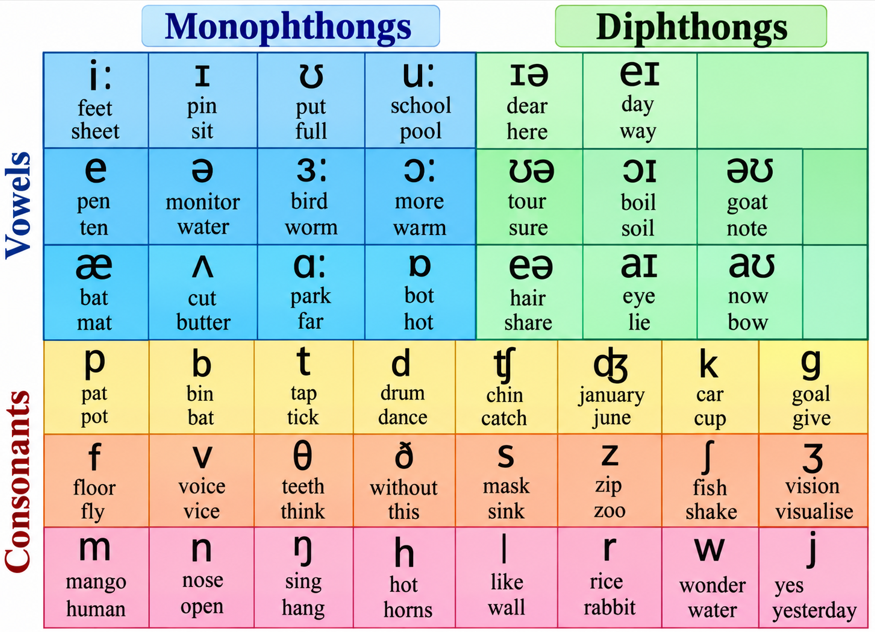
(c) Practise pronouncing each of the phonemes in the following Phonemic Chart and the words written below each phoneme. Think of any other words that contain such a phonemic sound and pronounce them.
|
Figure 1.1: Phonemic Chart |
(d) Read aloud the following poem while paying attention to the correct pronunciation of words.
In nature’s realm, where language weaves,
A poem sprouts with minimal leaves,
Leaf, leave, distinct as day and night,
A word’s journey takes flight.
Complement, compliment, a duo’s embrace,
One adds, the other shows grace.
Principal, principle, guiding light,
Leadership and truth take their right.
Elicit, illicit, the secrets unfold,
One seeks truth, while the other’s bold.
Proceed, precede, the order we told,
One comes first, and the other moves ahead.
Emigrate, immigrate, a tale of transition,
Leaving one’s land, and embracing a new vision.
Discreet, discrete, a subtle divide,
One’s cautious, the other’s set aside.
Stationary, stationery, words on a page,
One motionless, the other’s a sage.
Accept, except, a choice to be made,
One takes in, the other’s a shade.
Advice, advise, wisdom’s sweet sound,
One offers guidance, the other’s profound.
In language’s tapestry, these pairs entwine,
A symphony of words, harmonious and fine.
So let us explore their meanings sincerely,
These minimal pairs, to our hearts, draw near.
For in their subtlety, beauty does reside,
A poetic dance, where language takes a stride.
(e) Re-read the poem to practise pronunciation and do the following activities.
- Identify all the minimal pairs from the poem in Activity 1(d).
- Pronounce the minimal pairs you have identified in (1).
- Describe the phonological features that distinguish the minimal pairs you have identified.
DID YOU KNOW?
The two words in bold in the first stanza of the poem form a minimal pair. The concept of minimal pairs is an important aspect of phonetics and phonology. It refers to pairs of words that differ in meaning by only one sound or phoneme in the same position. In other words, minimal pairs are pairs of words that share the same sounds except for one phoneme, which, when changed, leads to a different meaning.
(f) Listen to the teacher or fellow student saying the words in Column 1 and Column 2. Say the words in the words in Column 1 or Column 2.
| Column 1 | Column 2 |
| Fit Pins Lick Grass Chin Ship Steering Hit It sit wick | Feet Beans leak Glass Cheap Sheep Heat stealing Eat seen week |
(g) Listen to your teacher or fellow student reading the sentences below. Circle the word you hear out of the two underlined words in each sentence.
- They need more bins/beans.
- It is not right/light yet.
- Do you want a tick/lick?
- He wants to buy the ship/sheep.
- He was steering/stealing the car.
- I can’t give you this chip/cheap.
- Your mouth I think is.
- He does feet sometimes.
- It was a long wick/week.
- The child had ice/lice in his hair.
Activity 1.2
Articulating words with appropriate syllable divisions
(a) Read the following words aloud paying attention to the divisions in brackets.
- chocolate (cho-co-late)
- elephant (el-e-phant)
- computer (com-put-er)
- camera (cam-er-a)
- telephone (tel-e-phone)
- restaurant (res-tau-rant)
- football (foot-ball)
- television (tel-e-vi-sion)
- dinosaurs (di-no-saurs)
- basketball (bas-ket-ball)
- universe (u-ni-verse)
- lift (lift)
- guitar (gui-tar)
- library (li-brar-y)
- banana (ba-na-na)
- octopus (oc-to-pus)
DID YOU KNOW?
The words in Activity 1.1(a) have been broken down into syllables. Syllables serve as building blocks for spoken and written language, and understanding them is essential for effective communication and developing English proficiency. Syllables are important in learning English for several reasons.
Pronunciation: Understanding syllables helps learners pronounce words correctly. By breaking down words into syllables, learners can focus on articulating each sound correctly, which improves their overall pronunciation.
Spelling: Knowing syllable patterns can assist learners in spelling words correctly. Many spelling rules in English are based on syllable patterns, such as doubling consonants before adding suffixes or using different vowel combinations.
Reading: Recognising syllables can help in decoding unfamiliar words while reading. By breaking words down into syllables, learners can more easily articulate and understand new vocabulary encountered in reading materials.
Writing: When writing, understanding syllables can help learners with wordchoice, sentence structure, and overall clarity. Breaking sentences into syllablescan also help learners improve their sentence rhythm and flow.Language fluency: Mastery of syllables contributes to overall language fluency.When learners can identify and produce English syllables accurately, they can communicate more effectively and confidently both in oral and in written forms.
b) Read the following paragraph aloud. Then, complete the task that follows.In the academic field, intellectual discourse often flourishes on sophisticatedconcepts that stimulate curiosity and push innovation forward. Through thoroughinvestigation and analysis, scholars reveal the complexities of the world, seekingto uncover profound truths that enrich our understanding of existence.
- Copy all the italicised words in the paragraph above and divide theminto syllables.
- Read each word that you have copied in (1) by pronouncing eachsyllable appropriately using standard British English.
- Construct oral and written sentences using the italicised words.
c) Play the Syllable Race game by dividing yourselves into teams.
- Prepare a list of 10 words.
- Take turns in saying a word and let the other team say how manysyllables the word contains. You should pronounce each word andsyllables correctly.
- The team that identifies the syllables and pronounces all the wordscorrectly wins.
www.learninghubtz.co.tz
Exercise
1.(a) Define the term Standard Pronunciation as used in the study of English Language.
(b) Explain the meaning of Received Pronunciation (RP).
(c) Discuss three reasons why standard pronunciation is important to an advanced secondary school student.
(d) Explain how mastery of standard pronunciation can influence a student's effectiveness in public speaking and interpersonal communication.
2. (a) Transcribe the following words using the appropriate phonemic symbols:
- rural
- squirrel
- thorough
- colonel
- phenomenon
(b) Identify the stressed syllable in each word.
(c) Explain the importance of word stress in effective spoken English.
(d) Construct one meaningful sentence using any three of the words.
3. (a) What is a phoneme?
(b) Distinguish between a phoneme and a letter.
(c) Using suitable examples, explain how phonemic differences can result in differences in meaning.
(d) Explain how the use of a phonemic chart can help an English Language student improve pronunciation.
4. Consider the following pairs of words:
- leaf – leave
- complement – compliment
- principal – principle
- elicit – illicit
- proceed – precede
(a) Define the term minimal pair.
(b) Identify the phoneme that distinguishes each pair.
(c) Explain how the difference in one phoneme changes the meaning of the words.
(d) Construct meaningful sentences using any three pairs.
(e) Explain why knowledge of minimal pairs is important in English pronunciation.
5. (a) Distinguish between the meanings and pronunciations of the following pairs:
- advice – advise
- emigrate – immigrate
- discreet – discrete
- stationary – stationery
- accept – except
(b) For each pair, explain the potential communication problem that may arise from incorrect pronunciation.
(c) Use each pair in meaningful sentences to demonstrate the difference in meaning.
(d) Explain the relationship between pronunciation and meaning in spoken communication.
6. Study the following pairs:
- fit – feet
- lick – leak
- chin – cheap
- ship – sheep
- hit – heat
- wick – week
(a) Identify the vowel sounds that distinguish each pair.
(b) Describe the articulatory difference between the vowel sounds in ship and sheep.
(c) Explain why a speaker may unintentionally change the meaning of a word by producing an incorrect vowel sound.
(d) Give four additional minimal pairs that demonstrate differences in English vowel sounds.
7. (a) What is meant by syllable division?
(b) Divide the following words into their appropriate syllables:
- chocolate
- elephant
- computer
- restaurant
- television
- universe
- library
- octopus
(c) Identify the stressed syllable in any four of the words.
(d) Explain four ways in which knowledge of syllables contributes to effective English language learning.
(e) Discuss the relationship between syllable knowledge and correct pronunciation.
8. Consider the following words:
entrepreneur, exacerbate, pseudonym, examine, quinoa, synecdoche, tsunami, xylophone, determine
- Divide any six of the words into syllables.
- Mark the primary stress in each of the six words.
- Write the standard British English pronunciation of any four words using phonemic symbols.
- Explain the difficulties that a learner may encounter when pronouncing unfamiliar English words.
- Suggest four strategies that can help an advanced learner overcome pronunciation difficulties.
9. Read the following passage carefully:
“In the academic field, intellectual discourse often flourishes on sophisticated concepts that stimulate curiosity and push innovation forward. Through thorough investigation and analysis, scholars reveal the complexities of the world, seeking to uncover profound truths that enrich our understanding of existence.”
- Identify six words from the passage whose pronunciation requires particular attention.
- Divide the selected words into syllables.
- Mark the stressed syllable in each selected word.
- Explain the role of stress, rhythm and intonation in delivering the passage effectively.
- Read the passage aloud using appropriate standard British English pronunciation.
10. Standard pronunciation involves more than simply producing individual sounds correctly.
(a) Explain the meaning of the following terms:
- pronunciation
- stress
- intonation
- phoneme
- syllable
(b) Discuss how these features work together to make spoken English clear and effective.
(c) Using relevant examples from English, explain how incorrect pronunciation can lead to misunderstanding.
(d) Assess the importance of standard pronunciation to a student who intends to participate in academic discussions, public speaking and future professional communication.
(e) Suggest five practical activities that a Form Five student can undertake to improve standard pronunciation.
Activity 1.3 Applying word stress in speaking and in reading sentences aloud
a) Read the following sentences aloud. Pay attention to the syllables in bold as theyindicate word stress.
- The sun is shining brightly in the sky.
- She likes to read books in her spare time.
- The teacher asked the class to complete the assignment.
- He enjoys playing football with his friends.
- Africa is known for its diverse culture and traditions.
- They enjoy listening to music in the evening.
- The students are studying hard for their exams.
- The rain fell softly on the ground.
- The bike ride was a fun and exciting adventure.
- She enjoys spending time with her family and friends
Activity 1.4Describing objects, events, and situations The words in the sentences in Activity 1.3 (a) contain stressed and unstress syllables. Stress refers to the emphasis placed on certain syllables within words or force length and pitch compand stressed syllables are pronounced without words on force, length and pitch compared to unstressed syllables. Stress paternes with preater English is considered as a stress timed and that is and linguistic patterns vary occur at a considered a language, meaning linguistic context occur at approximately intervals leading to meanings, Incorrect stress plemiscom placement can effect the misunderstanding, stressed syllables pronunciation and understanding stress patterns is essential for appropriate and clear communication in English
(b) Pronounce the following words and identify stressed syllables in each of the words. You may use dictionaries or internet sources to help you. Your task will become easier if you first divide each word into its syllables.
| Television, dictionary, lemonade,thermometer ,cucumber, extraordinary, correspondence, Watermelon , hippopotamus ,opportunity ,immediately, multiplication, unbelievable,accommodate, misunderstand , contradiction ,necessitate, exaggerate |
(c) Read the following sentences and considering the difference in the meaning of the word underlined word
- The object to the project proposal. found a strong object in the room.
- The present awards every year. The gift is a beautifull present.
- The record hows her last performance. Please record your performance.
- He will permit you to center. He require entry permit.
- They suspect was subjected to other integration. They suspect someone of frying to sabotage the place.
- The contract state the time neatly. I will contact for teacher job
- The desert has interest. Please dont desert me.
(c) Read the following sentences carefully, Practise reading aloud. Then explotion what emotion each sentence elicts when you use appropriate Intonation.
- I can't believe you did that!
- What a beautiful day it is!
- I'm not sure if I can attend the party.
- That's a great ideal
- Could you please pass me the salt?
- I told you to be carefully
- I'm really looking forward to the concert tonight.
- Why don't we go out for dinner?
- I'm worry, I won't make It.
- What do you want for your birthday?
DID YOU KNOW?
The sentences in Activity 1.4 (a) express different emotions, meanings and attitudes. There some of the main functions of intonation in spoken English. Intonation refers, among other things, to variations in pitch, stress, and rhythm patterns in spoken language. It crucially conveys meanings, emotions, and attitudes in communication. Intonation patterns can indicate whether an utterance is a question, a statement, a command, or an expression of surprise, among others. Rising intonation at the end of a sentence is often used to ask yes/no questions, while falling intonation typically indicates a wh- question or common statement. Additionally, changes in intonation can convey emphasis, sarcasm, uncertainty, or excitement. Therefore, intonation influences the overall interpretation of a spoken utterance. Mastering intonation is essential for effective communication and natural-sounding speech in English.
(b) Read the following passage and then, complete the activities that follow.
Tuntemeke owned a big furniture shop. It was full of unique and exquisite pieces that brought charm and comfort to homes far and wide. As I entered the shop, the first thing that caught my eye was a magnificent antique clock standing tall in the corner. Its melodious chimes echoed through the store, marking the passage of time with a sense of elegance and nostalgia. Adjacent to the clock, there sat a plush velvet armchair, signalling me to seat and enjoy its embrace. The soft fabric caressed my skin as I settled into its comfy cushions, the perfect spot to curl up with a good book, surf the net or indulge in daydreams. Walking further, I discovered a sleek glass dining table that seemed to defy gravity. Its transparent surface showcased the intricate design of the base, creating an illusion of weightlessness. Around the table was an eclectic mix of chairs, each with its own personality, from a vibrant red chair to a vintage wooden one that exuded timeless charm. In the bedroom section, a sumptuous canopy bed adorned with flowing curtains and intricate carvings stole the spotlight. Its regal presence commanded attention, promising nights of blissful slumber in its embrace. The accompanying elegant dresser and matching nightstands added a touch of sophistication, their polished surfaces reflecting the warm glow of the bedside lamps. Venturing into the sitting room area, I was captivated by a contemporary modular sofa, its versatile design allowing me to arrange and rearrange the sections to fit my space. The bold colour choice made a statement, infusing the room with a burst of energy and personality. Nearby, a charming coffee table made from reclaimed wood showcased the beauty of imperfections. Its knots and grain patterns told stories of its past, adding character to the room. On the table, a whimsical ceramic vase held a bouquet of freshly picked flowers, infusing the air with their sweet fragrance. As I explored every nook and cranny of the store, I couldn't help but admire the expertly crafted bookshelves that lined the walls. Each shelf held a diverse collection of books, their spines creating a colourful mosaic that invited me to embark on new adventures and explore different worlds. Throughout the store, the knowledgeable staff shared their passion for each piece, their voices rising and falling with excitement as they described the unique features and craftsmanship. Their intonation breathed life into the furniture, turning mere objects into storytellers and inviting me to create my own narrative within the walls of my home. Leaving the store, I carried with me the inspiration and warmth that each piece had ignited. The furniture from "Harmony Home Furnishings" will forever be a testament to the artistry and comfort that can transform a house into a home.
- Study the sentences with words in bold. How do the words in bold enhance the sentences containing them?
- Use the words in bold to write a passage describing a scenario of your choice.
(c) Describe images or objects in terms of size, colour, shape, meaning conveyed, and/or other relevant details with appropriate intonation.
(d) Share your personal experience of any event in your life. In your story, focus on using appropriate intonation to convey the importance, excitement, or seriousness of the events.
Activity 1.5 | Participating in discussions on various topical issues
(a) Study carefully the following statements. Then, say what the speaker assumes the hearer knows.
- When are you planning to visit your grandparents?
- Have you told your parents about your decision?
- I finished my homework before watching TV.
- What did your friends think about the party?
- We haven't returned the book yet.
- My interview went well.
- She is going to pass the exam this time.
- He will be joining us for dinner tonight.
- Why did you change your mind about the trip?
- When did you decide to start learning the guitar?
- How long have you been living in this neighbourhood?
- Email us your opinion on the new school policy.
- Where did you find the keys to the car?
- We finished our chores yesterday.
- What do you think about the upcoming school event?
DID YOU KNOW?
All the 15 statements in Activity 1.5 (a) contain presuppositions. A presupposition refers to an implicit assumption or belief that underlies the meaning of a statement, question, or conversation. It is what the speaker assumes to be true and that it is known by the hearer, often without explicitly stating it. For example, in the sentence "Lucy forgot to submit her homework" the presupposition is that Lucy had homework that she was supposed to submit.
Presuppositions can shape how we interpret language and can influence the direction of the conversation. They are important in the following ways:
Implicit communication: They allow for more efficient communication by letting speakers convey information indirectly. They can help in maintaining social norms and politeness, as well as in expressing complex ideas concisely.
Inference and understanding: Presuppositions offer context and background information that listeners or readers use to make inferences and understand the intended meaning behind statements. Understanding presuppositions helps in interpreting accurately the speaker's or writer's intended message.
Social dynamics: In social interactions, presuppositions crucially signal shared knowledge, beliefs, and expectations between speakers and listeners. The listener or hearer should be aware of presuppositions for effective communication and rapport building.
Avoiding misunderstandings: Failure to recognise presuppositions can lead tomisunderstandings or misinterpretations in communication. By being aware of presuppositions, speakers can ensure clarity and avoid or prevent confusion or offence.
Critical Thinking: Analysing presuppositions encourages critical thinking skills by prompting individuals to question underlying assumptions and beliefs. This fosters deeper understanding and promotes clearer communication by uncovering hidden meanings and implications.
(b) Identify the presupposition(s) in each of the following sentences.
- 'I am sorry I cannot find your book right now.'The utterance presupposes that ___________________________________
- 'On the occasion of my friend's birthday, I intend to buy her a new smartphone.'The utterance presupposes that ___________________________________
- 'The exam is not so difficult.'The utterance presupposes that ___________________________________
- 'She is not happy about the language course she's taking.'The utterance presupposes that ___________________________________
- 'We haven't heard anything from Subira.'The utterance presupposes that ___________________________________
- 'They were rich.'The utterance presupposes that ___________________________________
- 'Can you stop playing with your dog?'The utterance presupposes that ___________________________________
- 'She was not aware that her son has had an accident.'The utterance presupposes that ___________________________________
- 'I wish I had not booked the tickets.'The utterance presupposes that ___________________________________
- 'You will be amazed when you see the view.'The utterance presupposes that ___________________________________
(c) Choose any scenario such as a job interview, a conversation between two friends, or a conversation between an employee and his or her employer. Then do the following:
- Write a dialogue using appropriate language and level of formality of the chosen scenario.
- Role-play it in the class.
- After the role-plays, discuss the language choices made and the appropriateness of the level of formality.
(d) Study the following conversations and determine the relationship between the participants in each conversation.
Dialogue 1
A: Honey, did you get the Christmas tree?
B: Yep, I'm bringing it home!
A: Fantastic! Thank you! I'll start cooking dinner.
B: I'll help you when I get home. I'm just getting on the bus now. Do you need me to get anything else from the shop?
A: Nah, I think we're all good for a pasta night. Jenny is so excited to decorate!
B: Give her a kiss from me! See you soon, darling!
A: Can't wait to see you and the tree!
Dialogue 2
A: Have you done the English Lit homework?
B: Sure! Have you?
A: Yes but I'm not sure how well I did it exactly. I don't know about you but I find it so difficult to understand Shakespeare's language.
B: Yeah—I get that. You should try using this online dictionary, it really helped me!
Dialogue 3
Teacher: Good morning, John.
Student: Good morning, Miss Nightingale.
Teacher: I've reviewed your homework and I have to say it's excellent work. Well done!Student: Thank you, miss.
Teacher: Do you have any questions at all?
Student: Yes. The only thing I didn't understand is what Shakespeare means by 'the dickens'.
Teacher: 'Dickens' in Shakespeare's language is, of course, not the 19th-century author Dickens. This is a euphemism for 'devil'.
Student: Thank you, miss! Now it makes sense
DID YOU KNOW?
We follow specific social rules that are a reflection of our cultural norms when we interact with one another in society. As we interact, the level of formality can be used as a tool, fine by fit into different social situations and encounter to society or family, friends, school, colleagues at the workplace, etc. The level of formality guide our behaviour and communication patterns in different social environments and situations in which we find ourselves. The levels of formality help us to interact with each other in the way that is expected of us in specific circumstances.
Think about the language you use when you are talking with your friends versus the way you talk with your teachers. Levels of formality differ depending on the social context. Think about academic life. Some academic settings require specialised and professional language connected with specific academic fields. This requirement impacts the levels of formality in the language that is used in these environments.
Intimate language, as in Dialogue 1, is characterised by being simple and the grammatical norms are not necessarily adhered to. It can also include slang and colloquialisms, as it is in the casual level of formality which is frequently used among friends and acquaintances, such as classmates and colleagues presented in Dialogue 2. Both the intimate level of formality and the casual level of formality fit the language in an informal setting, with the same language will not be appropriate in the consultative level of formality which is used in formal, academic, public, and professional settings, as in Dialogue 3.
You need to select the best or most appropriate level of formality to us in each specific context to communicate effectively. Being aware of the differences in various registers and levels of formality, and knowing when and where it is appropriate to use them, will help you use language to communicate in the best way possible in order to deliver your meanings and messages clearly and consistently.
www.learninghubtz.co.tz
EXERCISE
1. (a) Define the term word stress.
(b) Explain the difference between stressed and unstressed syllables.
(c) Explain why correct word stress is important in spoken English.
(d) Identify the stressed syllable in each of the following words:
(i) television
(ii) dictionary
(iii) extraordinary
(iv) opportunity
(v) multiplication
2. Study the following words and answer the questions that follow:
lemonade, thermometer, cucumber, correspondence, watermelon, hippopotamus, immediately, unbelievable, accommodate, misunderstanding
(a) Divide each word into syllables.
(b) Mark the stressed syllable in each word.
(c) Select any three words and use each in a meaningful sentence.
(d) Explain how syllable division can help a learner to pronounce unfamiliar words correctly.
3. Consider the following pairs of sentences:
(i) The object to the project proposal. / I found a strong object in the room.
(ii) They present awards every year. / The gift is a beautiful present.
(iii) The record shows her last performance. / Please record your performance.
(iv) He will permit you to enter. / He requires an entry permit.
(v) They suspect someone of trying to sabotage the place. / The suspect was questioned by the police.
(a) Explain how stress changes the pronunciation of the underlined words.
(b) Explain how the change in stress affects the grammatical category or meaning of the words.
(c) Give two other English words whose meaning or grammatical function changes according to stress placement.
(d) Explain the importance of stress placement in avoiding misunderstanding in spoken English.
4. Read the following sentences:
(i) I can't believe you did that!
(ii) What a beautiful day it is!
(iii) I'm not sure if I can attend the party.
(iv) Could you please pass me the salt?
(v) Why don't we go out for dinner?
(a) Define the term intonation.
(b) Explain the role of pitch in intonation.
(c) State the likely intonation pattern for each of the following:
(i) a yes/no question
(ii) a wh-question
(iii) an ordinary statement
(iv) an expression of surprise
(d) Explain how changes in intonation can communicate emotions and attitudes.
(e) Explain why intonation is important for natural and effective spoken English.
5. Read the following passage:
Tuntemeke owned a big furniture shop. It was full of unique and exquisite pieces that brought charm and comfort to homes far and wide. As I entered the shop, the first thing that caught my eye was a magnificent antique clock standing tall in the corner. Its melodious chimes echoed through the store, marking the passage of time with a sense of elegance and nostalgia.
(a) Identify six words in the passage that may require particular attention during pronunciation.
(b) Divide the selected words into syllables.
(c) Mark the stressed syllable in each selected word.
(d) Explain how the selected descriptive words make the passage more effective.
(e) Read the passage aloud using appropriate stress, rhythm and intonation.
6. Study the following statements:
(i) When are you planning to visit your grandparents?
(ii) Have you told your parents about your decision?
(iii) I finished my homework before watching TV.
(iv) What did your friends think about the party?
(v) We haven't returned the book yet.
(vi) My interview went well.
(a) Define the term presupposition.
(b) Identify the presupposition contained in each statement.
(c) Explain how presuppositions contribute to effective communication.
(d) Discuss two ways in which failure to recognise presuppositions may lead to misunderstanding.
7. Identify the presupposition(s) contained in each of the following sentences:
(a) I am sorry I cannot find your book right now.
(b) On the occasion of my friend's birthday, I intend to buy her a new smartphone.
(c) The exam is not so difficult.
(d) She is not happy about the language course she is taking.
(e) We haven't heard anything from Subira.
(f) Can you stop playing with your dog?
(g) She was not aware that her son had an accident.
(h) I wish I had not booked the tickets.
(i) You will be amazed when you see the view.
(j) They were rich.
8. (a) What is meant by level of formality in language use?
(b) Distinguish between intimate, casual and consultative levels of formality.
(c) State the appropriate level of formality for each of the following situations:
(i) talking to your spouse at home
(ii) chatting with your close friend
(iii) speaking to a teacher about your academic performance
(iv) attending a formal job interview
(v) presenting an academic paper
(d) Explain why the same language style cannot be appropriately used in all social situations.
(e) Discuss the relationship between social context and language choice.
9. Study the following three situations:
Situation A: Two close friends are discussing their plans for the weekend.
Situation B: A student is asking a teacher for clarification about an assignment.
Situation C: A student is attending a job interview.
(a) Identify the most appropriate level of formality for each situation.
(b) Give three linguistic features that would be appropriate in Situation A.
(c) Give three linguistic features that would be appropriate in Situation C.
(d) Explain why the language used between close friends may differ from language used during a job interview.
(e) Write a short dialogue between a student and an interviewer during a job interview, using an appropriate level of formality.
10.(a) Explain the relationship between stress, intonation, presupposition and level of formality in effective communication.
(b) Explain how incorrect stress can change the meaning of an utterance.
(c) Explain how inappropriate intonation can affect the interpretation of a speaker's message.
(d) Discuss how awareness of presuppositions helps speakers and listeners avoid misunderstandings.
(e) A Form Five student has been invited to participate in a formal academic discussion. Suggest five language-use practices the student should observe to communicate effectively.

Hub App
 For Call,Sms&WhatsApp: 255769929722 / 255754805256
For Call,Sms&WhatsApp: 255769929722 / 255754805256  MATOKEO YA KIDATO CHA VI 2026
SECONDARY REGIONAL EXAMS
PRIMARY REGIONAL EXAMS
FORM VI NECTA REVIEWS
FORM IV NECTA REVIEWS
FORM II NECTA REVIEWS
STD VII NECTA REVIEWS
STD IV NECTA REVIEWS
SECONDARY EXAMS SERIES
PRIMARY EXAMS SERIES
PRIMARY SUBJECT NOTES
SECONDARY SUBJECT NOTES
SECONDARY TOPICAL EXAMS
SECONDARY TOPICAL QUESTIONS
PRIMARY TOPICAL QUESTIONS
PRACTICAL EXAMS & NOTES
SECONDARY REGIONAL EXAMS
DOWNLOAD SUBJECT NOTES
SCHEMES OF WORK (PRIMARY & SECONDARY)
LESSON PLAN
SECONDARY LOG BOOKS
PRIMARY LOG BOOKS
LITERARY WORKS / UCHAMBUZI VITABU
METHALI ZOTE ZA KISWAHILI
Vitendawili Vya Kiswahili
FORM VI RESULTS 2024
FORM FIVE SELECTION 2024
Matokeo KIDATO CHA II 2024
Matokeo Darasa IV 2024
MATOKEO KIDATO CHA IV 2023
FORM ONE SELECTION 2024
FORM VI RESULTS 2023
Matokeo Darasa IV 2022
MATOKEO YA KIDATO CHA VI 2026
SECONDARY REGIONAL EXAMS
PRIMARY REGIONAL EXAMS
FORM VI NECTA REVIEWS
FORM IV NECTA REVIEWS
FORM II NECTA REVIEWS
STD VII NECTA REVIEWS
STD IV NECTA REVIEWS
SECONDARY EXAMS SERIES
PRIMARY EXAMS SERIES
PRIMARY SUBJECT NOTES
SECONDARY SUBJECT NOTES
SECONDARY TOPICAL EXAMS
SECONDARY TOPICAL QUESTIONS
PRIMARY TOPICAL QUESTIONS
PRACTICAL EXAMS & NOTES
SECONDARY REGIONAL EXAMS
DOWNLOAD SUBJECT NOTES
SCHEMES OF WORK (PRIMARY & SECONDARY)
LESSON PLAN
SECONDARY LOG BOOKS
PRIMARY LOG BOOKS
LITERARY WORKS / UCHAMBUZI VITABU
METHALI ZOTE ZA KISWAHILI
Vitendawili Vya Kiswahili
FORM VI RESULTS 2024
FORM FIVE SELECTION 2024
Matokeo KIDATO CHA II 2024
Matokeo Darasa IV 2024
MATOKEO KIDATO CHA IV 2023
FORM ONE SELECTION 2024
FORM VI RESULTS 2023
Matokeo Darasa IV 2022
WHATSAPP US NOW FOR ANY QUERY
App Ya Learning Hub Tanzania