Chapter 02 : Earth System
| Introduction The Earth is a system that comprises interconnected spheres that interact with each other. This system changes over time and can be observed on temporal and spatial scales. In this chapter, you will learn about the four major components or spheres of the Earth and how they interact with each other. The competences developed will enable you to demonstrate an advanced understanding of the concepts that explain the interactions of the earth components. It will also enable you to conserve the environment and support life existence on Earth. |
| Think about The complex and dynamic earth systems and their interactions |
Earth as a system
Activity 2.1
Search from online sources or library about Earth's system. Illustrate layers of atmosphere and explain the characteristics of each layer.
The Earth is a complex system made up of interacting subsystems and consisting of both living and non-living things. The Earth system is composed of the atmosphere, hydrosphere, biosphere, and geosphere. These spheres are the main components that interact with one another within the Earth system. They are intricate, dynamic, and interconnected in such a way that changes in one component may result in the change of another component. As a result, it is essential to comprehend the components and the interactions that exist among them to predict how the Earth system may evolve in the future under different scenarios. Therefore, subsequent sections provide a detailed description of each sphere and the forms of interactions that exist among them.
Solar energy
The sun is the main source of energy which power the Earth systems as it drives many of the environmental processes operating in the four spheres of the earth system. The solar radiation, also known as short wave or insolation emitted by the sun travels through space from the sun in a form of electromagnetic energy. At the outer limit of the atmosphere the solar radiation consists of visible rays of about 41% in total, gamma rays, alpha rays, X-rays and ultraviolet rays of about 9% and the longer infrared and heat rays of about 50%.
During a clear day, there is net gain of heat from the Sun and temperature rises reaching its maximum in the early afternoon. During the cloudy day, incoming solar radiation is minimal, and during the night incoming solar radiation ceases while outgoing radiation continues.
Solar radiation balance
As solar radiation passes through the atmosphere, three processes take place which are absorption, reflection, and scattering.
Absorption
Absorption refers to the process through which solar radiation is retained by a substance and converted into heat. The solar energy is trapped and retained by various atmospheric components such as carbon dioxide, water vapour, ozone, and particles of dust and ice. As a result, the heat gained by atmospheric components enables them to emit their own radiation (infrared). Absorption of solar radiation by substances in the earth’s atmosphere results in temperatures of about 1800°C.
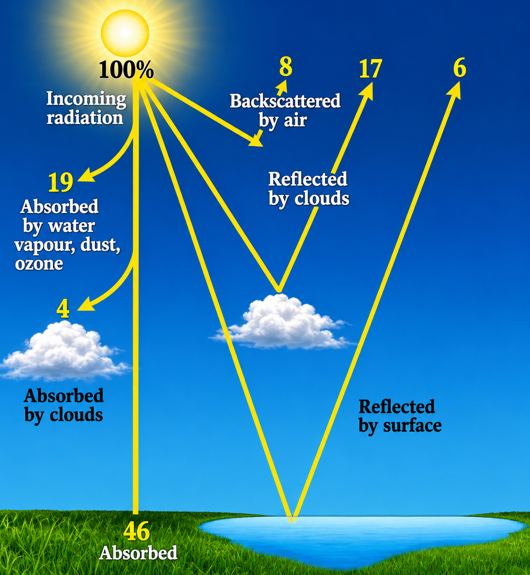
About 19% of the solar radiation is absorbed by the atmospheric contents. The absorbed proportion of solar radiation is so small (low) because they are in the form of short waves which pass with little check through the atmosphere.
An object or substance that is a good radiator is also a good absorber, and the vice versa is also true. For example, mineral materials like rocks and soils are generally excellent absorbers; snow and ice are poor absorbers, and dark coloured surfaces are much more efficient absorbers of radiation in the visible portion of the spectrum than light coloured surfaces.
Reflection
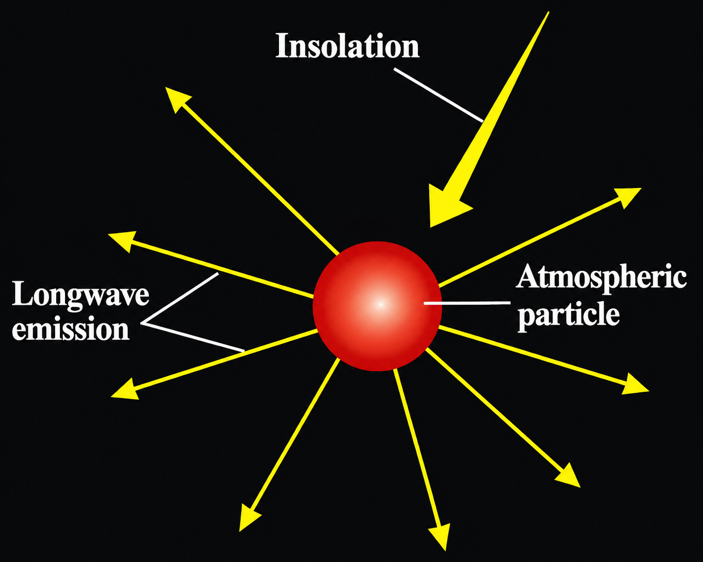
Reflection is a process whereby sunlight is redirected back after it strikes an atmospheric substances (Figure 2.1). It occurs when the radiation hits on the substances like clouds that are available in the atmosphere. Redirection of sunlight causes a 25% loss of the insolation. The ratio of the incoming radiation to the amount of reflected sunlight is known as albedo and it is expressed in percentage.
The albedo varies with cloud type from 30–40% in thicker stratus clouds and 90% in cumulo-nimbus clouds. However, only 10% of albedo reaches the atmosphere below cloud level. Furthermore, albedo varies over different land surfaces. The ocean and dark soil have less than 10%, coniferous forest and urban areas have 15%, grassland and deciduous forest have 25%, light-coloured deserts have 40% and fresh snow have 85%.
|
Figure 2.1: Reflection of solar radiation |
Scattering
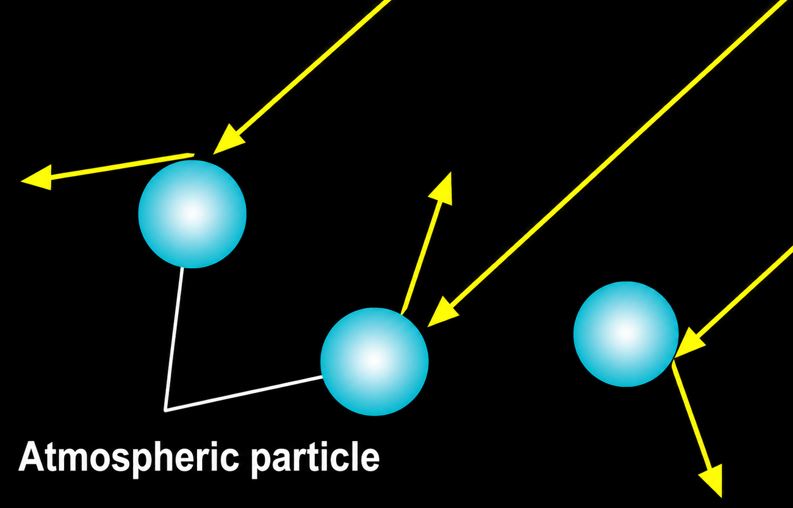
Scattering is a process whereby, sunlight is diverted from its straight path upon striking atmospheric obstacle like clouds, dusts, gases molecules and water vapour Scattering takes place in all directions, and about 8% of the incoming solar radiation is lost in that process. Scattering therefore, reduces the amount of incoming solar radiation reaching the earth’s surface. Moreover, significant proportion of scattered shortwave is redirected back to space (Figure 2.2).
The scattering effects always depend on two factors which are the wavelength of the incoming radiation, and the size of the scattering particle or gas molecule. Based on such grounds, scattering has three forms which are Rayleigh, Mie, and Non-selective scattering.
Rayleigh scattering occurs when the particles causing scattering are less or smaller than the wave lengths of radiation in contact. This form is, therefore, wave length dependent.
Mie scattering is caused by solid particles such as pollens, dust, and smoke in lower atmosphere. It occurs when the size of the particles that cause scattering is similar to the wave lengths of the incoming radiation.
Non-selective scattering occurs when the size of the particles are much bigger than the incidental radiation, usually in lower atmosphere. Scattering is a non-wave length dependent. Particles responsible for this effect are atmospheric water droplets and larger dust particles. The common example of non-selective scattering is the appearance of white clouds as white. The presence of a large number of particles with a size of about 0.5 microns in the earth’s atmosphere, results in shorter wavelengths being preferentially scattered. This factor causes the sky to appear blue as the colour corresponds to the wavelengths that are best diffused. If scattering was absent in our atmosphere the daylight sky would appear black.
|
Figure 2.2: Scattering of solar radiation |
It should be noted that, the presence of absorption, reflection and scattering processes of solar radiation, allows about 46% of incoming solar radiation to reach the earth’s surface directly (Figure 2.3). The incoming solar radiation is converted into heat energy when it reaches the earth’s surface. As the ground warms up, it radiates energy in a form of long waves back into the atmosphere where 6% is absorbed mainly by water vapour, methane, carbon dioxide and other atmospheric gases. The atmospheric gases, which have a tendency of absorbing the incoming short wave radiation from the sun and long wave radiation from the Earth are known as greenhouse gases. Out of all greenhouse gases, water vapour has a great impact in the absorption of incoming radiation and its conversion into heat energy. Without greenhouse gases, much of the outgoing radiation would have been lost and consequently the world temperature would be cooler than it is at present. Therefore, the existing mechanisms between the incoming and outgoing radiation creates a natural balance which is called heat budget or heat balance. However, the rise in greenhouse gases, notably carbon dioxide and other gases caused by human activities, is linked to global warming, which alters the natural heat balance, giving rise to the phenomenon known as climate change.
|
Figure 2.3: Solar energy transfer |
However, the amount of energy received by the Earth is determined by astronomical factors including incidence angle of the sun rays, length of the day, transparency of the atmosphere, variations in the distance between the earth and the Sun, and the solar constant (the quantity of radiation). 46% of solar radiation that passes through the atmosphere and become available on the earth’s surface is used for various purposes including heating the earth’s surface and the lower atmosphere, evaporating and melting of ice, snow, and glacier, controlling weather and climate, as well as running photosynthesis processes in plants. Moreover, this energy is converted into food substances that support all forms of life on Earth. Therefore, it is this radiation from the sun that drives the Earth system.
Atmosphere
The word atmosphere comes from two Greek words; atmos means vapour and sphaira meaning sphere. It is a layer of gas surrounding the planet Earth or other materials of sufficient mass that are held in place by gravity. In other words, the atmosphere is comprised of a mixture of colourless gases, suspended solids, and liquids that surround the Earth. The earth’s atmosphere is about 600–1000 kilometres thick.
Atmospheric composition
The atmosphere constitutes both living and non-living things. Living things include bacteria while non-living things are gaseous (Table 2.1), dust, and particles. The atmosphere is composed of the following gases;
(a) Nitrogen gas: 78% and it dilutes oxygen and prevents rapid burning of the earth’s surface. Living things need it also to make proteins.
(b) Oxygen gas: 21% and it is used by all living things for respiration. It is also necessary for combustion or burning.
(c) Carbon dioxide: 0.03% and it is used by plants to make oxygen. It also acts as a blanket and prevents the escape of heat into the outer space.
(d) Argon: 0.93% and it is used in light bulbs.
(e) Water vapour: 0.20 to 4.0% and it is essential for life processes and it prevents heat loss from the Earth.
(f) Trace gases: They are found in very small amounts, including neon, helium, krypton, and xenon.
The atmosphere is also composed of sulphur dioxide (SO₂), Nitrogen Oxide which when mixes with rain results into acid rain and Methane and Nitrous Oxide which are greenhouse gases.
Table 2.1: Atmospheric gaseous composition
| Gas name | Chemical formula | Percent (%) |
| Nitrogen | N₂ | 78.085 |
| Oxygen | O₂ | 20.95 |
| Water vapour | H₂O | 0.20 to 4.0 |
| Argon | Ar | 0.93 |
| Carbon dioxide | CO₂ | 0.03 |
| Neon | Ne | 0.0018 |
| Helium | He | 0.0005 |
| Methane | CH₄ | 0.0017 |
| Hydrogen | H₂ | 0.00005 |
| Nitrous oxide | N₂O | 0.0003 |
| Xenon | Xe | 0.0000087 |
| Ozone | O₃ | 0.00004 |
| Krypton | Kr | 0.000114 |
Other compositions of the atmosphere
Water vapour
Water vapour is a gaseous form of water present in the atmosphere. At any time the amount of water vapour in the atmosphere ranges from 0.20 to 4 percent. Maximum amount of water vapour is found in hot-wet regions and its least amount is found in the dry regions. The amount of water vapour decreases with an increase in latitude and altitude. In the same way, its amount goes on decreasing with increasing altitude. About 90 percent of the total vapour lies below 6 kilometres and about 50 percent is within 2 kilometres of height. Water vapour is a source of precipitation through cloud formation. It has reflective/absorptive characteristics of the incoming radiation. It also contributes in keeping the global temperatures constant and it is one of the naturally occurring causes of greenhouse effect.
Dust particles
Dusts are small solid and liquid particles suspended in the air. These particles come from both natural and human activities. They include; fine desert sand/soils, ash, and disintegrated particles of meteors. Dust particles are in higher concentrations in temperate and subtropical regions due to dry winds in contrast to the polar and equatorial regions. Their concentration is high in the atmosphere during dry seasons since the sands/soils are loose and easily carried by winds compared to a rainy season when soils/sands are settled and compacted. In terms of size, coarse dust particles are plentiful near the surface while fine dust particles are found several kilometres above the surface. Generally, large amount of dust particles are found in the lower layer of atmosphere and in a suspended form. Dust particles act as hygroscopic nuclei over which water vapour of the atmosphere condenses to create clouds. They also absorb/reflect incoming solar radiation.
Aerosols
Aerosols are extremely fine-sized solid particles which continue to be in a suspended form in gas for a long time. They are invisible, though they can be seen when they are in a high concentration in the atmosphere. Aerosols are grouped into two; hygroscopic aerosols which absorbs and retains atmospheric moisture and non-hygroscopic aerosols which are non-absorbing. Aerosols are released in the atmosphere from various sources, both naturally and humanly created. Aerosols includes; pollen, mineral dust, sea salt, carbon soot from burning fuels and volcanic dust. Concentration of aerosols is more over the industrial and urban areas where burning of fossil fuels and generation of smoke particles in the air in high quantities. Hygroscopic aerosols form as nuclei for condensation and thus help in precipitation.
Layers of the atmosphere
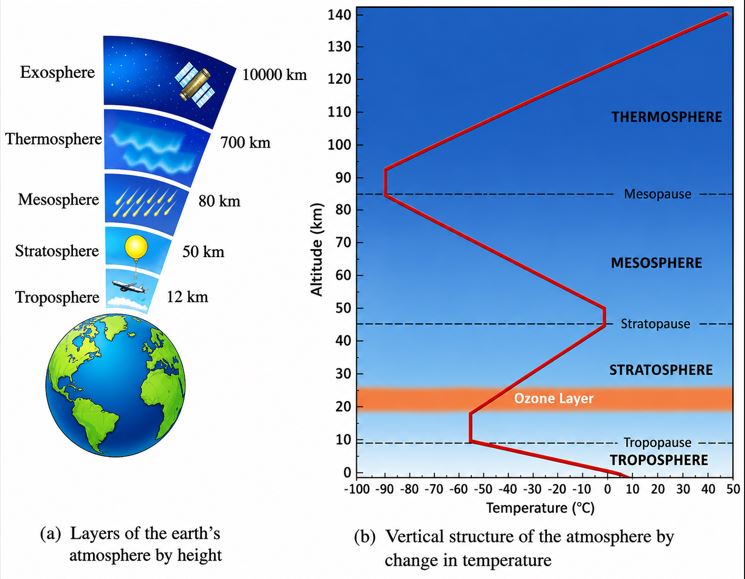
There are five main layers in the atmosphere namely; troposphere, stratosphere, mesosphere, thermosphere, and exosphere and they are categorized based on temperature.
Troposphere
The troposphere is the first and lowest layer of the atmosphere that directly touches the earth’s surface. It extends from the ground to an average of 12 kilometres although that extension varies from 8 kilometres at the poles to about 17 kilometres at the Equator. As altitude increases, the temperature in the troposphere decreases by 0.6°C for every 100 metres. This decrease is referred to as the environmental lapse rate. Additionally, the pressure falls with altitude as a result of the decrease in gravity. At the top of the troposphere, the air pressure is only 10% of that at sea level.
Throughout the troposphere, a variety of atmospheric phenomena occur, including; cloud formation, precipitation, and intense storms. As altitude increases, wind speed also increases, and nearly all water vapour is concentrated within this layer, making it the most humid part of the atmosphere. Additionally, the troposphere makes up a significant portion of the entire atmosphere’s mass, with three-quarters of its total mass contained within this layer. Lastly, there exists a narrow transition zone known as the tropopause between the troposphere and the stratosphere, with a consistent temperature range throughout its 12–20 kilometres span.
Stratosphere
This is the layer above the troposphere, extending up to approximately 50 kilometres, and it is characterized by a gradual rise in temperature. This is due to the concentration of ozone (O₃), which absorbs ultraviolet radiation from the sun and provides a protective shield against harmful particles that typically burn up upon entering the earth’s gravitational field. As altitude increases, winds become stronger while air quality worsens and air pressure continues to decrease.
About 90% of the ozone layer is located in the stratosphere extending from the top of the troposphere to about 50 kilometres (31 miles). The Ozone layer, which is a molecule containing three oxygen atoms, forms a thin shield found between 16–50 kilometres (10–31 miles) above the earth’s surface, protecting us from the sun’s harmful ultraviolet (UV) radiation. Unfortunately, there is a growing concern that man-made fluorocarbon is contributing to the depletion of the ozone layer. This could have potentially devastating consequences for life on Earth. The stratopause, marking the boundary between the stratosphere and mesosphere, is located between 49 and 52 kilometres above the earth’s surface. Despite its constant formation and destruction, the total amount of ozone in the stratosphere has remained relatively stable over the decades. The ozone layer is crucial as it absorbs harmful ultraviolet radiation, which can damage animal tissues. Additionally, the temperature in the stratosphere increases with height. This is a convenient layer for flying planes as it is free from turbulence that is common in the troposphere.
| Activity 2.2 Search from library or internet sources about factors contributing to ozone layer depletion. Write a summary on how human activities contribute to the depletion. |
Mesosphere
The mesosphere is a layer of the atmosphere that lies between the stratosphere and the thermosphere, at an altitude of 52–80 kilometres. This layer is known for its extreme cold temperatures, reaching as low as –90°C as the altitude increases. It also has the strongest wind speed reaching up to 3000 km/hr. Unlike other layers of the atmosphere, gases in the mesosphere are mixed instead of being layered by mass. The air is also incredibly thin, making it unsuitable for human breathing.
The mesosphere is a protective layer as most meteors and asteroids burn up before they reach the earth’s surface, producing the shooting stars seen in the night sky. The mesopause marks the end of this layer and it is characterized by the lowest temperature, with no change in temperature observed.
Thermosphere
The thermosphere is the outermost layer of the atmosphere and it constitutes the ionosphere. It extends from about 80 kilometres into space and boasts an extremely high temperature that can reach up to 2000°C. However, this temperature is not felt as the air molecules are widely dispersed. The atomic ions, like oxygen, present in this layer absorb short wave of solar energy by absorbing oxygen and nitrogen, thus causing high temperature. The thermosphere is an almost gravity-free, thin layer of air that is primarily composed of helium, atomic nitrogen, and atomic oxygen, rendering it unsuitable for breathing.
Though the thermosphere is uninhabitable to humans, it is an indispensable component in protecting lives on Earth. It absorbs X-rays and extreme ultraviolet radiation, supporting space exploration and making communication easy. The charged particles present in the thermosphere facilitate long-distance communication via radio, as radio signals can travel in straight lines and bounce back and forth between the earth’s surface and the ionosphere.
Exosphere
This layer, located at the highest altitude of the atmosphere, begins at about 700 kilometres and marks the edge of space. It is primarily comprised of hydrogen and helium along with nitrogen, oxygen, and carbon dioxide in trace amounts. It serves as earth’s initial barrier against harmful sun rays and protects from meteors, asteroids, and cosmic rays.
The vertical structure of the earth’s atmosphere, including this essential layer, is illustrated in Figures 2.4 (a) and (b).
|
Figure 2.4: Layers of the atmosphere and their vertical structure |
Hydrosphere
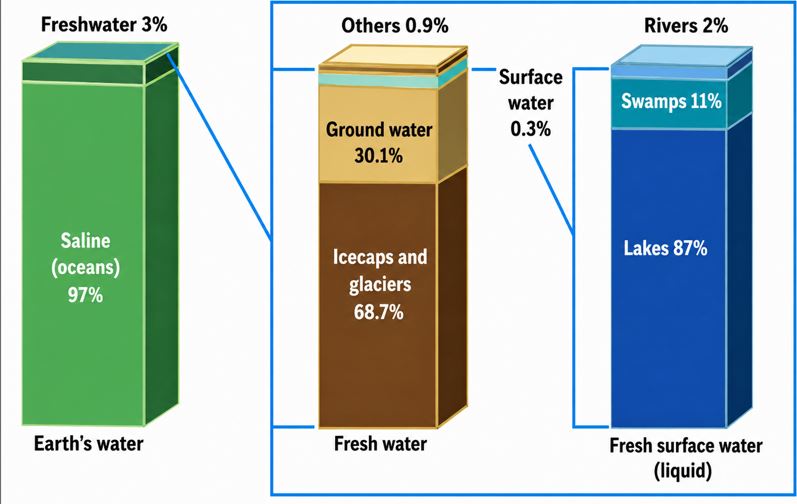
Hydrosphere is the area that includes all the earth’s water in the state of liquid, frozen or floating ice in the upper part or beneath the soil. Hydrosphere covers about 71 per cent of the earth’s surface. The seas and oceans make about 97% of the water on the surface of the Earth, while the fresh water found in glaciers, lakes, rivers, streams, wetlands, ponds, soil moisture, groundwater and polar ice caps and snow forms about 3% (Figure 2.5). Hydrosphere is referred to as a major setting of the earth’s hydrological cycle. Freshwater amounts are essentially held at a constant level by the hydrologic cycle that is driven by the sun. The hydrological cycle continuously moves water around the planet by exchanging water molecules from the vegetation and oceans to the atmosphere and back to the ground. It further hydrates life on the planet and transfer the energy from terrestrial to aquatic ecosystems.
|
Figure 2.5: Proportions of hydrosphere |
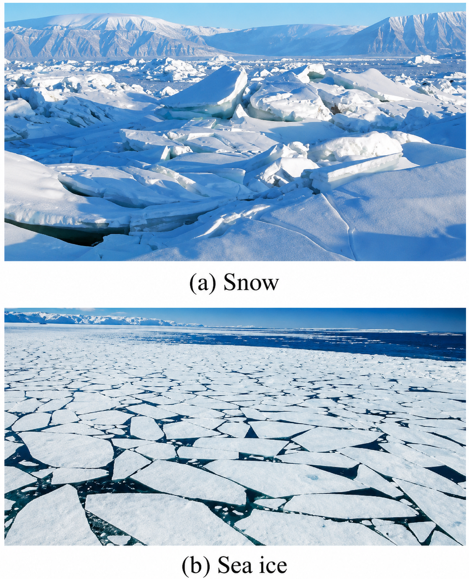
In some places on the Earth water exists in a form of solid ice or snow (Figure 2.6 a and b). These frozen pieces of the Earth are called cryosphere. The word cryosphere comes from the Greek word, kryos which means “cold” and sphaira which means “sphere”. The cryosphere are places where water is in solid form, where very low temperature freezes water and turns it into ice. The cryosphere forms the earth’s most important fresh water reservoir, of which the inland ice of Antarctica accounts for about 80% of the cryosphere. This is the coldest region of our planet that influences our entire world’s climate. Cryosphere covers most of the top and bottom of our planet in the polar regions. These are areas around the North Pole, the Arctic and the area around the South Pole, the Antarctica. Moreover, it covers many other locations on Earth far away from the cold poles including high elevations such as the snow on top of Mount Kilimanjaro found in Tanzania. Frozen soil can be found in the high mountains of the United States, as well as in the northern reaches of Canada, China, and Russia. The cryosphere expands during the cold winter months. Seasonal areas of the cryosphere include places where snow falls, and where soil, rivers, and lakes freeze. The cryosphere is central to the daily lives of people, plants, and animals. It has a great impact on the global cooling and distribution of cold winds without which life would cease to exist on the planet Earth.
|
Figure 2.6: Water in the form of solid ice and snow |
Biosphere
Biosphere refers to the narrow zone of the Earth in which all life forms exist. The zone extends vertically from the atmosphere to about 10 kilometres, downward into the ocean to a depth of about 10.4 kilometres. The biosphere is composed of living organisms such as plants and animals. There is an estimation of at least eight million species of animals and plants existing on Earth. These include human beings, plants, microorganisms and macro-organisms. Moreover, biosphere is not only about all the living organisms, but also about the remains of organisms that have died and not yet decomposed. It also includes the regions of the other parts of the Earth system (atmosphere, hydrosphere, geosphere) occupied by living organisms. Human activities in this layer for example, generate carbon dioxide and chlorofluorocarbon which are of concern due to their respective effect in global warming and depletion of the ozone layer. Furthermore, agricultural, industrial and mining activities generate wastes that compromise the natural status of the geosphere, atmosphere and hydrosphere.
Geosphere
This is the solid portion of the Earth which includes the continental and oceanic crust and all other layers of the earth’s interior. It also includes the rocks, sediments, soils, minerals, and landforms of the surface and the interior. Geosphere extends from the earth’s surface all the way to the innermost layer of the Earth. About 94% of the geosphere is made up of the following elements; oxygen, iron, silicon, and magnesium. Despite its solid nature, the geosphere is a dynamic sphere which is always in constant motion and processes. This motion creates continents, oceans, and their landforms. The geosphere is in a constant process of rock cycle such as metamorphism, melting and solidification, weathering, erosion, transportation and deposition which are responsible for the constant recycling of rocks on Earth between sedimentary, igneous, and metamorphic states. Moreover, the geosphere includes the abiotic (non-living) parts of soils and the skeletons of animals that may become fossilized over geologic time.
www.learninghubtz.co.tz
Exercise
1. How does the atmospheric radiation process support substance and flourishing of life on Earth?
2. How do human beings influence the radiation process on the Earth system?
3. Explain the earth’s surface as a whole does not accumulate too much heat.
4. Although the Ozone layer is located in the atmosphere, approximately 16–50 kilometres above the earth’s surface, it plays a crucial role in supporting life on the Earth. Discuss its importance to life on Earth’s surface.
5. How is studying layers of the atmosphere useful in the aviation sector?
Atmosphere-biosphere interactions
The atmosphere and biosphere constantly interact with each other. However, these interactions are numerous and complex. A few examples of how these subsystems interact includes, the exchange of gases and the deposition of particulates.
Gaseous exchange
Earth system as a set of interacting spheres involves constant cycling or movement of gases through different media such as the atmosphere, geosphere, hydrosphere, and biosphere, collectively known as biogeochemical or nutrient cycles. The term biogeochemical is made up of three terms; bio meaning biosphere, geo meaning geosphere and chemical meaning elements such as nitrogen, oxygen, carbon, hydrogen, phosphorus, and sulfur. The flow and interaction of these elements in the Earth system plays an essential role in the existence of life on the Earth.
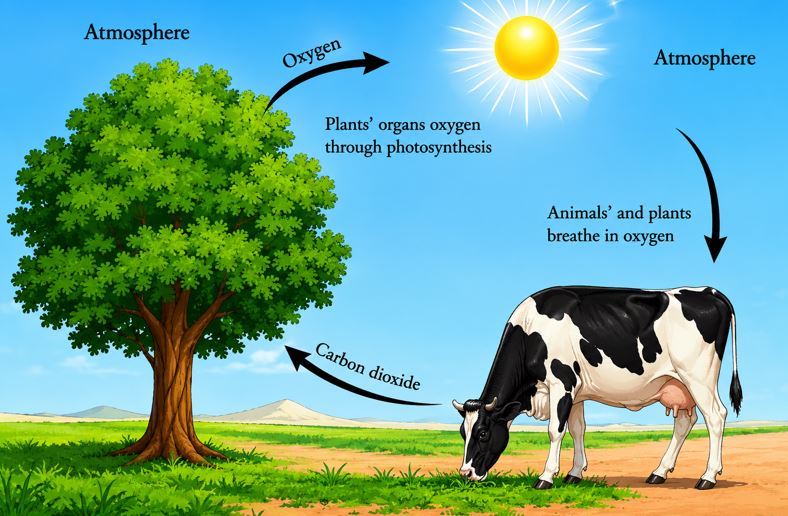
Vital gas cycles exist between the atmosphere and the biosphere. Living organisms depend on air or gases for survival. For example, humans and other animals inhale oxygen from the atmosphere and exhale carbon dioxide back into the atmosphere during respiration. On the other hand, plants absorb carbon dioxide from the atmosphere for photosynthesis and release oxygen gas. These exchanges are what make the gas cycle continuous and maintain life on Earth. Moreover, the decomposition of vegetation such as trees and grasses releases gases like carbon dioxide, methane, and others into the atmosphere.
Carbon cycle
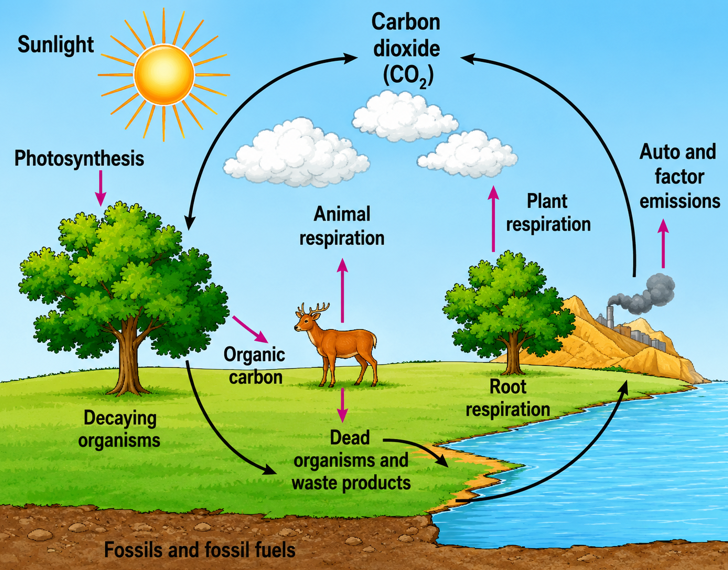
Elements of carbon are available in the atmosphere in the form of carbon dioxide. Plants receive about one quarter of the carbon dioxide from the atmosphere which with the support of sunlight is used for making food for plants through a process known as photosynthesis. Through this process, plants create carbohydrates in the form of food which is used as food by all living organisms.
Carbon dioxide dissolving (absorbed) in the water bodies such as lake, sea and ocean, through direct air-water exchange is again collected in the form of lime on the Earth. After the decomposition of limestone, carbon dioxide reaches the atmosphere again through a process called carbonization.
Furthermore, carbon dioxide is also added to the atmosphere naturally. When animals respire, living organisms decompose or decay and through human activities such as the burning of fossil fuels like coal, petroleum and natural gases. This is a continuous process through which carbon dioxide circulates between the four subsystems of the Earth (Figure 2.8).
|
Figure 2.8: Carbon cycle |
Oxygen cycle
The oxygen cycle is the process through which oxygen is produced and reused in the atmosphere (Figure 2.9). Oxygen which is the second most abundant gas in the atmosphere is produced by plants through photosynthesis with the support of sunlight. Through photosynthesis, plants convert carbon dioxide and water into oxygen and release it into the atmosphere. The released oxygen is used by all animals for respiration. It is also used by human beings for burning fuels like wood, coal, and gas. The oxygen cycle occurs due to the exchange between the atmosphere and the oceans. The cycling of oxygen is also accomplished by the weathering of carbonate rocks.
|
Figure 2.9: Oxygen cycle |
Nitrogen cycle
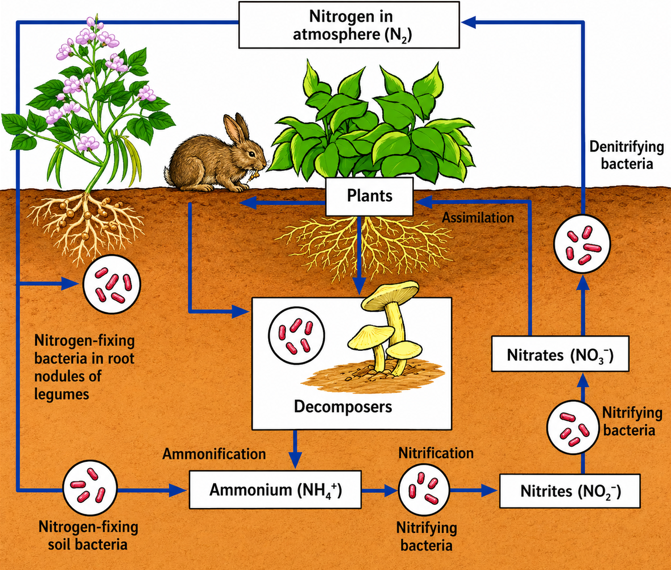
Nitrogen is an important element for life and the largest constituent of the gaseous envelope that surrounds the Earth. The main source of nitrogen are the nitrates present in the soil. From the atmosphere, nitrogen enters bio components through the biological and industrial processes. Regardless of the process involved, nitrogen gets to plants through the biological process known as Biological Nitrogen Fixation (BNF). It involves the incorporation of nitrogen gas into the roots of some plants. Such plants are legumes, cloves, alfalfa, soybeans, peas, peanuts and beans. The bacteria living in the nodules around these plants roots chemically convert nitrogen in the air to form nitrates (NO₃⁻) and ammonia (NH₄⁺) and make it available to plants.
Nitrogen compounds available in plants are transferred to animals through food chain. Animals that feed on the plants ingest the nitrogen and release it in organic wastes. Bacteria decompose decayed plants and dead animals and produce nitrogen gas which goes back into the atmosphere. In this way, a continuous cycle of nitrogen gas is completed (Figure 2.10).
|
Figure 2.10: Nitrogen cycle |
Deposition of particulates
As human beings engage in various activities such as agriculture, mining, and transportation, they may inadvertently produce fumes and aerosols that have a significant impact on the environment. These emissions can contribute to the deposition of particulates, which in turn affect atmospheric conditions.
Hydrosphere-biosphere interactions
The hydrosphere and biosphere share a complex relationship that impacts the environment. Their interplay has significantly influence the distribution and abundance of living organisms, as well as the state of the hydrosphere. Here are some examples of various interactions between these two spheres:
Life support
All living organisms depend solely on water. Plants require water during photosynthesis and for growth, while animals depend on water for hydration and other bodily functions.
Habitat
Many plants and animals live in the hydrosphere, including aquatic plants like water hyacinths and animals like fish and crocodiles.
Water cycle
The biosphere plays a crucial role in supporting the water cycle. For instance, plants release water vapour into the atmosphere through transpiration. Although human activities such as environmental conservation and management aid in evapotranspiration, unfortunately, deforestation practices by humans, especially on a large scale, negatively impact the water cycle.
Energy
The hydrosphere is an abundant source of energy for all life on Earth, especially humans. Through the use of water, humans can generate energy for a variety of purposes such as cooking, heating, transportation, and lighting. In Tanzania, Kidatu, Kihansi, Mtera, New Pangani, and Hale waterfalls have been the primary sources of hydropower for some years. However, with the completion of the construction of the Julius Nyerere hydropower station (JNHPS) at Stiegler’s Gorge in Morogoro region the country is ensured sufficient energy supply.
Atmosphere-hydrosphere interactions
The Earth is fundamentally a water planet, defined by the intricate interplay between its atmosphere and hydrosphere. These two subsystems are deeply interconnected, and their interactions take on many different forms. Examples of forms of interaction between these spheres include the following:
Atmospheric water circulation
The hydrosphere, consisting of rivers, streams, seas, and oceans, contributes water vapour to the atmosphere through evaporation. This water vapour then undergoes condensation to form clouds, ultimately resulting in precipitation that replenishes the evaporating surfaces.
Carbon sink
The ocean serves as a crucial carbon sink, as it can absorb more than 31% of the carbon dioxide gas (CO₂) present in the atmosphere. However, as atmospheric carbon dioxide levels rise, the ocean’s carbon dioxide levels tend to follow suit. Chemical reactions occur when carbon dioxide is absorbed by the ocean, leading to an increase in acidity levels. This process is commonly referred to as ocean acidification.
Temperature regulation
The process of temperature regulation, also known as heat sinking, is a vital component in maintaining a balanced environment. Both the atmosphere and hydrosphere work together to achieve this. In instances where the atmosphere is warmer than the ocean surface, heat energy is transferred from the air to the ocean. Conversely, when the air is cooler, heat energy is released from the ocean into the air.
Geosphere-biosphere interactions
The biosphere and geosphere are interconnected through processes such as the carbon cycle and denudation.
Biological weathering
Biosphere and geosphere interact through weathering and erosion. Living organisms like animals and plants which form biosphere can break down rocks in the geosphere to form sediments. This not only affects the landscape but also releases nutrients into the soil.
Hydrosphere-geosphere interactions
The hydrosphere and geosphere work together in a way that supports the hydrological cycle and sustains life in the biosphere. Some of interactions that occur between the hydrosphere and geosphere are:
Chemical weathering
Over time, water can weather down rocks through natural process of erosion. This happens when rain water comes into contact with minerals forming the rock and breakdown the rock into sediments. The sediment or broken rocks can then be transported by water, wind, or ice, eventually settling in a different location. This can result in a change in the landscape’s shape.
Water storage
Water is a vital component of earth’s subsystems, as it continuously circulates through the atmosphere, biosphere, and geosphere. When surface water enters the soil, it forms groundwater that flows down to the water table due to gravity. Large portion of water is stored on the surface as surface water and into the ground as groundwater.
Atmosphere-geosphere interactions
While the atmosphere and hydrosphere are distinct, they are closely interconnected, and they impact one another in numerous ways.
In terms of energy exchange, the atmosphere provides the geosphere with the necessary heat and energy for weathering and erosion. For instance, wind blowing leads to erosion. Conversely, the geosphere releases heat back into the atmosphere via conduction.
Additionally, water vapour in the atmosphere condenses to form clouds that eventually result in precipitation. This precipitation falls onto the geosphere, contributing to the formation of water bodies, which form part of the hydrological cycle.
Activity 2.3
1. With examples, use the knowledge developed from this chapter to create a summary using the table provided.
| | Atmosphere | Biosphere | Hydrosphere | Geosphere |
| Atmosphere | ✖ | | ||
| Biosphere | ✖ | |||
| Hydrosphere | | ✖ | ||
| Geosphere | | ✖ |
2. Use physical and online sources to read and write short notes about the following:
- Ozone layer
- Magnetosphere
- Ionosphere
- Homosphere
- Auroras and Tropopause
- Greenhouse effect
- The relationship between greenhouse effect and climate change
www.learninghubtz.co.tz
Revision exercise
1. Results from current research activities show that Ozone layer is continuously destroyed by human development activities. As an expert in Earth system interactions, explain how you can contribute on the protection of ozone layer.
2. Explain how the interactions among the earth’s spheres support lives of human beings and other living organism?
3. Explain how human actions alter the natural interactions of the earth’s sphere, and outline the possible consequences of such alteration to human development.
4. With examples, argue for or against the statement that, "the atmosphere is never stable".
5. Substantiate the statement "humans impact all spheres of the Earth".
6. Why is the Earth considered to be a system?
7. With relevant examples, explain why the Earth is considered to be a system.
8. Assess the importance of solar energy in maintaining the interactions among the Earth's spheres.
9. Explain how the processes of absorption, reflection and scattering influence the Earth's heat budget.
10. Describe the characteristics of the five major layers of the atmosphere and explain the importance of each layer to life on Earth
11. Examine the factors responsible for the depletion of the ozone layer and suggest measures that can be taken to protect it.
12. With examples, explain how the atmosphere interacts with the biosphere in sustaining life on Earth.
13. Using relevant examples, explain how the hydrosphere and biosphere interact to support human life and other living organisms.
14. Explain the role of the following biogeochemical cycles in maintaining the Earth's system:(a) Carbon cycle (b) Oxygen cycle (c) Nitrogen cycle
15. Discuss six ways in which human activities alter the natural interactions among the Earth's spheres. "The atmosphere is never stable."
16. Using relevant examples, justify this statement.With examples from Tanzania and elsewhere, examine the significance of interactions among the atmosphere, hydrosphere, biosphere and geosphere in environmental conservation and sustainable development.
17. Critically assess the statement:"Human beings impact every sphere of the Earth system." Support your answer with relevant examples.

Hub App
 For Call,Sms&WhatsApp: 255769929722 / 255754805256
For Call,Sms&WhatsApp: 255769929722 / 255754805256  MATOKEO YA KIDATO CHA VI 2026
SECONDARY REGIONAL EXAMS
PRIMARY REGIONAL EXAMS
FORM VI NECTA REVIEWS
FORM IV NECTA REVIEWS
FORM II NECTA REVIEWS
STD VII NECTA REVIEWS
STD IV NECTA REVIEWS
SECONDARY EXAMS SERIES
PRIMARY EXAMS SERIES
PRIMARY SUBJECT NOTES
SECONDARY SUBJECT NOTES
SECONDARY TOPICAL EXAMS
SECONDARY TOPICAL QUESTIONS
PRIMARY TOPICAL QUESTIONS
PRACTICAL EXAMS & NOTES
SECONDARY REGIONAL EXAMS
DOWNLOAD SUBJECT NOTES
SCHEMES OF WORK (PRIMARY & SECONDARY)
LESSON PLAN
SECONDARY LOG BOOKS
PRIMARY LOG BOOKS
LITERARY WORKS / UCHAMBUZI VITABU
METHALI ZOTE ZA KISWAHILI
Vitendawili Vya Kiswahili
FORM VI RESULTS 2024
FORM FIVE SELECTION 2024
Matokeo KIDATO CHA II 2024
Matokeo Darasa IV 2024
MATOKEO KIDATO CHA IV 2023
FORM ONE SELECTION 2024
FORM VI RESULTS 2023
Matokeo Darasa IV 2022
MATOKEO YA KIDATO CHA VI 2026
SECONDARY REGIONAL EXAMS
PRIMARY REGIONAL EXAMS
FORM VI NECTA REVIEWS
FORM IV NECTA REVIEWS
FORM II NECTA REVIEWS
STD VII NECTA REVIEWS
STD IV NECTA REVIEWS
SECONDARY EXAMS SERIES
PRIMARY EXAMS SERIES
PRIMARY SUBJECT NOTES
SECONDARY SUBJECT NOTES
SECONDARY TOPICAL EXAMS
SECONDARY TOPICAL QUESTIONS
PRIMARY TOPICAL QUESTIONS
PRACTICAL EXAMS & NOTES
SECONDARY REGIONAL EXAMS
DOWNLOAD SUBJECT NOTES
SCHEMES OF WORK (PRIMARY & SECONDARY)
LESSON PLAN
SECONDARY LOG BOOKS
PRIMARY LOG BOOKS
LITERARY WORKS / UCHAMBUZI VITABU
METHALI ZOTE ZA KISWAHILI
Vitendawili Vya Kiswahili
FORM VI RESULTS 2024
FORM FIVE SELECTION 2024
Matokeo KIDATO CHA II 2024
Matokeo Darasa IV 2024
MATOKEO KIDATO CHA IV 2023
FORM ONE SELECTION 2024
FORM VI RESULTS 2023
Matokeo Darasa IV 2022
WHATSAPP US NOW FOR ANY QUERY
App Ya Learning Hub Tanzania