Chapter 02 : Economic systems
| Introduction Have you ever imagined how goods and services that you daily consume are produced, allocated, and distributed within a society or country? The answer to this question depends on the kind of economic system a society has. In this chapter, you will learn about the concept of economic systems and resources allocation and distribution. The competencies developed will enable you appreciate the allocation and distribution of resources in your country. |
| Think The world without resources coordinating system. |
Activity 2.1
Create an imaginary country of your own and place it anywhere in the world. Have you thought of the presence of factors of production in the country? How will these factors of production be rewarded when involved in economic activity (production)? How will the goods produced be distributed? Do you think the government has any economic role? Explain.
The concept of economic systems
An economic system is a mechanism by which an economy makes decisions on how to coordinate the production, distribution and consumption of goods and services. It is through an economic system that a society tries to solve the central economic problem resulting from scarcity of resources and unlimited wants. Recall that, every society faces three basic fundamental economic questions which are:
What to Produce?
Due to scarcity of resources and unlimited wants, countries have to choose which goods and services to produce.
How to Produce?
Given the scarce resources, countries have to decide the best production methods (production) that minimise the cost of production with which they can attain the desired production level.
For Whom to Produce?
Since countries cannot meet all individuals’ wants, production decisions are made in order to meet specific needs of the market.
The way society answer these fundamental economic questions determines the type of economic system they have.
Forms of economic systems
There are four forms of economic systems. These are the traditional economic system; the centrally planned economic system; market economic system; and the mixed economic system.
Traditional economic system
A traditional economic system is one in which goods and services are produced and distributed based on customs, history, and time-honoured beliefs. The sole decision-makers in the traditional economy are residents of a society. Hunting, fishing, poultry, agriculture, and traditional industries are activities that countries rely upon to boost their economic condition. The traditional economic system mostly operates in developing countries and emerging markets such as Asia, Africa, the Middle East, and Latin America. In developing countries, the pockets of traditional economies are found scattered. All other economies started as traditional economies; therefore, economists expect that over time these economies will evolve into market, command or mixed economies. The societies that practise traditional economy rely on exchanging goods for goods. This traditional way of transaction is called the barter trade system. People’s traditions, rituals and habits determine what goods and services should be produced and how those goods should be produced and to whom the goods and services should be distributed. In the traditional economic system, production is only for subsistence with no or little surplus, and people’s needs determine what should be produced.
The traditional economic system works through the following assumptions: First, people are motivated by self-interest to produce and distribute goods and services given their cultural and traditional values. Second, the decision on the economy’s operation is the responsibility of only national individuals. Last, people have the freedom to change their decisions in response to certain beliefs and make changes for the welfare of all people in the society.
There are still many active traditional economies in the world today, including Hadzabe in Tanzania, Inuit tribes in northern Canada and Alaska, Amazon tribes in Brazil, Haiti, and Bhutan.
Characteristics of a traditional economic system
The important insight about the traditional economy is that it is not affected by external factors because it is highly isolated from external environment. People have the freedom to make decisions that maximise the welfare of their society. The other characteristics of a traditional economy is that a traditional economy consists of a nomadic society of hunters and gatherers involved: fishing, gathering, hunting, and agriculture. The primary mode of payment is barter trading, rather than using currency as a mode of transaction. In a traditional economy, people consider their benefits rather than profit when exchanging goods for goods. The goods produced are for subsistence with little or no surplus, meaning that all goods produced are consumed. Hunting in the traditional economy is a source of living for many people. People depend on hunting and then exchange hunted animals for other goods and services they need.
Advantages of traditional economic system
Even though no currency is involved in the transaction in a traditional economy, it has some advantages. The following are the advantages of the traditional economy. First, a traditional economy has no profit motive since people have different roles; they fulfil their roles, and the economy continues to flourish. Thus, eliminating any pressure to constantly compete and maximise profits. Second, the traditional economy is based on family or tribe, in which customs and traditional norms regulate the allocation and distribution of resources. Each family member contributes to producing goods and services required for the family. Third, the traditional economy is self-sustained and concentrates on producing goods available within their geographical locations. It does not rely on the external trade. Last, there is little conflict in the traditional economy because everyone knows their roles. For instance, if someone is responsible for fishing, they would not want to be involved in agriculture. Instead, they would exchange the goods they want with someone responsible for producing the goods they want.
Disadvantages of traditional economic system
The traditional economy lacks a workable balance, poor production efficiency, and a variety of jobs and skills. The traditional economy fits societies with small populations in which communities produce very little depending on their needs and no surplus to be regulated. The decision-making relies on elders, mostly local leaders.
Centrally planned economic system
A centrally planned economy also called command economy or socialist economy was advocated by Karl Marx. He led a revolt against market economy by arguing that allowing the economy to be controlled by individuals’ self-interests would lead to crisis and disorder. As a result, he emphasised on the role of the government in controlling and regulating the economy. Thus, under command economy, the government owns and controls all productive resources in their society’s overall interests.
Characteristics of centrally planned economic system
In a centrally planned economy all means of production are owned by the government in the interests of society. That is, individuals have no right to own any property from which they could earn profit. The government makes decisions at macro level aimed at maximising social welfare rather than maximising individual profit, meaning that forces of demand and supply have no influence in the market. Economic planning is done centrally whereby the government makes all decisions concerning production and consumption, which ensure efficient utilisation of resources. The government makes decisions on what to produce and how much to produce, and these decisions are imposed on the society by law or by force, for example, by using production quotas.
Most modern economies practise both centrally planned and market economic systems. But, the most common examples of centrally planned economies are the Former Soviet Union, which was dismantled in 1991 and China in the late 1970s. However, Cuba and North Korea are the only countries which still practise centrally planned economy.
Advantages of centrally planned economy system
Centrally planned economy provides economic security since its main objective is to improve the welfare of all citizens and to ensure all resources are fully employed. As a result even the disadvantaged are able to get their basic needs. Unnecessary competition and income inequalities are reduced. That is, the government has the power to set the price levels that eliminate unnecessary competition and the levels of wages that reduce income inequality. Centrally planned economy enables rapid transformation of societies to conform to the government vision. This may involve shifting production of resources away from one sector to the sector of interest or increasing wages in sectors of interest in order to motivate workers. There are no industrial unrests in socialist economies because wagesare determined by the government. In addition, socialist economies put great emphasis on improving the quality of life rather than increasing quantity of goods and services. Centrally planned economies are able to reduce income inequalities through various means such as setting wages. This is possible because there is no right to owning private property and economic decisions are centralised. That is to say, no other economic agent other than the government is allowed to make economic decisions.
Disadvantages of centrally planned economic system
Centrally planned economy leads to lack of economic freedom for producers and consumers because the government determines what, how and for whom to produce. Consumers have limited choices in the market place. Moreover, centrally planned economy can cause economic inefficiency due to the fact that there is no price mechanism to determine optimal amount of goods and service to be produced. The country that practice centrally planned economy may fail to meet society’s needs, leading to shortages. In a centrally planned economy, business have little incentive to innovate because workers and managers are not motivated to take risks to improve production and there after to maximise profit. In addition, conflicts of interests may arise between the government and its people because what is produced does not always match what is demanded. Governments are made up of people too, subjecting interests of people to government implies subjecting interests of the majority to self-interests of few in the government.
Market economic system
A market economy is also called a free enterprise economy, or a capitalist economy, or a laissez-faire economy. Earlier classical economists led by Adam Smith advocates laissez-faire economics, which means freedom in economic decision-making, with little or no government intervention. Adam Smith argues that allowing individuals to pursue their self-interests would lead to an outcome beneficial to all. Thus, Smith advocates for market economy such that individuals are free to make their own choices. Producers’ choices are driven by the profit maximisation motive, whereas consumers’ choices are driven by utility maximisation motive. He refers to this coordination of economic activity as the “Invisible Hand” because self-interest of individuals, namely, profit maximisation and utility maximisation, guide these interactions between producers and consumers, and regulate market competition. Hence, no government interference.
In the free market economy, price mechanism with through forces of demand and supply. The market forces determine what to produce, how to produce and for whom to produce as well as the rewards for the factor services.
Characteristics of a market economic system
Within the market economic system, there is freedom to ownership of private property. Individuals are free to own properties such as factories, machines and land from which they can earn profit. There is also freedom to make production decisions. Individuals are free to make their own decisions in terms of the occupation they want and the kind of goods and services they want to produce, with the main aim of maximising their incomes. Moreover, people have freedom to make consumption decisions. Consumers are free to make their own choices on goods and services on which their income will be spent in order to maximise utility. This freedom is called consumer’s sovereignty.
Moreover, in market economic system, there is little or no role played by the government in economic activity. This helps markets to function freely and efficiently. Entrepreneurs are guided by the profit motive to maximise revenue and minimise cost. This motive brings about efficiency and self-regulation in a market economy. Moreover, there is presence of stiff competition in the market due to freedom of entry or exit. Market freedom allows prices to reflect what is actually happening in the market and what is desired by economic agents. Thus, prices are determined by forces of demand and supply. Furthermore, the fundamental economic questions of what to produce, how to produce and for whom to produce are answered by the private sector because economic decisions are made by individuals.
There are no countries that practice pure market economy in the world today. However, few economies known to be capitalistic countries include United Kingdom, United States of America, Germany, the Netherland, Australia, France and Canada with an active intervention of the government in economic development.
Advantages of the market economic system
In the market economy system, the decision-making process is greatly participatory because there is little or no government control. Producers are free to produce what consumers demand and consumers are free to spend their incomes according to their preferences. This allows producers and consumers to satisfy their self-interests. Moreover, there is market efficiency because resources are allocated to their mostprofitable use, prices are determined by market forces of demand and supply and what is produced is assumed to be entirely consumed. Therefore, the economy has neither shortages nor surpluses.
There is improvement in the quality of the products. Stiff competition motivates firms to improve their products’ quality in order to compete in the market. Stiff competition prevents firms from selling the products at higher prices, and hence, consumers benefit from low prices. In addition, stiff competition stimulates firms to invent new techniques that will maximise their profits and make them competitive in the market.
Disadvantages of the market economic system
Within the market economic system, producers tend to produce only goods and services that yield the highest profit. This is because producers in market economies are driven by a profit maximisation motive. Therefore, goods and services that do not yield the highest profit but are essential to the public, for example, street lights, traffic lights and national defence which are public goods may not be efficiently produced.
Consumers could be charged high prices even for essential goods. This could happen because there is little or no government interference in price determination. There are high income inequalities between the rich and the poor. Since these economies tend to be self-regulating, the rich are more likely to get richer and the poor are more likely to get poorer.
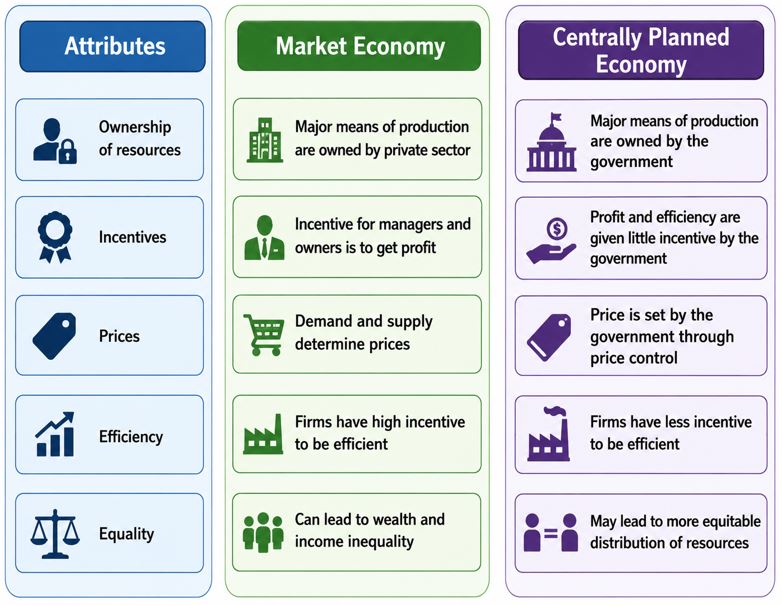
If the market economy is not well regulated, there can be over-production and/or over-consumption of demerit goods such as illegal drugs, cigarettes, and alcohol. These are results of freedom of producers to decide what and how much to produce and consumers to decide how to spend their incomes. Since producers are free to decide on what and how much to produce, they are likely to focus only on profit maximisation motive and ignore the negative impacts of their production processes. Figure 2.1 shows the differences between market and centrally planned economies based on ownership, incentives, prices, efficiency, and equality.
|
Figure 2.1: Differences between market and centrally planned economies based on listed attributes |
Mixed economic system
A mixed economy, also called hybrid economy, was advocated by John Maynard Keynes who argues that in order to expand aggregate demand and restore people's confidence the government should take some control over a market economy. This is not done by controlling wages and prices like in centrally planned economy, but by running budget deficits and increasing government expenditure on public works. This type of economic system is referred to as a mixed economy because it combines some features of both market and command economic systems. Individuals enjoy freedom of choice but the government also intervenes to protect the welfare of its citizens, especially the disadvantaged/ marginalised ones.
Characteristics of mixed economic system
Mixed economic system is characterised with co-existence of private sectors and public sectors. This fact implies that the economy is not driven by both profit maximisation motive and social welfare improvement motive. In theseeconomies, the government regulates the private sectors through policies such as monetary and fiscal policies.
There is freedom of individuals to choose any occupation that serves their income and any good or service they want to consume and produce, keeping in mind people's welfare. Thus, the government intervenes by putting some restrictions on consumption and production of certain items that are harmful to people. The government can intervene in the market by setting price ceiling or price floor to improve people's welfare. The government can also intervene through redistribution of income to reduce income inequality. This can be done through various means such as setting minimum wages and imposition of progressive taxes. Moreover, economic planning is done by the government through indicating roles to be played by both public sectors and private sectors. To motivate the private sector, the government provides incentives and subsidies to ensure that national priorities are met. Prices are determined by the forces of demand and supply.
Most countries are now considered to be mixed economies because of the active role of the government and private sector. Some examples of countries that are now practising mixed economies include China, Vietnam, India as well as Scandinavian countries namely Sweden, Norway, Finland and Denmark.
Advantages of mixed economic system
The government can protect its people from unfair practices by setting laws that restrict such practices and thus, improve social welfare. Mixed economic system also allows the government to play a big role in mobilising resources for public goods such as defence, which could otherwise be neglected.
The mixed economy encourages innovation because the most efficient producers are rewarded, creating a strong incentive for them to further improve their performances. Moreover, there is improvement in service quality, since public and private sectors cooperate in providing certain services such as education and health care to people. Thus, the quality of these services is likely to improve and hence, improving the social welfare of people.
Disadvantages of mixed economic system
Too much government intervention can diminish the essence of free market. If the government always sets price ofcommodities, markets will not clear, that is, there may arise excess demand or excess supply, which in the long-run may distort the whole economy. Mixed economies can lead to creation of monopolies, for example, the government can grant a monopoly power to a company to be a sole producer and supplier of electricity to improve provision of the services. In case the company fails to achieve efficiency in production, in the long-run the entire economy can be negatively affected by such inefficiency.
Transition period
A transition period is a period in which a country economy is transformed from one economic system to another, mostly from centrally planned economy to a market or a mixed economy. In Tanzania this happened twice: in 1967 Arusha declaration where the country was moving from private ownership of all major means of production and also from 1990s when the country decided to move back to market system.
The economy in transition period is characterised by features of both, the new economic system, which is being introduced and the old system which is replaced out. There are different policy reforms in different economic aspects. On one hand, if an economy is moving from a command economy to a market economy, policies like privatisation and liberalisation of the market are adopted. On the other hand, if the economy is moving from market to centrally planned economy, nationalisation policy is adopted.
Most of economies are in transition from a state controlled economy (socialism) to market controlled economies. This has necessitated these countries to embark on major programmes of economic reforms. The reform programmes involve the following key elements: freeing prices and withdrawal of subsidies, adaptation of privatisation policy, budget deficit and development of budgetary and fiscal system.
| Activity 2.2 Search from different sources including online and identify the economic system in which your country exists. How does the economic system answer the fundamental economic questions within your country? Identify the strengths and weaknesses of the economic system in your country. |
www.learninghubtz.co.tz
Economic system and resources allocation and distribution
Resource allocation and distribution are the foundation of any economic system. It refers to the distribution of limited resources among various uses and users. Different economic systems have distinct approaches to resource allocation and distribution as described hereunder:
Resources allocation and distribution in a traditional economy
In the traditional economy, people’s self-interests guide decisions regarding allocating and distributing goods and services. Also, resources allocation and distribution depend on cultural and traditional values.
Resources allocation and distribution in a centrally planned economy
A centrally planned economy is an economic system in which the government makes all decisions about allocating and distributing resources, such as setting production goals and distribution methods. The government will determine the resources available, the amount required for investment, and the amount the population will consume. Centrally planned economies aim for equitable distribution of resources. They provide equal access to resources such as healthcare and education. The challenge is that these economies can suffer from inefficiencies due to a lack of competition and profit incentives. Also, bureaucratic processes can lead to slow decision-making and resource allocation.
Resources allocation and distribution in a market economy
The idea of a market economy relies on private individuals allocating and distributing resources most efficiently. It is a decentralised system in which there is free access to resources. The prices of goods and services guide resource allocation and signal producers and consumers about where resources are most needed. The production of goods and services is determined by consumer demand. In a market economy, the market allocates resources based on a price mechanism through forces of demand and supply. The implication is that the price will rise with more demand than supply. If there is more supply than demand, the price will fall. In addition, resources are allocated to their most valued uses in market economies without much wastage. The distribution of wealth and income in market economies can be relatively uneven. However, the challenge is that pursuing for profit may lead to disregard of social welfare and public goods.
Resources allocation and distribution in a mixed economy
In a mixed economy, where the public and private sectors co-exist, resources allocation depends on the extent of roles performed by public and private sector in this case, market forces of demand and supply as well as government involvement will determine where the resources should be allocated and distributed. As it stands, with the co-existence of the public and private sectors, the economic activities aredivided between the private and public sectors.
Activities which involve less risk and less investment, like agriculture, trade, and small consumer goods industries, are included in the private sector. Industries like defence, railway, electricity, and water distribution, which involve more risk and investment, lie with the public sector as they are critical for social welfare. Public and private sectors co-exist in specific industries, such as transport, education, and health. Recently Public Private Partnerships (PPP) have been forged. For example, in Tanzania, UDA Rapid Transit Public Limited Company (UDART) provide bus services through PPP arrangement. But, balancing market efficiency with social welfare and public services is a constant challenge.
Efficiency and equity in resource allocation and distribution
Competition and profit motives drive market economies to achieve high levels of efficiency. However, the challenge is that the motive for profit can lead to under-provision of social services and public goods. Centrally planned economies focus on equitable distribution but often at the expense of economic efficiency and dynamism. Low productivity and innovation are due to lack of incentives in planned economies. Mixed economies aim to ensure equitable resource distribution and market efficiency. Still, the extent to which the government intervenes in the economy varies, thereby influencing the balance between these two goals.
| Activity 2.3 Search from different sources including online and identify the types of economic systems practiced by East African Community. Countries other than Tanzania. |
Chapter summary
1. An economic system is an institutional mechanism for determining ways of utilising scarce resources to satisfy human needs and wants.
2. A traditional economic system is a system in which goods and services are produced and distributed based on customs, history, and time-honoured beliefs. The sole decision-makers in the traditional economy are residents of a society.
3. A centrally planned economic system is also known as a command economy in which the government control and regulate the economy. Therefore, the government owns and controls all productive resources in society's overall interests under a centrally planned economy.
4. A market economy is also known as a free economy or laissez-faire economy in which the forces of demand and supply determine what to produce, how to produce and for whom to produce, and the rewards for factor services.
5. A mixed economic is also known as a hybrid economy in which it combines some features of both market and centrally planned economic systems. Individuals enjoy the freedom of choice, but the government also intervenes to protect the welfare of its citizens.
6. A transition period is when a country changes from one economic system to another, mostly from traditional or centrally planned economy to a market or mixed economy. The economy in the transition period is characterised by features of both the new economic system, which is being introduced and the old system.
7. Resources allocation and distribution are the foundation of any economic system. The term refers to the distribution of limited resources among various uses and users. Different economic systems have distinct approaches to resources allocation and distribution.
www.learninghubtz.co.tz
Revision Exercise
1. Mention which economic system is well described by the following statements:
- Values society welfare and equitable distribution ______
- Values competition and hard work ______
- Means of production are owned by public and private ______
- Means of production are publicly owned ______
- The government determines the price of goods and services ______
- The market forces of demand and supply determine the prices of goods and services ______
- The government determines the type of goods and services produced ______
- The market forces determine the quantity of goods and services produced ______
- Government and market forces determine the quantity of goods and services produced ______
- The active role in ensuring economic strength and social justice is played by the government ______
- Government should avoid interfering in the economy ______
- The individuals and groups can start their businesses ______
- The government ownership of all firms ______
- The businesses are operated for the interest of the people ______
- The businesses are operated by owners and investors who take risks in search of profits ______
- The economic system of most nations of the world ______
- The economic system of the United Republic of Tanzania ______
2. Carefully read the questions below and answer accordingly.
(a) Consider a situation where the new leaders take over the country after the election and decide to take ownership of all energy resources, such as natural gas and electric companies. They promise citizens they will lower energy prices because the government will run these industries for the people's interest and not for profit. However, all other industries will remain privately owned. What type of economic system does this country have and why?
(b) Consider a situation where the country after the election, and the government takes ownership of all industries. The new leaders promise the citizens that the operation of all businesses in the country will be for people's interests, not profit. Every adult is guaranteed employment; however, the government will sell all prices of goods and services. No one will be hungry or homeless. What type of economic system does this country have and why?
(c) Consider a situation where food shortages and other products appear in the country, increasing prices, but wages stay the same. Elections were held, and new leaders were elected. These new leaders promise to return business and industry to private ownership. They encourage new businesses and promise opportunities for big profits for owners and investors. Less government involvement in the economy and competition produce more goods and services at lower prices. What type of economic system does this country have and why?
(d) Consider a situation whereas the country's businesses and industries become privately owned many people lose their jobs. More goods and services are available, and prices fall, but people can't afford to buy much. Elections were held, and new leaders were elected. The new leaders take control of the largest and most important businesses and hire more people. They also hire people for public service jobs such as cleaning roads and health centres, and repairing public buildings. What type of economic system does this country have and why?
3. There were various economic systems in the past, but today, the most popular system is the mixed economy. Why do you think that is the case based on what you know about the United Republic of Tanzania?

Hub App
 For Call,Sms&WhatsApp: 255769929722 / 255754805256
For Call,Sms&WhatsApp: 255769929722 / 255754805256  MATOKEO YA KIDATO CHA VI 2026
SECONDARY REGIONAL EXAMS
PRIMARY REGIONAL EXAMS
FORM VI NECTA REVIEWS
FORM IV NECTA REVIEWS
FORM II NECTA REVIEWS
STD VII NECTA REVIEWS
STD IV NECTA REVIEWS
SECONDARY EXAMS SERIES
PRIMARY EXAMS SERIES
PRIMARY SUBJECT NOTES
SECONDARY SUBJECT NOTES
SECONDARY TOPICAL EXAMS
SECONDARY TOPICAL QUESTIONS
PRIMARY TOPICAL QUESTIONS
PRACTICAL EXAMS & NOTES
SECONDARY REGIONAL EXAMS
DOWNLOAD SUBJECT NOTES
SCHEMES OF WORK (PRIMARY & SECONDARY)
LESSON PLAN
SECONDARY LOG BOOKS
PRIMARY LOG BOOKS
LITERARY WORKS / UCHAMBUZI VITABU
METHALI ZOTE ZA KISWAHILI
Vitendawili Vya Kiswahili
FORM VI RESULTS 2024
FORM FIVE SELECTION 2024
Matokeo KIDATO CHA II 2024
Matokeo Darasa IV 2024
MATOKEO KIDATO CHA IV 2023
FORM ONE SELECTION 2024
FORM VI RESULTS 2023
Matokeo Darasa IV 2022
MATOKEO YA KIDATO CHA VI 2026
SECONDARY REGIONAL EXAMS
PRIMARY REGIONAL EXAMS
FORM VI NECTA REVIEWS
FORM IV NECTA REVIEWS
FORM II NECTA REVIEWS
STD VII NECTA REVIEWS
STD IV NECTA REVIEWS
SECONDARY EXAMS SERIES
PRIMARY EXAMS SERIES
PRIMARY SUBJECT NOTES
SECONDARY SUBJECT NOTES
SECONDARY TOPICAL EXAMS
SECONDARY TOPICAL QUESTIONS
PRIMARY TOPICAL QUESTIONS
PRACTICAL EXAMS & NOTES
SECONDARY REGIONAL EXAMS
DOWNLOAD SUBJECT NOTES
SCHEMES OF WORK (PRIMARY & SECONDARY)
LESSON PLAN
SECONDARY LOG BOOKS
PRIMARY LOG BOOKS
LITERARY WORKS / UCHAMBUZI VITABU
METHALI ZOTE ZA KISWAHILI
Vitendawili Vya Kiswahili
FORM VI RESULTS 2024
FORM FIVE SELECTION 2024
Matokeo KIDATO CHA II 2024
Matokeo Darasa IV 2024
MATOKEO KIDATO CHA IV 2023
FORM ONE SELECTION 2024
FORM VI RESULTS 2023
Matokeo Darasa IV 2022
WHATSAPP US NOW FOR ANY QUERY
App Ya Learning Hub Tanzania